
Freshness in fruit packaging isn’t a material property — it’s the result of how packaging interacts with pre-cooling, cold storage, transport, and retail display across the whole supply chain.
A well-designed container can support airflow during cooling, limit moisture loss in transit, reduce condensation during temperature transitions, protect fruit from bruising and compression, and provide a stable structure for sealing film or other shelf-life solutions. What it cannot do is compensate for delayed pre-cooling, inconsistent refrigeration, or poor handling. Packaging works within a cold chain — it doesn’t replace one.
The right balance also differs by fruit. Too much ventilation isn’t always better. A sealed container isn’t automatically MAP. And a feature that helps blueberries can be the wrong design decision for grapes or fresh-cut melon. This guide explains how the key technologies actually work and what buyers should evaluate before committing to a specification.
What Happens to Fruit After It’s Packed
Fresh fruit is still living tissue after harvest. It continues to respire — consuming oxygen and releasing carbon dioxide, heat, and moisture. The rate of this process varies significantly by species and temperature. At higher temperatures, respiration accelerates; at lower temperatures, it slows. This is why rapid pre-cooling matters so much, and why packaging must work reliably through cold storage rather than only at ambient conditions.
Several things can go wrong in the period between packing and sale. Moisture loss causes softening, shriveling, and loss of visual appeal — visible especially in grapes where stems dry and brown, and in berries where skin becomes dull. Excess trapped moisture creates the opposite problem: water droplets on fruit surfaces promote mold and decay, particularly on already-damaged or overripe tissue. Bruising and compression damage during transport or stacking creates soft spots that deteriorate faster than intact tissue, reducing both shelf life and saleable yield. For a deeper look at these mechanisms, see how packaging affects fruit ripening and shelf life.
Temperature fluctuations compound all of these risks. When cold fruit moves into a warmer environment — at a distribution center, at import, or on the retail floor — moisture condenses on the packaging surface and sometimes inside the pack. This is a physics problem driven by dew point, not a packaging defect. But packaging design can influence how severe it is and how quickly the condensation clears.
The Core Technologies: What They Do and What They Don’t
The technologies used in fruit packaging freshness fall into two broad categories: those built into the container structure, and those added as accessories or active elements. Understanding the difference matters because they solve different problems and require different evaluation approaches.
| Technology | How it works | What it doesn’t do |
|---|---|---|
| Ventilation holes | Allows passive air exchange during cooling and storage | Doesn’t control gas composition; effectiveness depends on carton and pallet alignment |
| Moisture-management design | Headspace, drainage, and vent placement reduce condensation risk | Doesn’t eliminate condensation from cold-chain instability |
| MAP (modified atmosphere) | Sealed film + controlled gas exchange slows respiration | Requires compatible tray, film, gas, equipment, and process — not just a sealed lid |
| Absorbent pads | Absorb free moisture inside the pack | Address symptom, not cause; don’t replace ventilation or cold-chain control |
| Ethylene-control inserts | Absorb or neutralize ethylene to slow ripening | Fruit- and application-specific; require market and food-contact evaluation |
| Temperature/freshness indicators | Record or signal cold-chain conditions | Monitor problems after the fact; don’t actively preserve fruit |
Ventilation
Ventilation holes allow respiratory heat and gases to escape, and let cold air reach the fruit during forced-air pre-cooling. The effectiveness of ventilation depends on far more than hole count. Position matters — sidewall openings provide airflow paths when containers are packed tightly and top or bottom openings are partially blocked by adjacent packs or labels. Total open area matters relative to container rigidity — excessive openings weaken sidewalls and reduce stacking strength, which then transfers compression load to the fruit. And carton alignment matters: ventilation in the punnet only works if the carton’s own openings allow air to move through the packed load.
A ventilation pattern designed for large grapes is not automatically suitable for small blueberries, where berry diameter and hole size interact. More holes in the wrong position can leave contact marks on delicate fruit surfaces. Buyers should evaluate ventilation as part of the complete system — container, carton, and pallet — not as a standalone container feature. For a detailed look at ventilation design for specific fruit, see our guide on blueberry clamshell ventilation and cooling.
Moisture Management and Condensation
Moisture management is rarely achieved by one element alone. Adequate headspace allows air to circulate around the fruit rather than being trapped against it. Vent positioning influences whether humid air can escape or accumulates in still zones inside the pack. Stable cold-chain temperature reduces the frequency of dew-point crossings that cause condensation. Where these aren’t sufficient, absorbent pads can be added to address free moisture — but they address the symptom rather than the cause.
Anti-fog films and anti-condensation treatments spread condensed moisture into a more transparent layer, which maintains product visibility on the retail shelf. They don’t remove water from inside the pack. Where condensation forms repeatedly and heavily, the underlying issue is usually temperature instability in the supply chain, not a packaging deficiency. For guidance on protecting fruit during distribution, read how to package fresh fruit for shipping.
Modified Atmosphere Packaging
MAP is one of the most misunderstood terms in fresh produce. A sealed container is not MAP. A container with a lidding film is not automatically MAP. MAP describes a packaging system that actively maintains specific oxygen and carbon dioxide concentrations inside the sealed pack — concentrations that are matched to the fruit’s respiration rate to slow biological activity and extend shelf life.
Achieving this requires the sealing film’s gas permeability to be precisely calibrated to the fruit variety, maturity, pack weight, and expected temperature range. A film specification that works for one fruit at one temperature will not produce the same result for a different variety, a different maturity, or the same variety at a different storage temperature. The tray or cup must provide a consistent sealing surface. The equipment must apply the seal reliably. And the gas composition must be validated for the specific application.
StlPak manufactures PET and rPET trays and cups that are compatible with sealing-film evaluation for appropriate applications. Whether MAP is genuinely warranted — and which container format provides the right starting point — depends on the fruit, target shelf life, filling conditions, and distribution route. StlPak can support the container evaluation stage, but MAP system design requires collaboration with the film supplier and packing equipment provider.
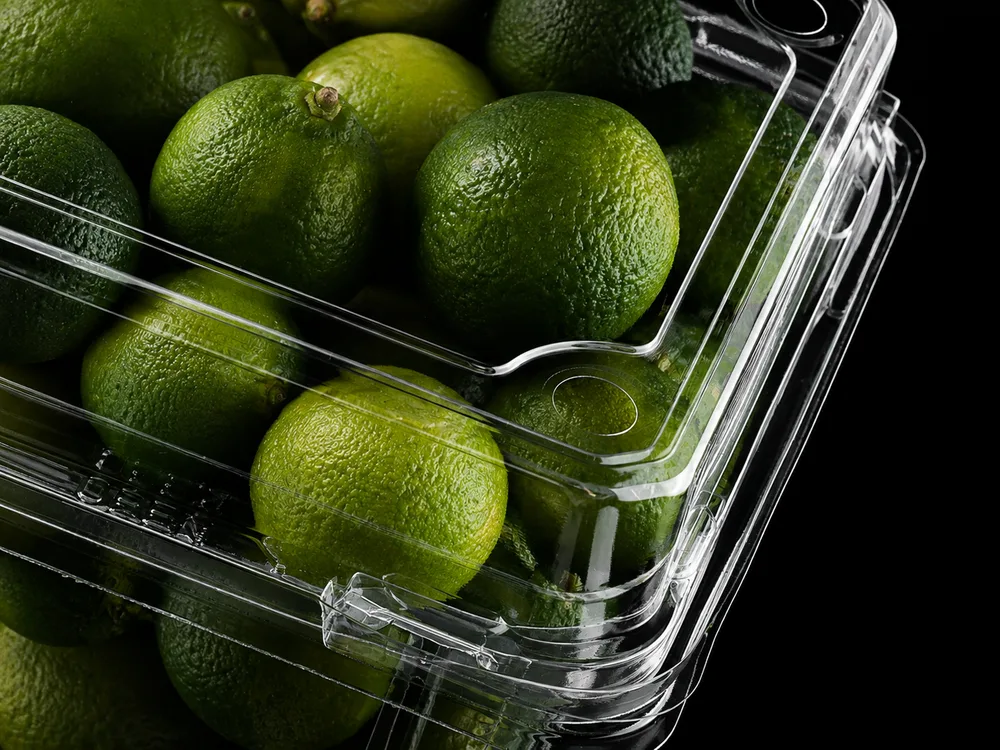
Packaging Priorities by Fruit Category
Different fruits have different respiration rates, physical structures, and primary causes of quality loss. The container design priorities follow from these differences. For an overview of retail-ready formats, see how to package fresh fruit for retail sale.
Berries
Blueberries, raspberries, blackberries, and strawberries are among the most compression-sensitive categories. Their thin skins bruise easily, and surface damage accelerates mold development. The container needs to hold the fruit without stacking pressure reaching the bottom layer, which means sidewall and base rigidity under carton stacking load matter as much as ventilation design.
For blueberries specifically, closure gaps and vent openings must be small enough that individual berries don’t escape or become trapped near the locking edge. For raspberries and blackberries, fill height control is often more protective than maximizing ventilation area — a shallower fill reduces the weight pressing on lower fruit. Strawberries need enough headspace that the lid doesn’t contact the calyx or upper fruit surface, and enough ventilation to prevent steam buildup, but not so much that moisture loss becomes visible during multi-day retail display.
Grapes
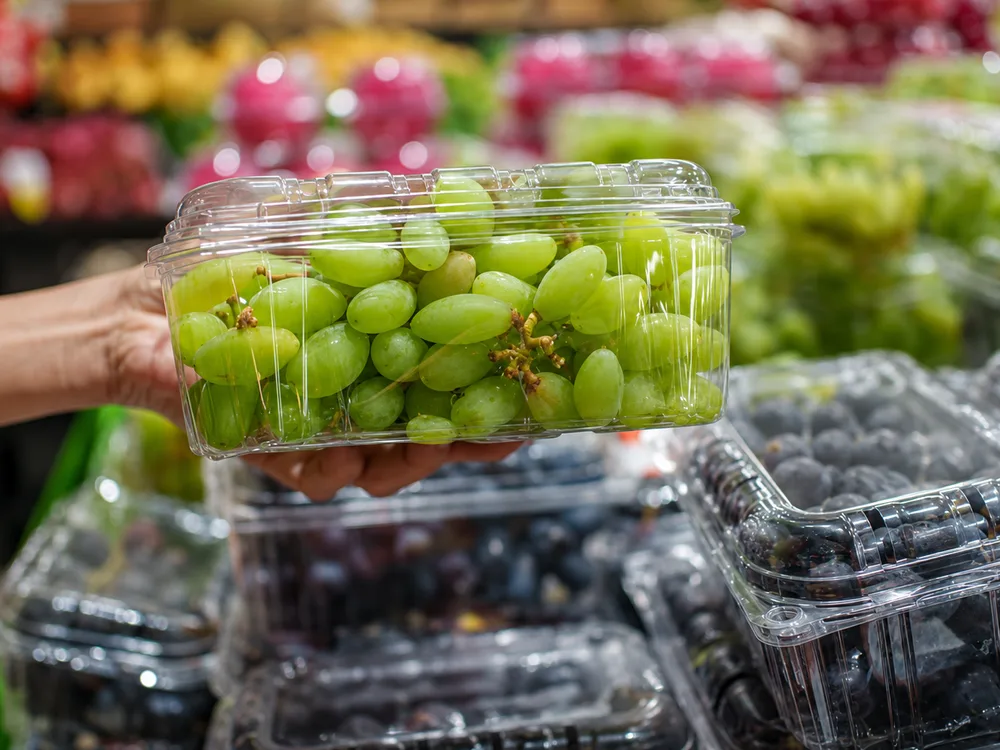
Grape packaging presents a distinct challenge because the unit is a bunch, not individual fruit. Bunch height, berry diameter, and stem structure together determine the container depth required — and two varieties at the same net weight may need meaningfully different containers because their bunch structures differ.
Insufficient headspace compresses the upper berries and can cause the lid to press on stems, creating pressure marks and accelerating shatter. Excessive headspace allows the bunch to shift during transport, causing bloom loss through friction. Strong sidewall geometry and a stable base are important because grape clamshells experience significant stacking load in export carton configurations. Ventilation must support cooling without weakening the areas of the container that carry that load. For a detailed comparison of grape packaging formats, see how grapes are packaged for retail and export.
For export grape programs, StlPak recommends evaluating container depth, sidewall strength, and ventilation layout together with the intended carton arrangement and transport route rather than selecting by pack weight alone.
Whole Fruit
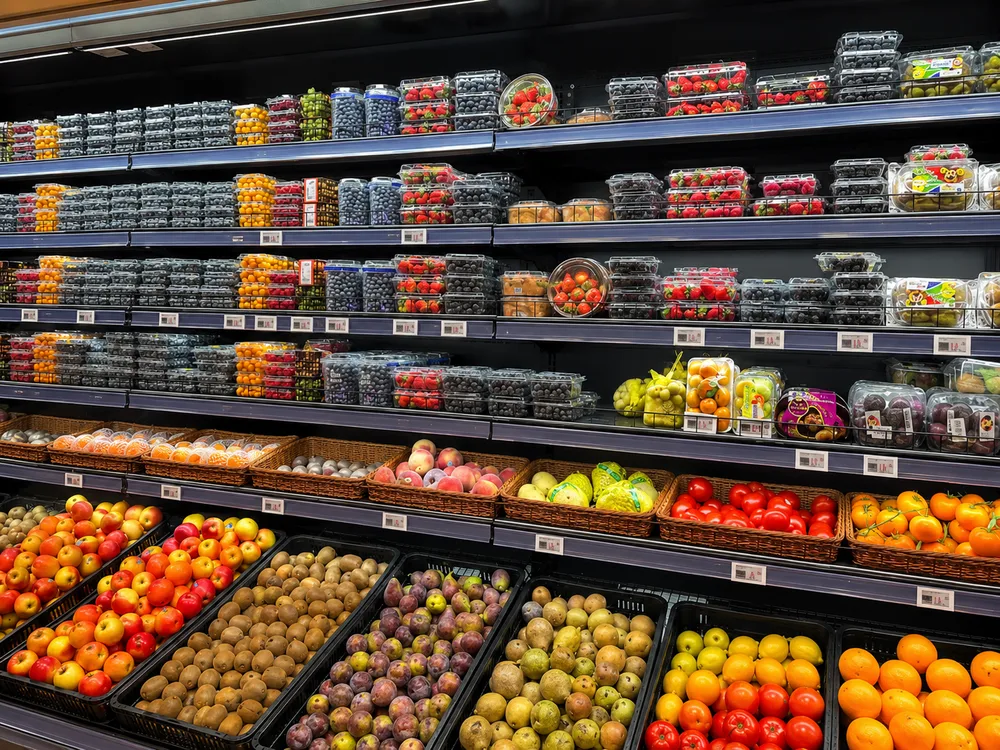
Cherry tomatoes, kiwifruit, small apples, and avocados present different challenges depending on how they’re sold. The primary concern is usually fit: the container should hold fruit securely without creating pressure points, while allowing enough movement for easy filling without allowing so much that fruit collides during transport.
Cavity geometry matters for single-fruit formats. Ventilation needs vary considerably by fruit — kiwifruit and avocados have different respiration rates and moisture sensitivity from tomatoes. Container dimensions should be evaluated against carton efficiency alongside fruit protection, because small footprint changes can significantly affect packing yield per carton.
Fresh-Cut Fruit
Cut fruit has fundamentally different packaging requirements. Removing the protective skin exposes tissue to oxidation, juice leakage, microbial contamination, and moisture loss. The packaging priority shifts from ventilation and compression protection to reliable closure, leak resistance, and cold-chain hygiene.
For fresh-cut melon, pineapple, mixed fruit, and fruit salad, the container must maintain seal integrity during transport and after repeated temperature transitions. Headspace design affects condensation behavior on the underside of the lid. Compartment layouts allow mixed fruit to be separated without juice transfer between components. These applications are where MAP evaluation becomes most relevant — and where the interaction between tray geometry, film permeability, and cold-chain conditions requires the most careful validation.
Key Design Features That Support Shelf Life
When evaluating fruit packaging for a specific application, the following factors deserve direct assessment rather than assumption from specifications alone:
- Container depth relative to actual fruit height — not nominal capacity. A container too shallow creates lid pressure; one too deep allows movement and bloom loss.
- Ventilation layout matched to the fruit and cooling method — position and total open area, evaluated together with the carton and pallet airflow path.
- Closure performance under filled weight and cold-chain conditions — a closure that works when hand-tested at room temperature may behave differently after filling, refrigeration, and vibration.
- Sidewall and base rigidity under stacking load — particularly important for berry and grape applications where multiple carton layers are common in export packing.
- Compatibility with sealing films, absorbent pads, or MAP accessories — the tray or cup must provide a consistent interface for any secondary solution.
- Label area and placement — labels that cover ventilation openings or the sealing rim affect both product visibility and packaging function.
- Carton loading efficiency — container footprint and height determine how many units fit per carton, which affects both logistics cost and stacking stability.
Testing Before Specifying
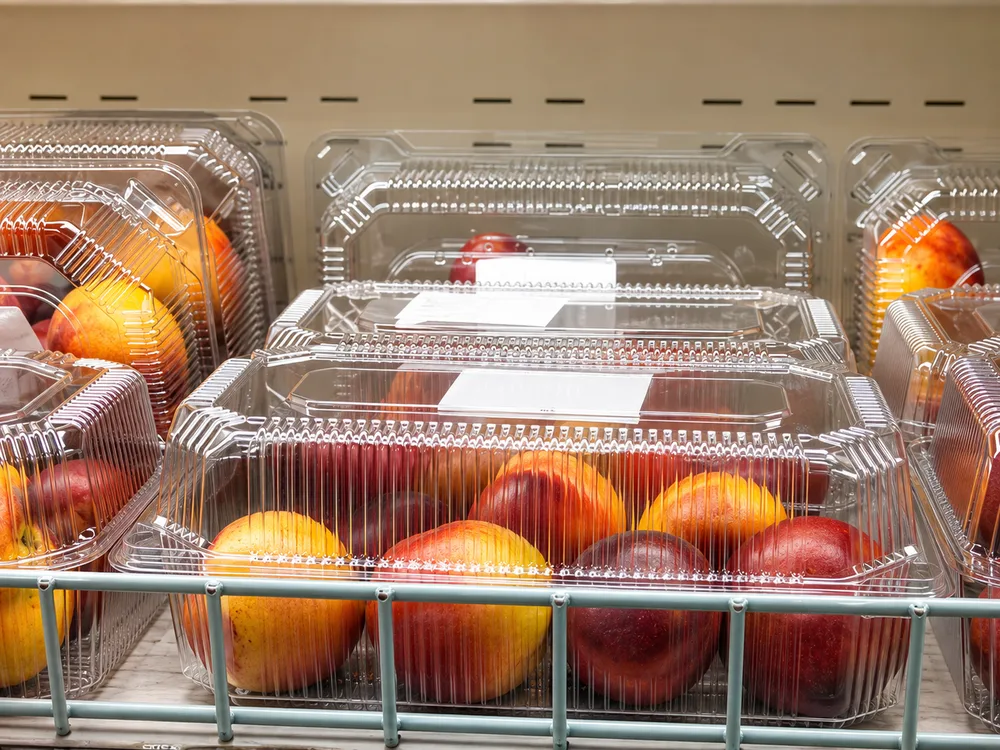
Empty container inspection doesn’t reveal how packaging performs with fruit. The variables that matter — fill weight, cold storage, vibration, label application, carton stacking, temperature transitions — are only present during actual use.
Before confirming a specification, buyers should test:
- Fruit fit and headspace with the actual variety at target fill weight — check lid clearance, fruit movement, and whether small fruit can escape through openings
- Closure performance after filling and refrigeration — the locking edge should engage consistently and remain closed under handling and light stacking pressure
- Condensation behavior under representative cold-chain conditions, including any temperature transitions expected during distribution
- Ventilation effectiveness by monitoring pre-cooling speed with the container inside the intended carton configuration
- Stacking stability under realistic carton load and humidity conditions, not just empty-box compression tests
- Sealing film compatibility if MAP or sealed formats are being evaluated — confirm seal integrity and gas retention after filling, refrigeration, and transport simulation
StlPak can provide samples of PET and rPET fruit containers — browse our fruit punnets and clamshells range for these evaluations. Share the fruit type, target pack weight, carton dimensions, and distribution route, and we can identify suitable existing models or assess whether a different depth, ventilation layout, or closure structure would better fit the application.
Common Questions
Can packaging extend the shelf life of fruit?
Packaging can help fruit stay marketable longer by reducing bruising, moisture loss, and condensation. But it operates within a cold chain — pre-cooling speed, storage temperature consistency, and handling quality determine the baseline. Packaging preserves what’s already there; it can’t recover fruit that was poorly handled before packing.
What’s the difference between ventilated packaging and MAP?
Ventilated packaging allows passive air exchange through holes. MAP maintains specific oxygen and carbon dioxide concentrations inside a sealed pack, calibrated to the fruit’s respiration rate at the expected storage temperature. MAP requires compatible tray geometry, sealing film, gas composition, filling equipment, and cold-chain control — changing to a sealable container doesn’t create a MAP system.
Does more ventilation always keep fruit fresher?
No. Excessive ventilation can accelerate moisture loss, weaken the container structure, and allow small fruit to escape through openings. The right ventilation design depends on the fruit, pack weight, cooling method, and how the container aligns with the carton and pallet. More holes in the wrong position solve less than fewer holes correctly placed.
How can packaging help reduce condensation?
Suitable ventilation, adequate headspace, and cold-chain stability all reduce condensation. Anti-fog films improve visibility when condensation does form, but don’t eliminate it. Where condensation is frequent and heavy, the underlying cause is usually temperature instability in the supply chain — that needs to be addressed at the process level, not the container level.
Can PET and rPET containers be used with sealing film?
Selected PET and rPET trays and cups can be evaluated for sealing-film applications. Compatibility depends on the tray sealing rim geometry, film specification, sealing equipment, and operating conditions. StlPak can support the container evaluation stage of this assessment. For more on PET and rPET sustainability, see can plastic fruit packaging be recycled.
What should buyers test before finalizing fruit packaging?
Fruit fit and headspace, closure performance after refrigeration, condensation behavior, pre-cooling speed inside the carton, stacking stability under load, label adhesion under cold and moist conditions, and — for sealed formats — seal integrity and gas retention through transport simulation.