
Retail fruit packaging starts with the target selling weight — but that’s only the first step. A container needs to match the actual fruit dimensions, present the product clearly on the shelf, close consistently on the packing line, carry the label without covering ventilation or fruit, and fit efficiently into the shipping carton.
Getting one of these right while ignoring the others leads to the most common packaging failures: a container that looks fine when empty but presses on the fruit when closed, or one that photographs well as a sample but creates problems on the line at production speed.
This guide covers how to work through each decision in the right order — and what to test before placing a bulk order.
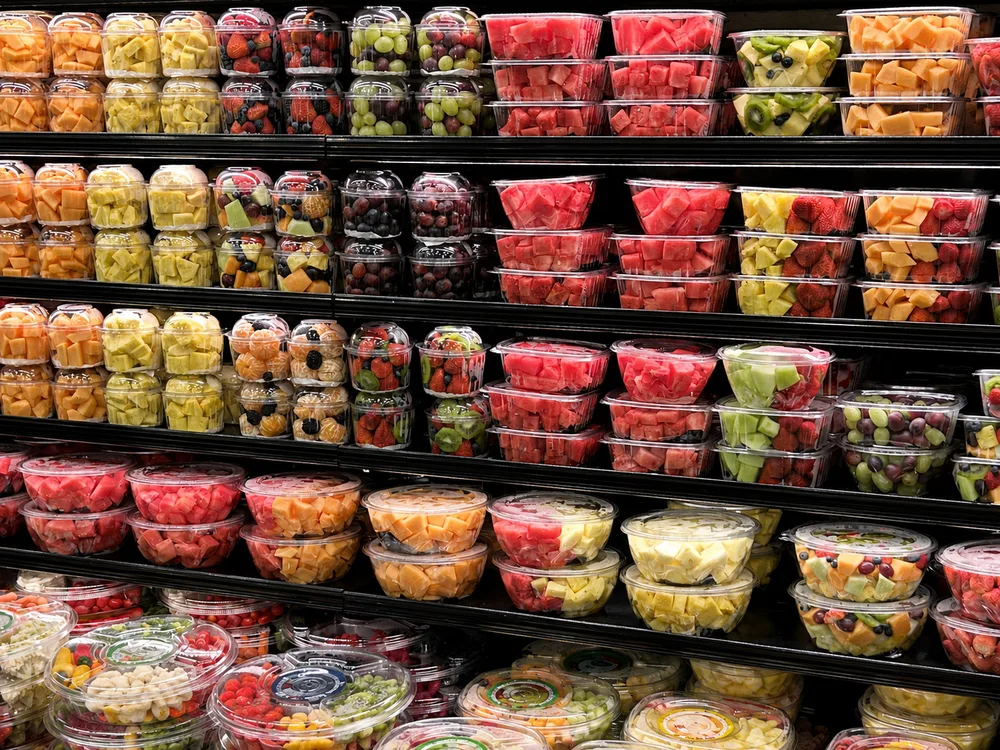
Fill Weight Is the Starting Point, Not the Answer
The target net weight determines the size range to consider. Common retail formats:
- Berries: 4.4 oz, 6 oz, 8.8 oz, 1 lb
- Grapes: 1 lb, 1.5 lb, 2 lb, 3 lb
- Fresh-cut fruit: 8 oz, 12 oz, 16 oz, 24 oz
These are reference categories, not container specifications. One pound of large blueberries occupies more space than one pound of small berries. A loose grape bunch with long stems requires a deeper container than a compact bunch at the same net weight. Fresh-cut melon cubes and mixed fruit salad have different packing densities even at identical weights.
The practical test is visual: the container should look full without the fruit pressing against the lid. Too little internal space causes bruising and makes the container difficult to close consistently. Too much space allows the fruit to shift and makes the product look underfilled — which matters on a supermarket shelf where consumers are making quick visual judgments.
Matching the Container to the Actual Fruit
Fill weight tells you which size category to start from. The fruit’s actual dimensions determine which container within that category actually fits.
For berries, individual fruit diameter matters primarily because small fruit can become trapped in or escape through oversized ventilation openings. For grapes, bunch length, width, height, and stem structure together determine the required container depth — two varieties at the same net weight may need containers of noticeably different depths. For strawberries, the upper layer needs sufficient headspace to prevent the lid from pressing on the fruit, and large berries near the top are the most common point of lid contact.
The filling method also affects which container works. Fruit packed manually often settles differently from fruit filled on an automated line. A container that closes well when carefully hand-packed may prove inconsistent at production speed.
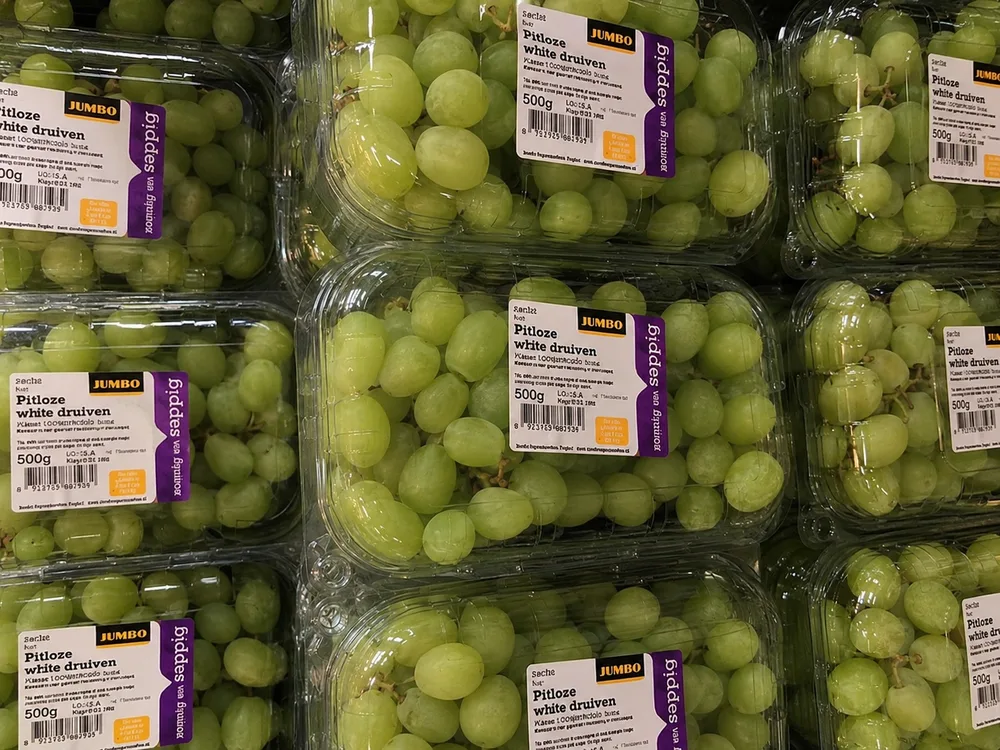
When contacting StlPak for a recommendation, providing fruit measurements, photos, and the dimensions of current packaging allows us to identify the closest existing model from our 600+ mold designs. But the decision should still be confirmed through a physical filling test with the actual fruit — not from drawings or stated capacity alone.
Shelf Visibility and Retail Presentation
Consumers evaluate fresh fruit before reading the label. They look at color, uniformity, and whether the produce appears fresh and undamaged. Clear PET packaging allows the fruit to make that impression directly, which is one reason it dominates supermarket fresh produce.
Visibility is affected by more than material transparency. Heavy reinforcing ribs, large ventilation openings positioned across the viewing area, and oversized labels can all interrupt the view of the fruit. The container needs to be structurally sound, but the design shouldn’t hide what’s inside more than necessary.
Label position has a direct effect on how much fruit is visible. A compact label on a flat lid area leaves the fruit exposed. A large wraparound label can cover the sidewalls and reduce product visibility significantly. For fruits with strong visual appeal — bright strawberries, blueberries, or mixed fruit salad — preserving a clear viewing area is a commercial decision, not just an aesthetic one.
Consistent filling matters here too. A transparent container amplifies inconsistency. Some packs looking full while others have obvious gaps undermines the retail presentation regardless of how good the container design is.
Ventilation: Design Around the Fruit and Cooling Method
Ventilation helps remove field heat, supports airflow during pre-cooling, and allows moisture and respiratory gases to escape. The right amount and position depends on the fruit, the cooling process, and the supply chain — not on maximizing hole count.
Blueberries, raspberries, strawberries, and grapes commonly use ventilated packaging. Openings may appear on the lid, sidewalls, base, or in combination. The critical design constraint is that hole size and position must match the fruit. A pattern suitable for large grapes may not work for small blueberries — openings that are too large for small fruit create escape paths and can leave contact marks on delicate surfaces.
More holes also means less material, and that has structural consequences. Excessive or poorly positioned openings reduce container rigidity and affect stacking performance. A container that holds its shape when empty may flex and transfer stacking pressure to the fruit once it’s filled and placed in a carton under load.
Fresh-cut fruit is a separate case. Because cut fruit releases juice and is typically sold ready-to-eat, it requires a more enclosed container. Ventilation hole count is not the primary concern — lid fit, condensation behavior, and leakage resistance are.
Closure Structure
Hinged Clamshells
Hinged clamshells are the standard format for berries, grapes, cherries, and cherry tomatoes. The lid and base are formed as one piece, which simplifies filling by eliminating the need to manage separate components. This matters at production speed — any step that requires alignment or a secondary action adds time and error risk.
The locking points need to close consistently. A closure that’s too loose opens during handling; one that’s too tight slows packing and frustrates the consumer. Both problems are best identified through closure testing under actual packing conditions, not by manually pressing samples at a table. StlPak’s fresh food tray and fruit clamshell models are designed for consistent closure on automated and manual packing lines.
Separate-Lid Cups and Trays
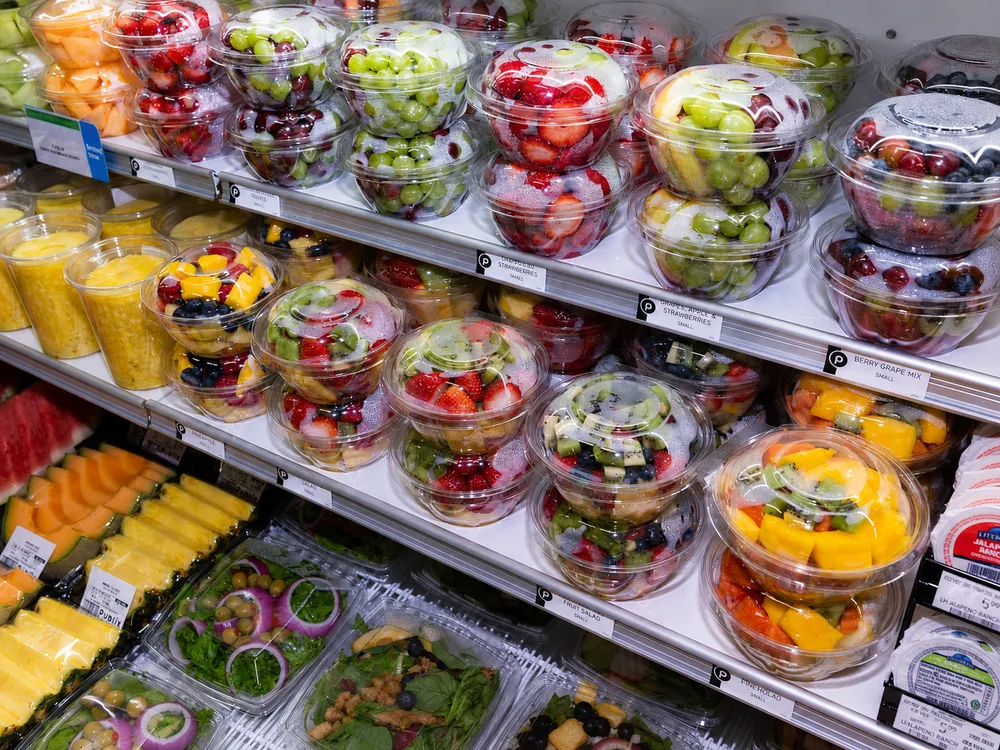
Cups and lidded trays with separate bases are common for fruit salad and sliced fruit. They offer a clean retail appearance and can be produced in different depths and capacities. The lid and base must be precisely matched — small dimensional differences that aren’t visible in an empty sample can cause closure instability after refrigeration, when the material has contracted slightly.
Resealable and Tamper-Evident Options
Resealable packaging allows consumers to close the container after partial use, which is useful for larger fresh-cut or fruit salad packs. It’s worth noting that resealable is not the same as leakproof. Any resealable container for sliced fruit or juice-releasing products should be tested filled, refrigerated, tilted, and handled before it’s specified. Browse our cut fruit container collection for resealable lidded cup and tray options.
Tamper-evident closures are appropriate when the retailer wants visible evidence of first opening — common for prepared fruit and ready-to-eat products. The closure structure still needs to be tested for filling efficiency and ease of opening, since tamper-evident designs vary significantly in how they perform at production speed.
Label Planning
Label requirements should be defined during container selection, not after the bulk order has been placed.
A typical retail fruit label needs to carry the product name, net weight, country of origin, barcode, packing date, storage instructions, and brand information. Some markets require additional regulatory information. The container needs a flat area large enough and positioned correctly for the label to adhere evenly — curved surfaces, reinforcing ribs, and ventilation holes all reduce the usable label area.
The label must not cover the main ventilation openings, interfere with the closure, or obscure too much of the fruit. Cold storage is also a factor: a label that adheres cleanly at room temperature may lift or wrinkle after refrigeration and condensation exposure. The actual label material and adhesive should be tested under real packing and storage conditions before finalizing the specification.
Carton Efficiency and Packing-Line Fit
The unit price of a container is only part of the total packaging cost. A slightly cheaper container that packs poorly into cartons, fills slowly, or requires extra manual handling often costs more overall.
Empty containers should nest consistently so workers can separate them without force. Filled containers need to stack without the upper pack pressing on the fruit below — which means the lid structure, not just the container depth, determines stacking behavior. Container footprint directly affects how many units fit per carton layer. A small change in width or depth may reduce the count per carton and increase carton and freight costs across a large order.
StlPak can compare container dimensions, carton quantities, and shelf-footprint efficiency across existing models when the stated capacity is the same but the shape and packing arrangement differ. This is particularly useful when buyers are evaluating several options that appear equivalent on paper.
Packaging by Fruit Type
| Fruit | Recommended Format | Key Selection Factors |
|---|---|---|
| Blueberries and small berries | Vented PET punnet | Berry diameter, ventilation opening size, fill weight |
| Strawberries | Clear ventilated clamshell | Headspace, lid clearance, top-layer pressure |
| Grapes | Deep PET clamshell | Bunch height, berry diameter, stem space, container depth |
| Cherries and cherry tomatoes | Vented PET clamshell | Fruit containment, closure stability |
| Fresh-cut fruit | PET cup or lidded tray | Juice leakage, condensation, lid fit |
| Fruit salad | Clear PET container with secure lid | Presentation, resealability, label area |
This is a starting point. Variety, grade, and retail program affect which specific model within each format is actually suitable. Physical testing with the actual fruit remains the only reliable confirmation. Explore our fruit packaging range and PET plastic tray categories for matching existing models.
Testing Before Bulk Orders
No container decision should rest on drawings, stated capacity, or empty sample inspection. The conditions that reveal real problems — fruit weight, cold storage, vibration, label application, carton stacking — are only present during actual use.
Filling test. Fill the sample with the actual fruit at the target net weight. Check whether the fruit sits naturally, whether the lid closes without contacting the produce, whether small fruit moves through ventilation openings, and whether the finished pack looks appropriately full from multiple angles.
Closure and handling test. Open and close samples under normal packing conditions — including at production speed if automated filling is involved. Confirm the locking edge engages consistently, the container stays closed when tilted or stacked, and stems or leaves don’t interfere with the closure.
Label test. Apply the actual label to a filled, refrigerated container. Check adhesion after cold storage and condensation exposure. Confirm the barcode scans correctly and the label doesn’t cover ventilation openings or the closure.
Carton-fit test. Pack the planned number of containers into the actual shipping carton. Check for excessive empty space, sidewall deformation, and whether the arrangement is stable. Count the units per layer against the expected carton quantity.
Stacking and leakage test. For fresh-cut fruit and fruit salad, fill the container, refrigerate it, then tilt and handle it to check whether liquid reaches the lid edge or escapes through the closure.
StlPak provides samples for these evaluations. Buyers can test with their own fruit, labels, and cartons before confirming the specification. Sample freight is typically arranged or covered by the customer.
What to Provide When Requesting a Recommendation
A general request for a “1 lb fruit box” gives a supplier very little to work with. More specific inputs lead to a more accurate recommendation:
- Fruit type and variety
- Target net weight
- Approximate fruit or bunch dimensions
- Current container dimensions, if available
- Product photos
- Ventilation requirements
- Label size and preferred position
- Estimated order quantity
- Destination market
- Whether an existing mold or custom design is needed
StlPak supplies vented PET punnets, fruit clamshells, grape containers, fresh-cut fruit cups, and lidded trays. Existing models are the most efficient starting point — buyers can test samples without committing to tooling investment. Custom development is worth considering when available models don’t fit the fruit, the filling line, or the retail program requirements.
Common Questions
What packaging is used for grocery store fresh fruit?
Berries, grapes, and cherries are typically sold in ventilated PET punnets or hinged clamshells. Apples and firm fruit may be loose, in mesh bags, or on trays. Fresh-cut fruit and fruit salad require cups or lidded trays with secure closures. The format follows the fruit’s fragility, retail weight, and whether juice leakage is a concern.
Does a 1 lb container fit every type of fruit?
No. One pound of large blueberries occupies different space from one pound of smaller berries. Grapes of the same weight can require different container depths depending on variety and bunch structure. Fill weight is a starting point — actual fruit dimensions determine the correct container.
Are more ventilation holes always better?
No. Additional holes may improve airflow but reduce container rigidity and can create escape points for small fruit. The right ventilation design is matched to the fruit size, cooling method, and required structural strength — not maximized in isolation.
Can hinged clamshells be reclosed after opening?
Most hinged clamshells can be closed again, but closure performance after reopening varies by design. A container that reclosed reliably in an empty sample test may perform differently after cold storage. Test with the actual product under realistic conditions.
Should I request samples before ordering in bulk?
Always. Sample testing with actual fruit, labels, and cartons confirms whether the container works across filling, closure, cold storage, carton loading, and shelf display — none of which can be verified from a drawing or stated capacity.