
Walk into any supermarket and a punnet of grapes looks simple. Clear pack, visible fruit, a label with the weight and origin. What the shelf doesn’t show is everything that had to go right before those grapes arrived there — and how differently the people involved in that process think about “packaging.”
A grower thinks about protecting bloom and stems during filling. An exporter thinks about carton strength and pre-cooling performance. A retailer thinks about shelf presentation and label placement. A logistics team thinks about pallet airflow and carton durability in cold storage. They are all talking about grape packaging, but they are not talking about the same thing.
This article follows the supply chain from harvest to shelf — and explains what packaging is actually doing at each stage, and for whom. At StlPak, we work with growers and exporters to match packaging to the actual supply chain, not just the spec sheet.
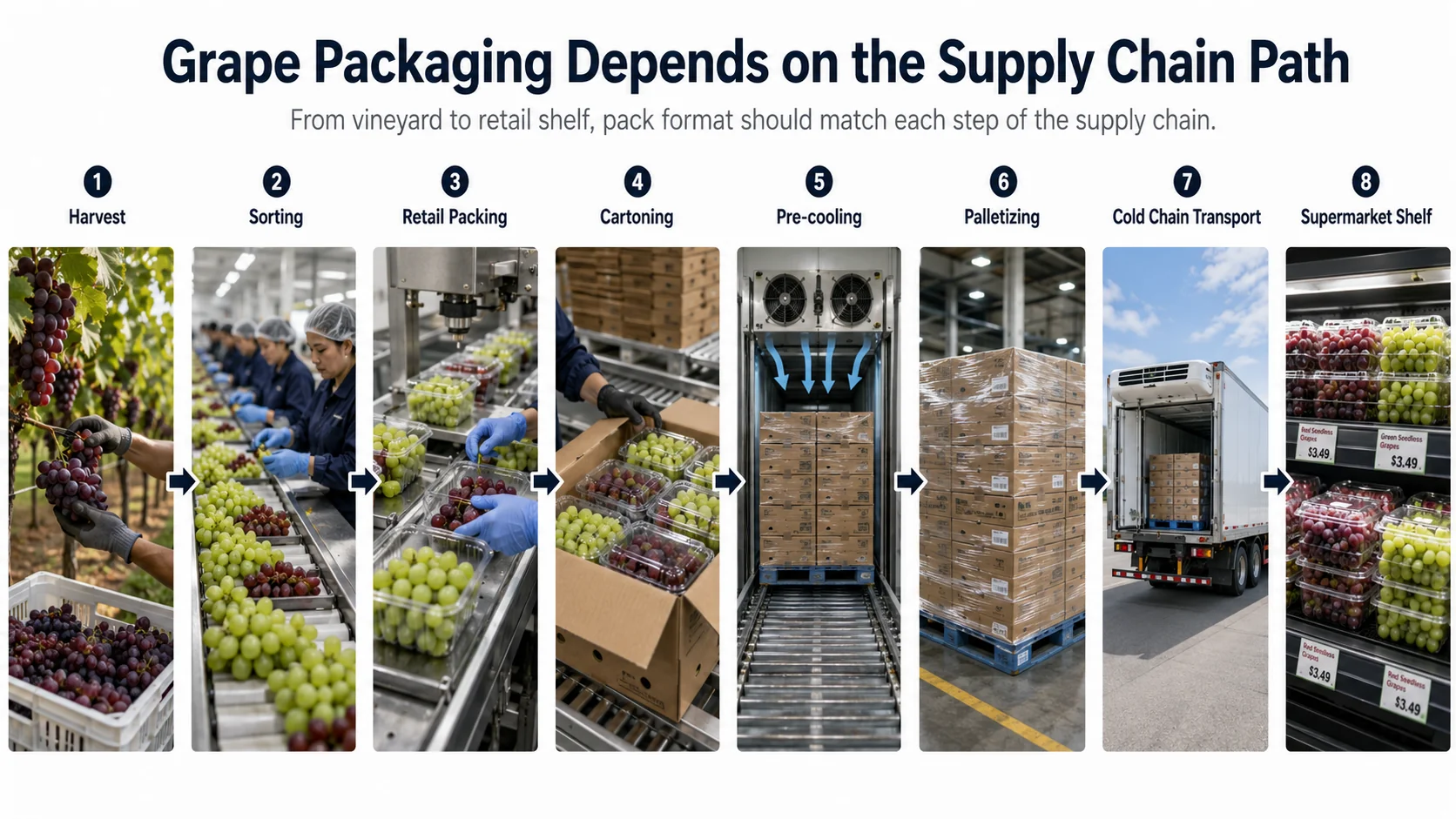
The Supply Chain Comes First
Fresh table grapes don’t move in one straight line. Depending on the destination, the same fruit may go through a packing shed, a pre-cooling room, a palletised reefer container, an import warehouse, a regional distribution centre, and finally a retail shelf — or it may travel no further than a local market twenty minutes from the farm.
The packaging system has to be designed around the actual route, because each step adds new demands.
There are broadly three supply chain scenarios:
Local and short-route retail. Grapes are packed and delivered to nearby retailers within hours or a day or two. The cold chain is short, handling is limited, and the main job of the packaging is to present the fruit well and protect it during a brief journey.
Regional distribution. Grapes move through a distribution centre before reaching retail. They may be rehandled several times, stored briefly in refrigerated warehouses, and delivered across a wider area. The packaging needs to remain stable through more handling stages without losing retail presentation quality.
Export and long-distance cold chain. Grapes are packed, pre-cooled, palletised, and shipped — sometimes for weeks — before reaching the destination market. The packaging system here is not just a retail pack. It is the retail pack, the outer carton, the pallet configuration, and the cold chain working together as one system. Each element affects the others.
Understanding which route the grapes will take is the prerequisite for every packaging decision that follows.
At the Packhouse: Protecting the Fruit Before It’s Ever Packed
Before any packaging decision is made, the grapes go through sorting, trimming, and preparation at the packhouse. This stage matters for packaging because no container can fix what goes wrong here.
Table grapes don’t continue ripening after harvest. Their quality is fixed at picking and can only decline from that point. The two most visible signs of quality — the natural bloom on the berry surface and the condition of the stems — are also the most fragile.
Bloom is the light powdery coating on grape berries. It’s a natural wax layer that signals freshness and affects how the fruit looks under retail lighting. It is easily removed by friction — rough handling, excessive rubbing, or movement inside an ill-fitting pack. Once it’s gone, it doesn’t come back.
Stems dry out and brown relatively quickly after harvest. Stem condition is one of the first things consumers and buyers use to judge freshness. Packaging that causes stem compression or allows bunches to shift during transport accelerates this deterioration.
Packhouse operations — gentle handling, accurate sorting, careful weighing, and clean filling — set the baseline that packaging is trying to preserve. For growers and packhouse managers, this is where the real quality conversation happens. The packaging comes after.
The Retail Pack: What It Does and Who Cares About What
Once grapes are sorted and weighed, they go into the consumer pack. This is the unit the shopper picks up, evaluates, and carries home — and the part of the system that retailers and brand owners focus on most.
Visibility and Shelf Presentation
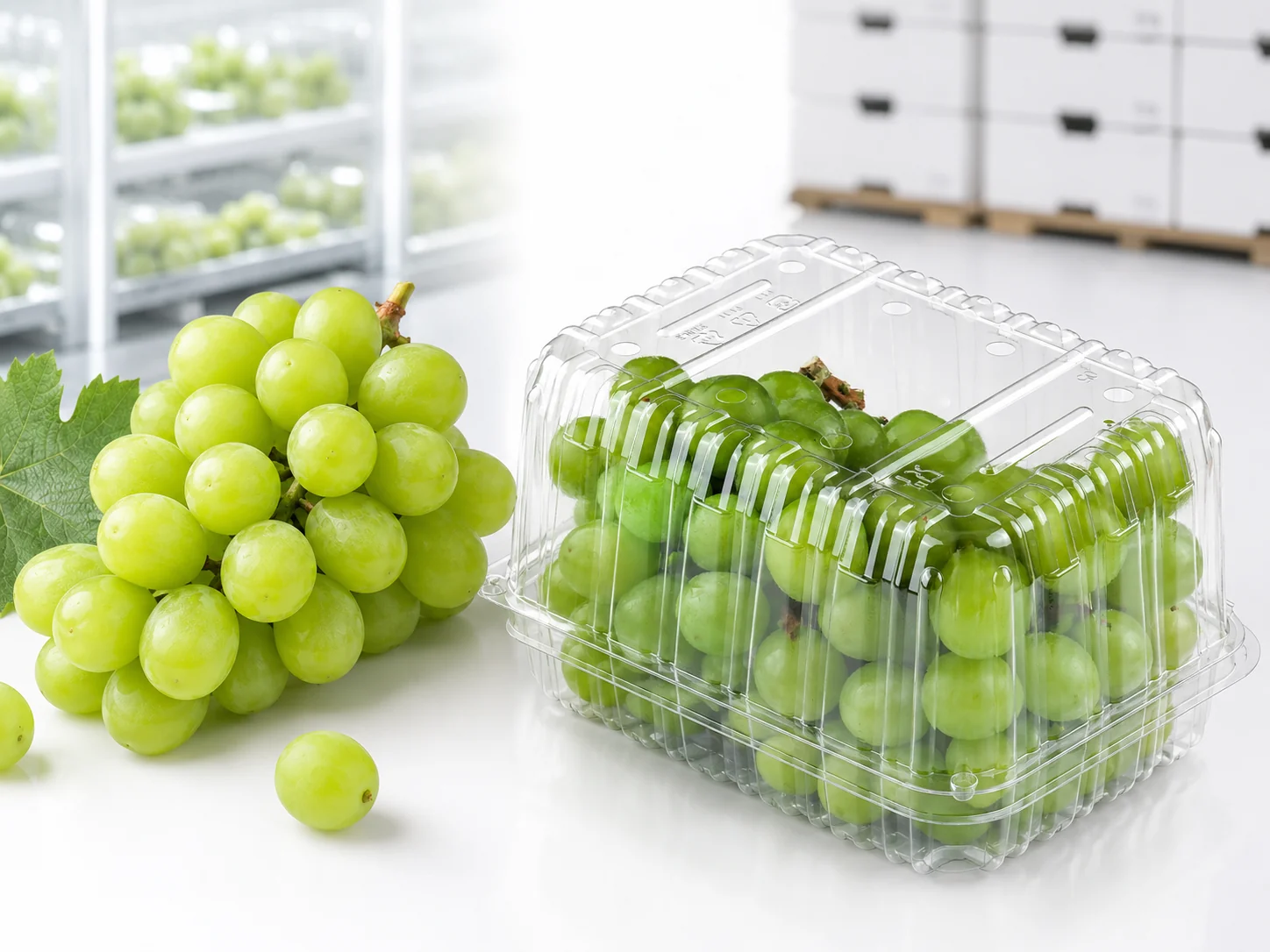
Table grapes are almost always sold in transparent packaging, because consumers buy them visually. They look at berry colour, bunch shape, stem condition, and the presence of bloom before they buy. A clear clamshell or punnet lets the fruit speak for itself. Opaque or heavily printed packaging removes that selling point.
This is why clear PET and rPET clamshells dominate supermarket grape packaging in most markets. They offer transparency, structure, and a defined space for labels — without obscuring the product.
Container Depth and Bunch Fit
The correct container isn’t determined by target weight alone. A 500g pack of compact, small-berry grapes and a 500g pack of a long-stemmed variety with large berries may need completely different container depths.
Too little headspace and the lid presses on the top layer of berries and stems — causing bruising, broken stems, and inconsistent closure. Too much space and bunches move during transport, rubbing against each other and stripping bloom in the process.
Getting the depth right requires testing with the actual grape variety at actual fill weight, not estimating from nominal volume.
Labels and Traceability
Retailers and brand owners need the pack to carry a defined set of information: net weight, variety, country of origin, barcode, batch code, traceability data, and sometimes retailer-specific artwork or language versions for different markets.
Where the label sits matters. A label over ventilation openings restricts airflow. A label across the closure area makes the pack harder to open. Labels that don’t adhere cleanly in cold, humid conditions cause retail presentation problems. For packing lines using automated label application, the pack also needs a flat, consistent surface and reliable orientation on the conveyor.
Format Choices
Clamshells are the most common format for supermarket grapes, but they’re not the only option. For packhouses evaluating different plastic punnets and fruit packaging formats, the choice affects filling speed, material cost, and downstream logistics. For guidance on matching container dimensions to specific pack weights, see our guide to grape punnet sizes for 500g, 750g and 1kg grapes.
Top-seal trays suit packhouses running automated filling and sealing lines, and give a large, clean top surface for branding. Perforated bags are used in value-tier programs and for larger family packs where material cost and filling speed are priorities. Flow-wrap formats appear in certain high-speed retail programs.
The format follows the packing operation and the retailer’s requirement — not just aesthetic preference. For a side-by-side comparison of all three formats, read grape clamshell vs bag vs top-seal punnet.
The Outer Carton: What Exporters and Logistics Teams Are Actually Managing
For export programs, the retail pack is only the inner layer of a two-layer system. The outer carton is what exporters, freight forwarders, and logistics teams are managing — and it has a completely different job.
Structural Performance Under Load
Export cartons stack. A standard pallet of grape cartons carries significant cumulative weight on the bottom layer. In a refrigerated container or cold store, that load is held for days or weeks, sometimes in high-humidity conditions that weaken corrugated board over time.
A carton that looks adequate when empty may compress, deform, or collapse under real stacking conditions — and when the carton fails, the retail packs inside are damaged before the grapes ever reach a consumer.
Carton strength should be evaluated filled, in the actual pallet configuration, under realistic cold-chain conditions. Empty box burst tests alone are not a reliable predictor of real-world performance.
Airflow and Pre-cooling
Before a pallet of grapes can go into a reefer container, it needs to be pre-cooled — brought down to storage temperature quickly and evenly. This process depends on cold air being able to move through the pallet: through the carton ventilation openings, through the gaps between packs inside the carton, and up through the stacked layers.
If carton openings don’t align with the airflow path through the pallet, or if the retail packs inside leave no space for air movement, cooling becomes slow and uneven. Some grapes reach temperature while others remain warm. Uneven cooling accelerates decay and quality loss — and it can’t be corrected once the pallet is sealed and loaded.
Ventilation design is a system question, not a single-pack question. The retail pack ventilation, the carton opening pattern, and the pallet configuration all need to work together.
Carton Fit and Pack Arrangement
How the retail packs sit inside the carton affects stability, airflow, and arrival condition. Too much empty space and packs shift during transport. An arrangement that doesn’t distribute weight evenly can cause compression on packs in the lower layers. A carton footprint that doesn’t match the pallet pattern creates instability in the full pallet stack.
For export programs, the carton should be specified together with the retail pack dimensions — not selected separately and then adjusted to fit.
Cold Chain: The Environment the Packaging Has to Survive
Packaging doesn’t create the cold chain. It has to survive it — and support it where it can.
After packing and pre-cooling, grapes move through refrigerated trucks, port storage, reefer containers, import warehouses, and distribution centres before reaching the retail shelf. Temperature, humidity, vibration, and handling conditions change at every stage — from the packhouse through to the retail shelf.
Packaging that performs well in a controlled packhouse environment may behave differently in a humid reefer container after two weeks at sea. Corrugated cartons absorb moisture over time, losing compression strength. Labels may lift or wrinkle. Closures on retail packs may loosen under repeated vibration.
The cold chain also introduces condensation risk. When refrigerated packs are moved into warmer environments — at import, at distribution, or at retail — moisture can form on and inside the packaging. Poor ventilation design or poorly fitted packs can trap this moisture, accelerating decay even after the grapes have survived a long transit.
For export programs with long transit times, the packaging specification needs to account for these conditions — not just for how the packs look and perform when they leave the packhouse.

How the Pieces Fit Together
Grape packaging looks different depending on where you’re standing in the supply chain. But the decisions made at each stage affect all the others.
A retail pack that fits the bunch poorly causes quality problems at the packhouse and presentation problems at retail. A carton that wasn’t specified around the retail pack dimensions creates airflow and stability problems during export. A ventilation pattern designed for the retail pack without considering the carton and pallet creates cooling problems that show up as decay and quality loss on arrival.
The system works when each layer — the retail pack, the outer carton, and the cold chain — is designed with the others in mind. For packhouses and exporters supplying clamshell grapes to retail programs, this means getting the container, the carton, and the cold-chain specification right as one system.
For growers and packhouses, that means getting fill quality and container fit right before the grapes leave the shed. For exporters and traders, it means evaluating cartons and pallets as a system, not as individual components. For retailers and brands, it means specifying label position, presentation requirements, and pack size with an understanding of what the pack has already been through. For logistics teams, it means treating pallet airflow and carton durability as packaging decisions, not afterthoughts.
For high-value or ready-to-eat fruit formats sold in-store, tamper-evident food containers add tear-strip security using the same food-grade PET.
FAQ
Why are table grapes almost always sold in transparent packaging?
Consumers judge grapes visually before buying — by berry colour, bloom, stem condition, and bunch shape. Transparent packaging lets the fruit make that case directly. Opaque formats remove the main selling signal.
What’s the difference between retail grape packaging and export grape packaging?
Retail packaging protects the bunch and presents it to the consumer. Export packaging — primarily the outer carton and pallet system — protects those retail packs through weeks of refrigerated transport, stacking, and repeated handling. They are different problems with different specifications.
Why does container depth matter so much for grapes?
Grape bunches vary significantly by variety. The correct depth comes from the actual bunch profile at fill — stem length, berry size, bunch structure — not from the target net weight. Wrong depth causes either lid pressure and bruising, or excessive movement and bloom loss.
What does ventilation actually do in grape packaging?
Ventilation allows cold air to move through the retail pack during pre-cooling and refrigerated transport. But it has to be evaluated as a system: retail pack openings, carton ventilation pattern, and pallet airflow all need to work together. More holes on the retail pack doesn’t automatically mean better cooling.
Why do export cartons need to be tested filled rather than empty?
Compression strength, airflow, and pack stability can only be properly assessed under real conditions — with the actual retail packs inside, in the intended pallet configuration. Empty box tests don’t account for how humidity, load, and pack arrangement affect performance over a long cold chain.