
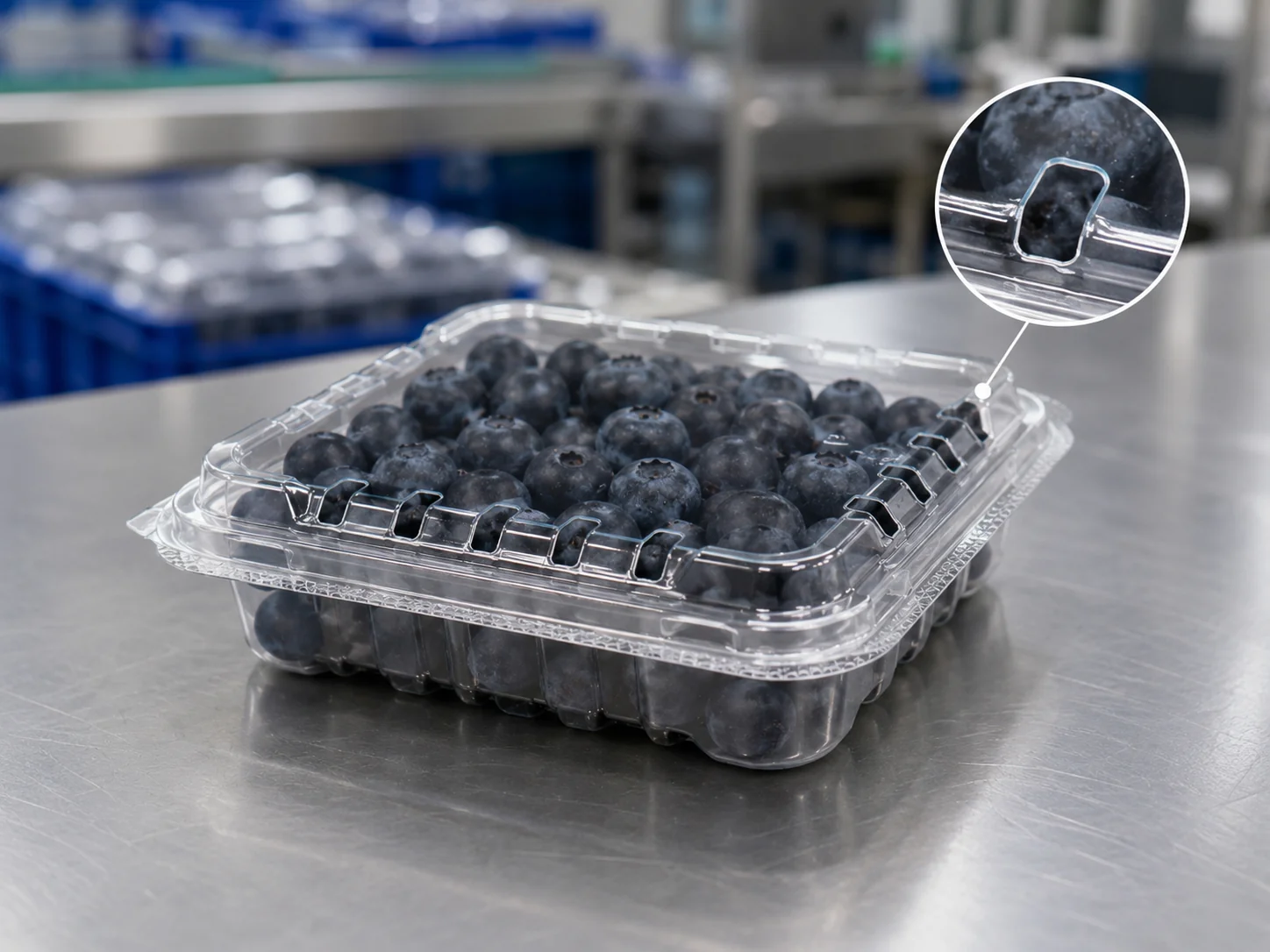
Short answer: yes, most commercial blueberry programs need ventilated clamshells — but “how many holes” is the wrong question. The questions that actually determine pack performance are where the vents sit, how much open area they create, and whether they still work once the clamshell is packed, stacked and on a truck.
A blueberry clamshell is not just a retail container — it is part of the cold chain. Get the vent design wrong and the consequences show up at different points depending on who you are:
- Growers and packhouses see it in cooling speed and consistency right after harvest.
- Exporters and traders see it in temperature stability across a multi-week shipping route.
- Retailers see it in whether the fruit looks dry and fresh on the shelf, or fogged and tired.
This guide walks through each of those, then gets into the part that actually matters most: where the holes should go.
Why Ventilation Matters at the Packhouse
Freshly picked blueberries still carry field heat. Getting that heat out quickly — and evenly — is one of the biggest factors in how long the fruit holds up.
Vent holes help cold air reach the packed fruit during pre-cooling and storage. But holes alone do not guarantee this works. If the clamshells are packed tight, stacked badly, or sealed inside a carton with no matching openings, the air has nowhere to go regardless of how many vents the clamshell has.
When airflow is poor, the symptoms are predictable: cooling takes longer, some berries in a carton stay warmer than others, and any temperature swing during storage turns into condensation. None of this requires bad fruit to start — it can happen to good fruit in the wrong pack.
The fix is not “more holes.” It is checking ventilation against the real packing process: how fast fruit goes into pre-cooling, whether forced-air cooling is used, what the fill height is, and whether the vents are still open once cartons are stacked on a pallet.
Why Exporters Need to Think Beyond the Clamshell
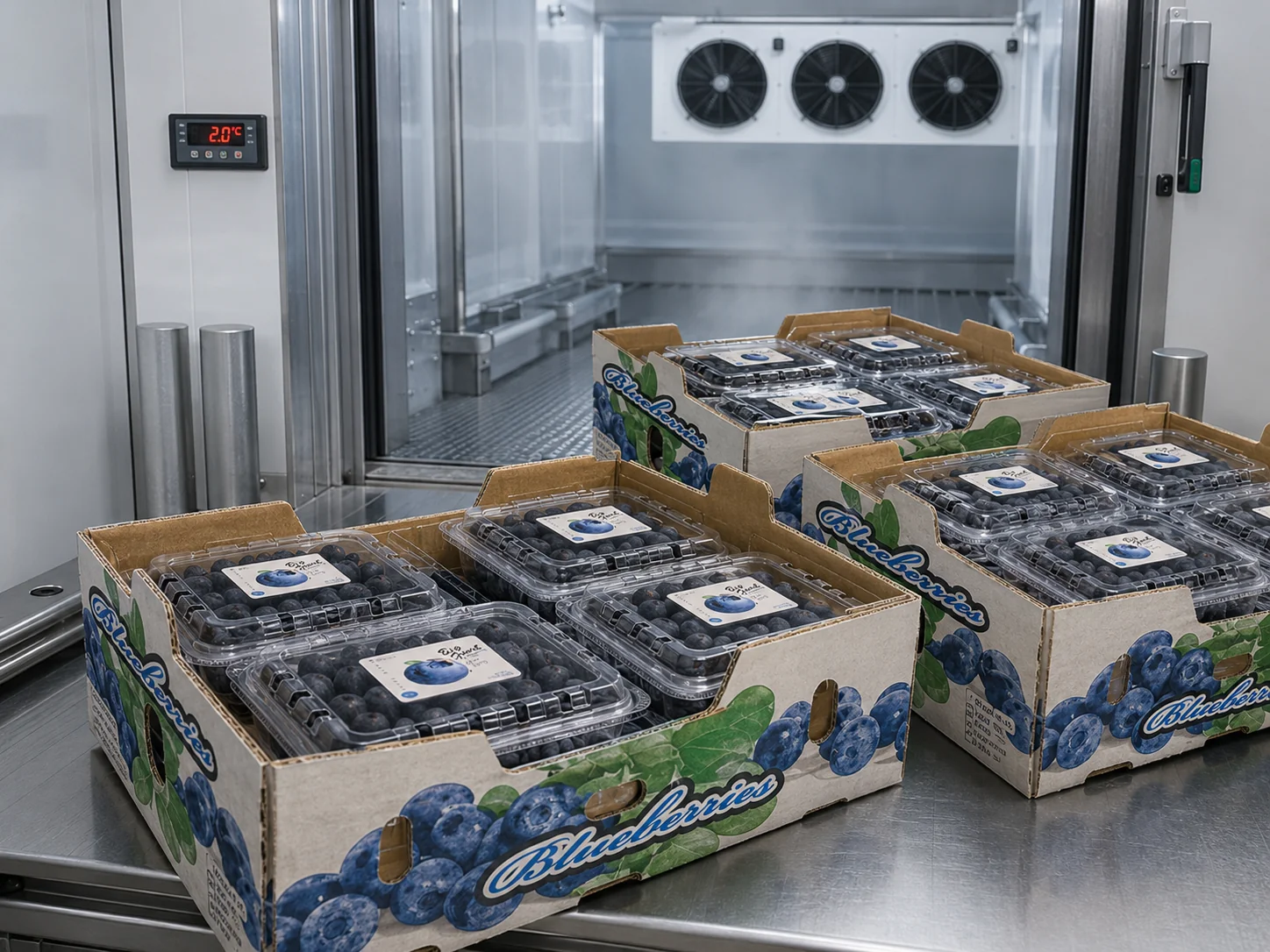
For a short local delivery, the clamshell mostly just needs to survive the trip. Export is a different problem. A pallet of blueberries can pass through pre-cooling, cold storage, port handling, ocean or air transport, customs, and importer storage before it ever reaches a shelf — and the clamshell has to hold up through all of it.
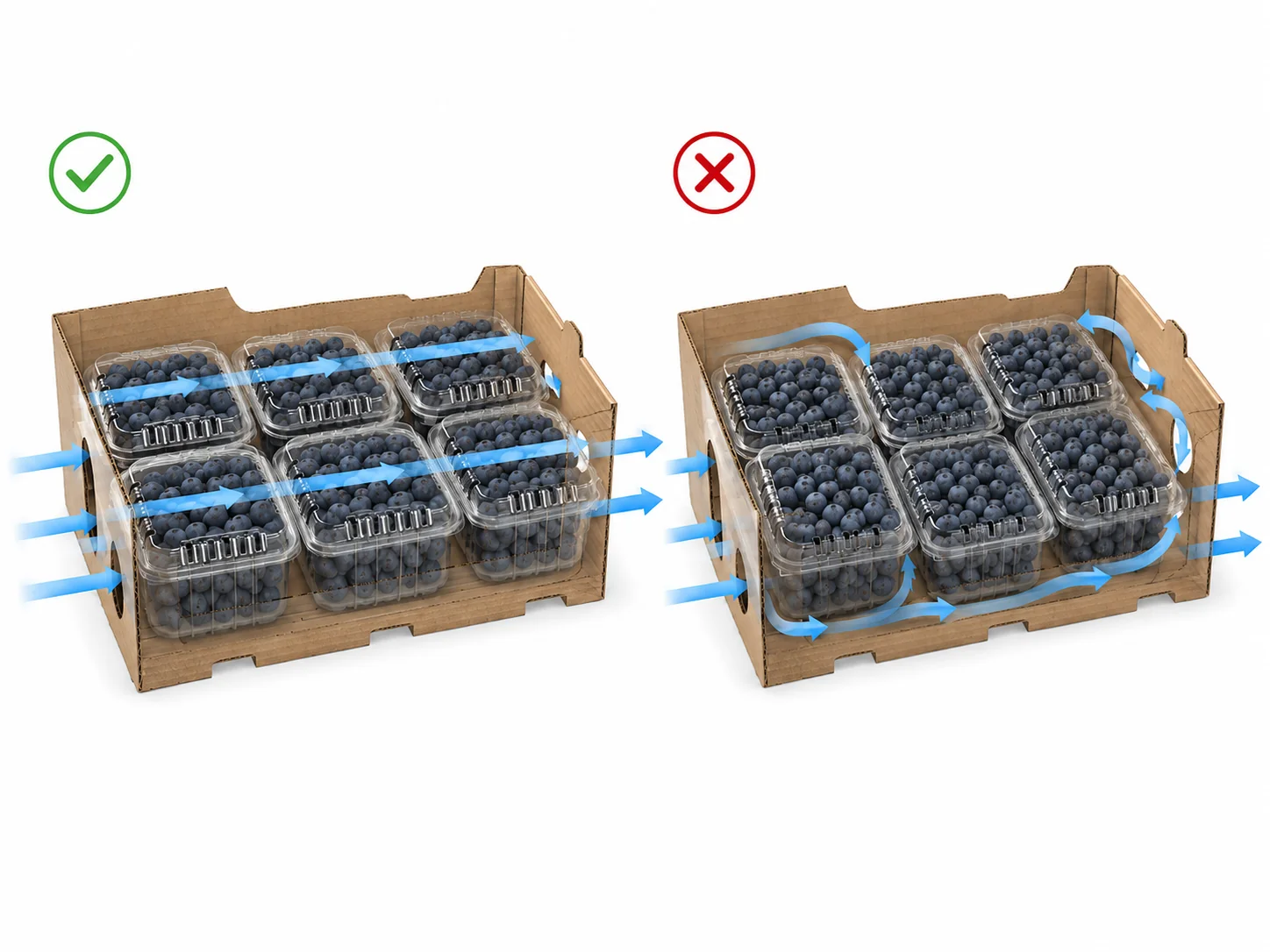
This is why a vented clamshell cannot be evaluated on its own. It only works as part of a system: the clamshell vents, the carton openings, the pack arrangement, and the pallet wrap all have to line up. A common failure mode is a carton with side vents that do not align with where the clamshell vents actually are — air moves around the packs instead of through them, and cooling becomes uneven inside the same carton.
Before locking in a clamshell for export, it is worth checking:
- Do the carton openings line up with the clamshell’s airflow path?
- Are vents blocked once the carton is fully packed?
- Does the packing pattern leave room for air to move?
- Will pallet wrap restrict airflow through the carton?
Treat this as cold-chain risk control, not packaging cosmetics — a clamshell, carton, and pallet pattern that were never tested together are a common source of unexplained quality loss on long routes.
Why Retailers Should Care About the Same Thing
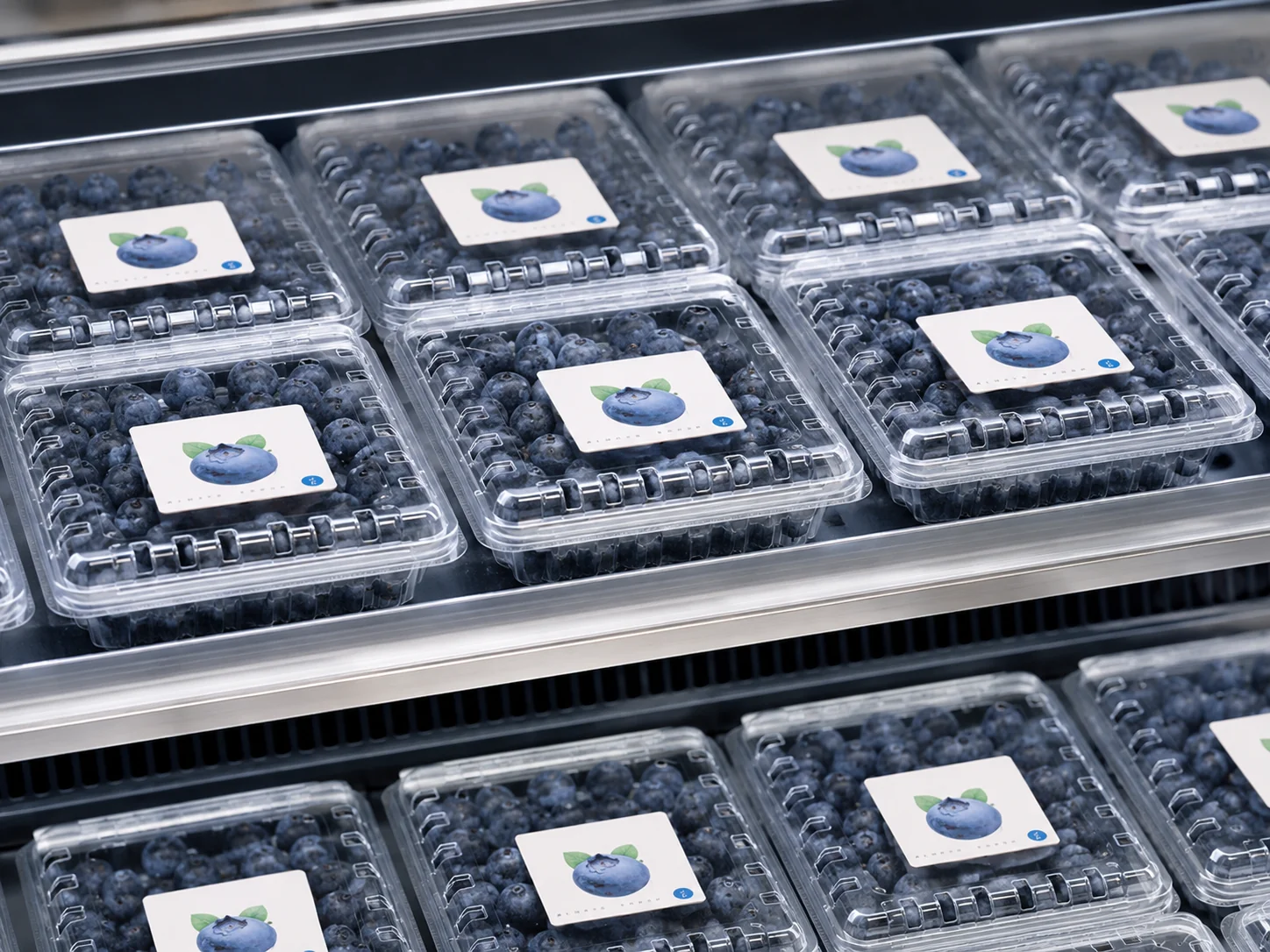
By the time blueberries hit the shelf, nobody is thinking about airflow — they are looking at the fruit. Visible condensation on the lid, soft or crushed berries, dull bloom: these read as “not fresh” to a shopper even when the fruit is technically within spec. With clear PET or rPET clamshells, every flaw is visible, which makes the packaging design part of the product’s first impression.
This pulls retail packaging in two directions at once. It needs enough airflow to prevent condensation, but enough structure to protect the fruit from friction and compression — plus space left over for labels and branding. Too little ventilation and the pack fogs up; too much and the fruit looks beat-up or dried out. The right design sits in the middle, and where that middle is depends on the variables below.
Hole Position Matters More Than Hole Count
This is the part most buyers get wrong. A clamshell with fewer, well-placed vents will often outperform one with more holes that get blocked the moment it is stacked.
| Vent Position | What It Is Good For | What to Watch |
|---|---|---|
| Lid vents | Top-side air exchange, moisture release | Easily blocked by tight stacking or cartons placed on top |
| Side vents | Horizontal airflow, pairs well with carton side openings | Larger openings can expose fruit to contact damage |
| Base vents | Vertical airflow in select designs | Must not compromise base strength or fruit support |
Lid vents are the most common choice and tend to work well when there is clearance above the pack. But that “works well” is conditional — test it in the actual packed and stacked configuration, not on an empty clamshell sitting on a table. A vent layout that looks generous when empty can be half-covered the moment the carton is full.
The rule of thumb: the vent layout needs to match the real airflow path — from the carton opening, through the stacked clamshells, to the berries — not just look open on its own.
More Ventilation Is Not Automatically Better
It is tempting to treat “more holes = more airflow = better” as a simple equation. It is not.
Too little ventilation risks slow or uneven cooling, condensation, and inconsistent quality across a carton. But going too far the other way brings its own problems: faster moisture loss, weaker stacking strength, more exposure to dust and handling damage, and less protected bloom — plus less surface area for labeling. For most retail and export programs, the goal is controlled airflow, not maximum airflow, especially on routes involving repeated handling, vibration, and carton compression.
One exception worth flagging: low-vent or sealed clamshells used for modified-atmosphere packaging (MAP) are a different strategy entirely, not just “fewer holes for longer shelf life.” MAP requires balancing fruit respiration, film permeability, pack weight and storage temperature as one validated system — it is not a simple swap from a standard vented clamshell.
How to Choose the Right Design for Your Program
Before settling on a clamshell, it helps to work through four things:
- Cooling method — Is the fruit pre-cooled immediately? Is forced-air cooling used? The faster and more aggressive the cooling, the more airflow through the pack matters.
- The fruit itself — Berry size, fill height and pack weight change how tightly the fruit sits in the clamshell. A 125g pack of large berries behaves differently than 125g of small ones — test with real fruit, not an empty container.
- Carton and stacking — The carton is not separate from the clamshell. Its openings, internal dimensions and stacking pattern decide whether the clamshell’s vents actually do anything once palletized.
- Route and destination — A short local delivery, a supermarket distribution run, and a multi-week export shipment all call for different priorities. The longer the route, the more it is worth testing the full pack-carton-pallet combination before committing.
Working With StlPak
At StlPak, we work through clamshell selection based on pack weight, berry size, carton design, labeling needs and transport route — and for programs that need a custom vent layout, we test it with real fruit and real packing conditions before mold approval, not after.
The same vented design principles apply across our fruit punnets range, and for ready-to-eat berry and cut-fruit formats, tamper-evident food containers add tear-strip security.
If you are sourcing a blueberry clamshell for a retail or export program, get in touch and we can help match an existing design or scope a custom one for your cold chain.