
Commercial fruit shipping is a system problem, not a container problem. A clamshell that performs well on a retail shelf can still fail when it goes through pre-cooling, carton stacking, refrigerated transport, and several days in a reefer container. The damage doesn’t always come from one weak point — it comes from the interaction between a container that fits poorly, a carton that blocks ventilation, and a pallet that concentrates stacking load in the wrong place.
This guide covers how growers, packhouses, exporters, and produce distributors can select primary containers, prepare shipping cartons, maintain cold-chain conditions, and test the complete system before dispatch. Browse StlPak’s fruit packaging range to see the container types referenced throughout this article.
Understand the Three-Level System First
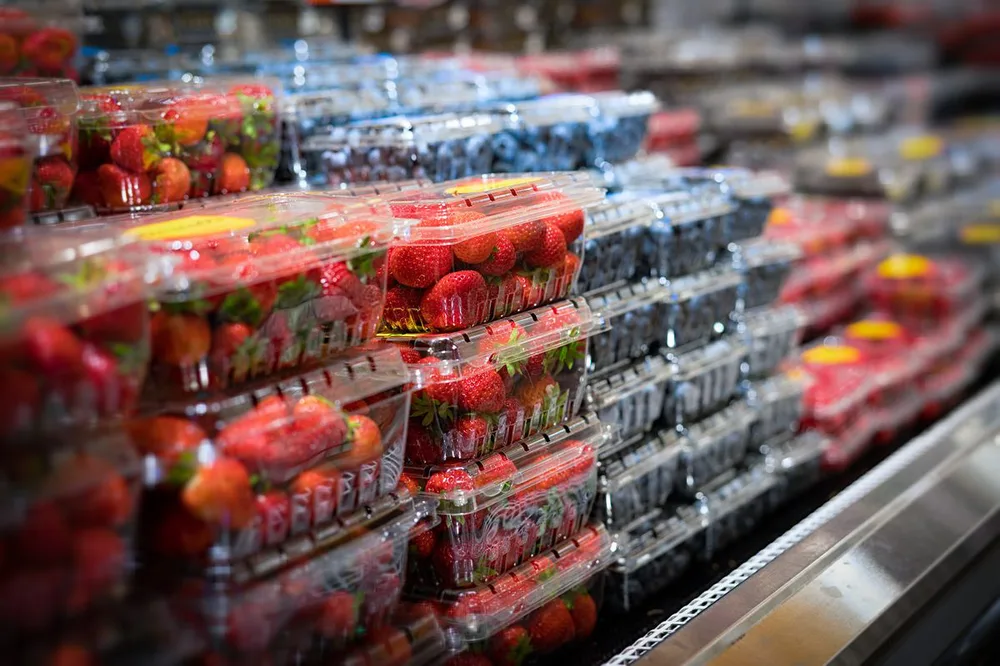
Commercial fruit packaging operates across three connected levels. Each has a different function, but they must work together — a failure at any level affects the others.
| Level | Function | Common formats |
|---|---|---|
| Primary | Directly contains and protects the fruit | Vented punnet, clamshell, molded tray, fruit cup |
| Secondary | Groups primary packs, supports stacking | Ventilated corrugated carton |
| Tertiary | Stabilizes cartons during bulk handling and transport | Pallet, corner boards, straps, stretch film |
The relationship between levels matters more than any individual component. A strong clamshell inside a poorly ventilated carton still cools slowly. A well-designed carton on an unstable pallet still arrives damaged. And ventilation must remain functional across all three levels — openings in the punnet provide no benefit if they’re blocked by labels, pressed shut by carton walls, or sealed behind tightly wrapped stretch film.
Before selecting any component, define the distribution route: distance, transit time, cold-chain method, stacking height, and destination requirements. A 1 lb grape pack shipped to a nearby supermarket has genuinely different packaging requirements from the same pack moving through a 21-day export cold chain, even though the net weight is identical.
Choosing the Primary Container
The primary container determines how much the fruit moves, what pressure it experiences, and how efficiently it cools. The choice should follow from the fruit’s physical characteristics — not from a nominal capacity.
| Fruit | Common primary format | Key shipping concern |
|---|---|---|
| Blueberries and small berries | Vented punnet or clamshell | Berry movement, airflow, moisture balance |
| Grapes | Deep ventilated clamshell | Bunch height, stem space, compression |
| Strawberries | Rigid transparent clamshell | Top pressure, bruising, visibility |
| Apples, pears, kiwifruit | Molded tray or divided carton | Fruit-to-fruit contact, rolling |
| Peaches, plums, stone fruit | Molded tray or shallow punnet | Pressure marks, softening during transit |
| Fresh-cut fruit | Sealed or tamper-evident container | Leakage, hygiene, temperature sensitivity |
Container depth is where most selection errors happen. If the container is too shallow or overfilled, the lid presses against the fruit and transfers stacking pressure directly to the produce. If it’s too deep, the fruit shifts and collides during vibration. For grapes, bunch height and berry diameter must be measured — two varieties at the same net weight may require different container depths because their bunch structures differ. For blueberries, closure gaps and ventilation openings need to be small enough that individual berries can’t escape.
StlPak recommends testing the actual fruit at the target fill weight rather than selecting by stated capacity. A description like “1 lb” or “2 lb” doesn’t confirm that the container depth matches the specific variety being packed.
The Packing Process
Sort, Grade, and Pre-Cool Before Packing
Packaging cannot correct poor fruit quality. Damaged or overripe fruit releases moisture during transport, accelerates decay in adjacent produce, and increases condensation risk inside the carton. Before packing, remove fruit with cuts, mold, soft spots, or serious bruising. Grade by size and maturity. Avoid mixing very firm fruit with overripe fruit in the same pack.
Pre-cooling is one of the most critical steps and is frequently underestimated. Freshly harvested fruit retains field heat, and removing that heat before the pallet is assembled is far more effective than trying to cool a dense, fully wrapped pallet from the outside. Forced-air cooling depends on cold air moving through the carton and primary container — poorly positioned or blocked vents significantly increase cooling time and cause uneven temperatures within the pallet. Fruit pulp temperature should be monitored directly where possible, not assumed from cold-room air temperature.
Loading the Primary Container
Once the fruit is sorted and pre-cooled, loading should balance fill efficiency with headspace. Check that the target weight fits without excessive empty space; that the lid closes without contacting the fruit; that small fruit can’t move through ventilation openings; and that the container closes completely along its full perimeter. For grapes, examine the clearance above the bunch. For strawberries, check that large berries near the top aren’t pressed by the lid.
Ventilation design should reflect the fruit and the cooling method together. More holes aren’t automatically better — excessive open area increases moisture loss, weakens container sidewalls, and may allow small berries to escape. Vent locations on the primary pack need to align with the airflow paths in the corrugated carton. Labels should not cover critical vents. This is why StlPak evaluates vent location, container rigidity, pack weight, and carton loading as a system rather than treating hole count as a measure of performance.
Packing Into Corrugated Cartons
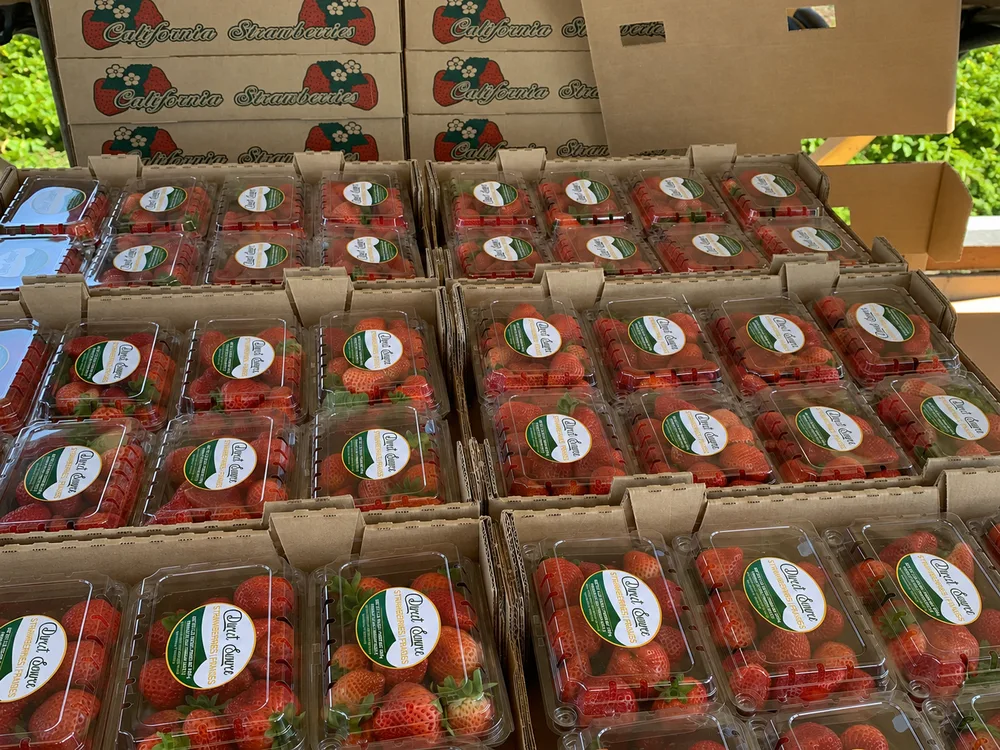
The carton should hold primary packs securely without crushing or distorting them. Internal dimensions should match the container arrangement without forcing the sidewalls to buckle. Containers should remain upright unless specifically designed for another orientation. Carton vent openings must align with the cooling direction and must not be blocked by labels, liners, or adjacent packs.
High humidity and condensation reduce corrugated board strength significantly over time. Carton performance should be evaluated under refrigerated and humid conditions representative of the actual distribution route — not only in a dry warehouse.
Palletizing for Transport
A stable pallet must withstand warehouse handling, forklift movement, truck vibration, and prolonged stacking without restricting the airflow the fruit depends on.
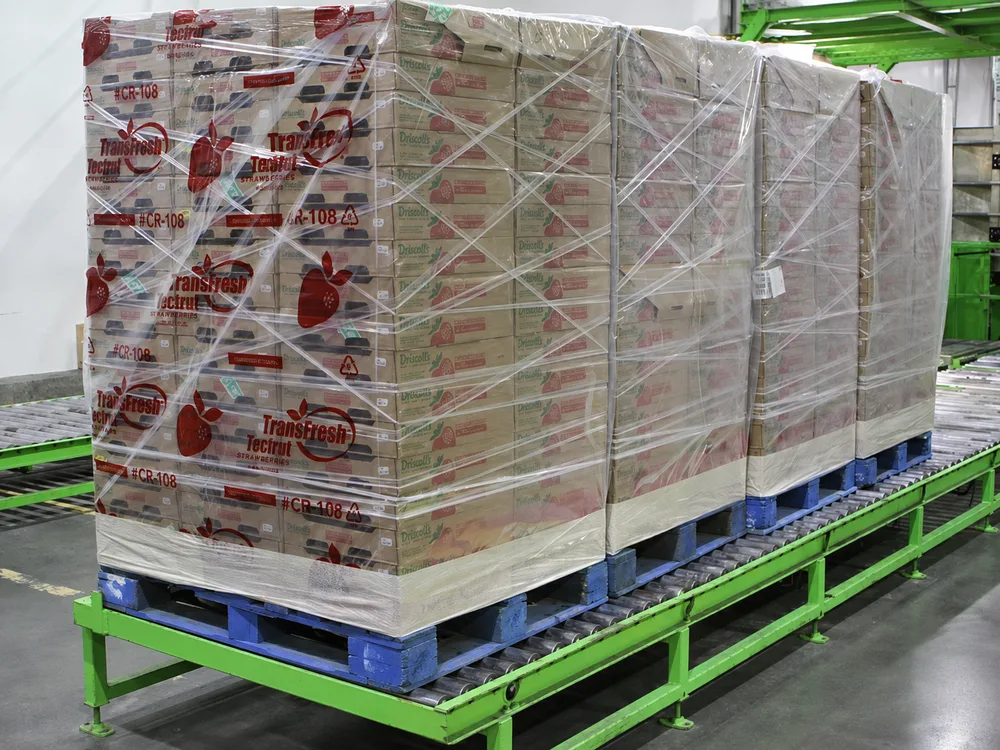
Use a consistent carton arrangement on every layer. Keep cartons within the pallet footprint — overhanging edges receive less support and concentrate load on unintended points. Align carton vents vertically so cold air can move through the pallet from base to top. Corner boards, straps, and stretch film improve stability, but excessive wrapping restricts ventilation. The goal is a pallet that is secure and breathable.
The bottom cartons carry the accumulated weight of everything above them. A pallet that looks stable immediately after assembly can still develop crushed lower cartons after several days in refrigerated storage. Compression testing should reflect the expected pallet height and storage duration, not an ideal empty-carton test.
Temperature Control Through the Cold Chain
Packaging supports temperature management — it doesn’t replace it. Commercial fruit shipments depend on prompt pre-cooling, refrigerated storage, refrigerated vehicles, and for long-distance export, refrigerated containers with monitored conditions.
Gel packs are appropriate for small consumer parcels and short direct-to-consumer deliveries. They are not a commercial cold-chain solution for larger fruit shipments and should never contact fruit susceptible to cold damage. Dry ice is used for frozen products, not fresh fruit — it is significantly colder than required, releases CO₂, and is subject to carrier regulations.
For commercial export, the practical steps are: pre-cool the fruit before palletizing; minimize time outside refrigerated storage during loading; monitor pulp temperature with recorders on significant shipments; coordinate with the receiving party to confirm they can unload and refrigerate promptly; and plan departures to avoid unnecessary weekend or holiday storage.
What to Test Before Bulk Shipment
No packaging decision should be made based on drawings, stated capacity, or empty sample inspection alone. Performance changes once fruit is loaded, cooled, stacked, and subjected to transport vibration.
Fruit-fit and closure test. Pack the actual fruit variety at the target net weight. Check fill height, fruit movement, closure security, and whether stems or leaves interfere with the locking edge. Confirm the lid stays closed when the pack is tilted or subjected to light pressure.
Carton-fit test. Load the planned number of containers into the actual shipping carton. Check for excessive empty space, sidewall deformation, and vent alignment. This is where many problems are first identified — a container that works perfectly in isolation may create poor vent alignment or inconsistent stacking behavior inside the carton.
Stack compression test. Evaluate the complete loaded carton under the anticipated stacking load, and include the effect of humidity on carton strength for refrigerated routes. The bottom layer of a full pallet under cold-room conditions is a different environment from an empty carton in a warehouse.
Vibration and drop test. Simulate the shocks and vibration experienced during loading, transport, and unloading. Inspect the fruit for bruising and the packaging for opening, cracking, or deformation.
Condensation and cold-room test. Place loaded packages under target temperature conditions and observe where moisture forms. Check whether condensation affects fruit quality, label adhesion, carton strength, or visibility.
Trial shipment. Laboratory checks are useful but limited. A trial shipment on the actual route, with temperature logging, provides evidence that cannot be replicated in a controlled test environment. Record fruit condition, package integrity, carton performance, and customer feedback before scaling to full volume.
StlPak can provide samples of existing punnet and clamshell models for these tests. Buyers can compare different container depths, ventilation layouts, and carton arrangements before committing to bulk production.
Export Requirements
Fruit crossing international borders may face agricultural, plant-health, and import restrictions that are entirely separate from packaging performance. Clearance to sell a fruit domestically does not mean it can be exported to every market.
Before dispatch, confirm: whether the fruit is permitted at the destination; phytosanitary and plant-quarantine requirements; import permits and inspection procedures; labeling and country-of-origin requirements; any treatment or certification requirements; carrier rules for perishable goods; pallet and wood-packaging requirements; and any customer or retailer packaging specifications. Requirements differ by fruit and destination and should be confirmed for each route.
Common Shipping Problems and Their Actual Causes
Most fruit losses during transport result from a combination of factors rather than a single defect. Corrective action should address the real cause.
| Problem | Likely cause | Corrective approach |
|---|---|---|
| Bruising | Excess movement or fruit-to-fruit contact | Use correctly sized containers or molded trays |
| Crushed fruit | Overfilling or stacking pressure transferred to fruit | Adjust fill height; test container compression strength |
| Condensation | Warm fruit packed before pre-cooling, or temperature fluctuations | Pre-cool before packing; evaluate the full cold chain |
| Dehydration | Excessive ventilation or low humidity | Balance ventilation with moisture retention |
| Open containers | Weak closure or fruit trapped in the locking edge | Test closure with filled containers |
| Deformed cartons | Moisture exposure or excessive pallet load | Use suitable corrugated board; test under refrigerated conditions |
| Uneven cooling | Blocked or misaligned ventilation | Align vents across containers, cartons, and pallet |
| Leaking fresh-cut packs | Weak seal or inappropriate closure | Conduct filled-pack leakage tests |
Adding ventilation holes, using a heavier container, or tightening the pallet wrap will not resolve every problem and may create new ones elsewhere in the system.
Common Questions
What is the best way to package fruit for commercial shipping?
Sort and pre-cool the fruit, load it into a correctly sized primary container, pack into ventilated corrugated cartons, and stabilize on a pallet. Temperature, movement, compression, and airflow need to be controlled across the entire journey — not just at the point of packing.
Do fruit shipping containers need ventilation holes?
Most whole-fruit and berry packs do, but the required open area and hole position depend on the fruit, cooling method, humidity, and transport conditions. Ventilation in the primary container must align with openings in the carton and the pallet airflow path to be effective. Fresh-cut fruit typically requires a more sealed system.
Can fresh fruit be shipped in plastic containers?
Yes. PET punnets and clamshells are widely used for berries, grapes, and strawberries. The container needs to provide suitable ventilation, rigidity, closure security, and correct internal dimensions for the fruit. A ventilated plastic punnet is fundamentally different from an unventilated plastic bag. See StlPak’s fruit packaging options for container types suitable for shipping applications.
Should fruit be pre-cooled before or after packing?
This depends on the fruit, the packing operation, and the cooling method. The most important point is that field heat should be removed before the pallet is assembled and wrapped — cooling a dense, fully built pallet from the outside is significantly less efficient.
How do you prevent bruising during transport?
Use an appropriately sized container that limits fruit movement without overfilling. Molded trays or dividers may be necessary for larger individual fruits. Test the complete pack under vibration, drop, and compression conditions that reflect the actual distribution route.
What packaging tests should be done before bulk shipment?
Fruit-fit, closure, carton-fit, stack compression, vibration, cold-room, condensation, and pallet-stability tests — followed by a limited trial shipment on the actual route before full-scale distribution.
How should fruit be packaged for export?
All the above applies, plus: confirm phytosanitary requirements, import restrictions, labeling rules, treatment or certification needs, and pallet specifications for the destination market. Requirements differ by fruit and country and should be verified for each route rather than assumed from a previous shipment.