
A blueberry punnet, a grape clamshell, an egg carton, and a cake container may all be made from the same PET, but they shouldn’t be designed the same way. The food determines the structure. A good disposable plastic food container has to match the product’s weight, shape, fragility, ventilation needs, packing process, transport conditions, and retail presentation — a structure that works well for 125g of blueberries may not hold up under a 2 lb grape pack, and a flat lid suited to a tamper-evident deli container may be the wrong choice for a decorated cake that needs headspace. At StlPak, this is why we push buyers to look past length, width, capacity, and material name: the actual structure of the base, lid, sidewalls, ribs, vents, compartments, and closure is what determines how a package performs from packing to retail.
Explore StlPak’s broader Disposable Plastic Food Containers range when comparing formats and applications.
Related guidance: hinged-lid and separate-lid comparison.
Why Container Structure Follows the Food
There’s no single “best” disposable food container design, because different products create different packaging challenges.
| Application | Main Packaging Challenge | Typical Structural Response |
|---|---|---|
| Blueberries | Small portions, airflow, easy handling | Compact vented clamshell |
| Grapes | Higher packed weight | Stronger walls, ribs and base |
| Tamper-evident foods | Security, stacking, shelf display | Tamper feature with flatter lid |
| Eggs | Fragility and ventilation | Individual cavities, separators and vents |
| Cakes | Protecting decoration | Extra headspace or dome lid |
| Fresh-cut fruit | Visibility, juice and takeaway | Clear container with secure closure |
| Snacks | Multiple ingredients | Compartment structure |
| Desserts | Protection and presentation | Clear cup, dome and optional insert |
These features don’t work in isolation. A ventilation hole affects airflow, but it also changes structural strength. A deeper container adds internal space, but it can affect sidewall rigidity. A thicker sheet improves stiffness, but without the right geometry and material distribution, thickness alone won’t fix a weak structure. Food container design is almost always a balance between several of these requirements at once, not an optimization of any single one.
How Structure Changes Across Applications
Blueberries: Compact by Design
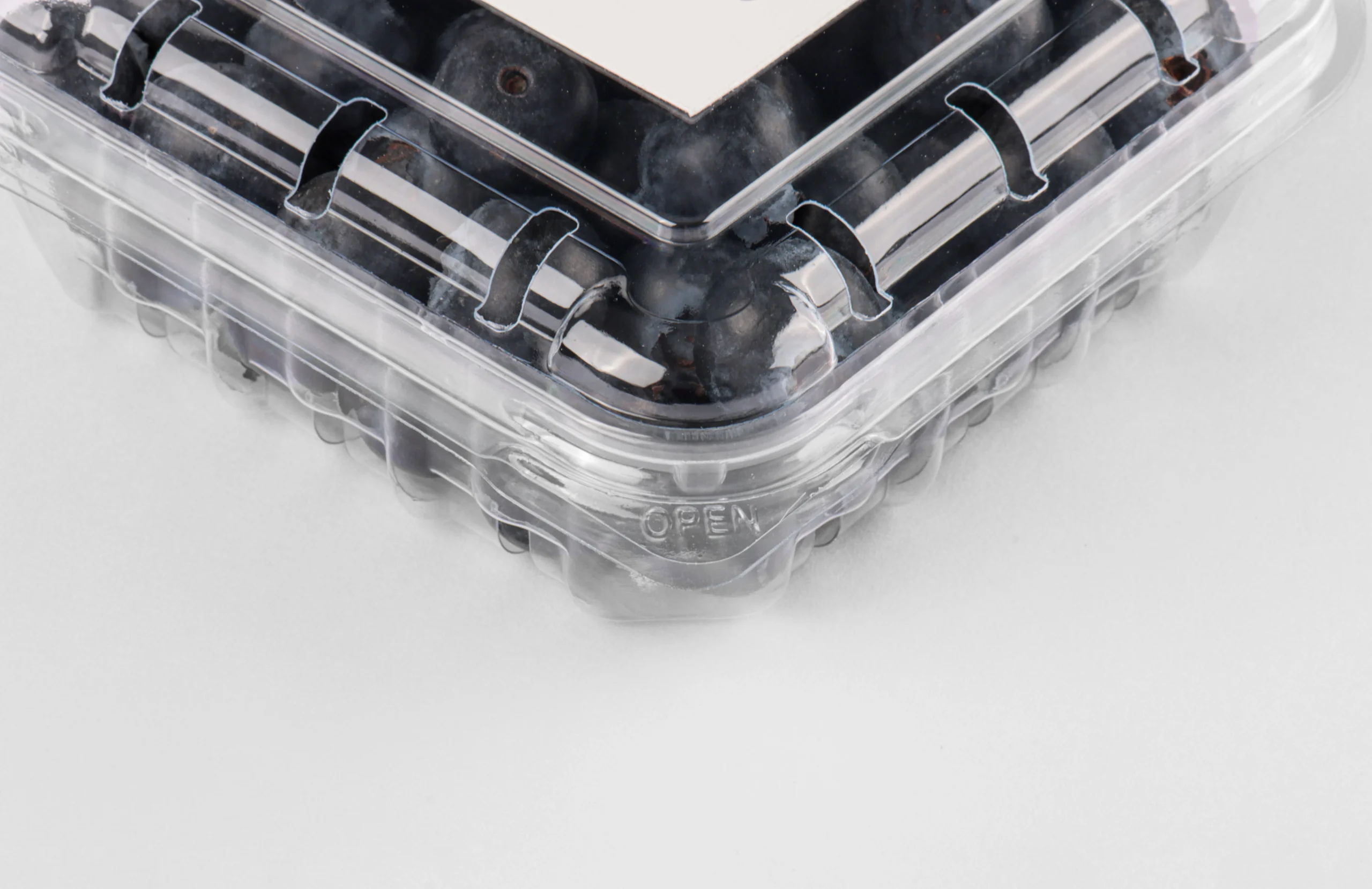
Blueberries are small and lightweight, and they’re typically packed into small retail portions — which is why blueberry containers don’t need the structure a grape or bakery pack requires. StlPak’s STL-125C1 blueberry container is built around how the fruit actually moves through the supply chain: weighed and packed quickly at the farm or packing house, arranged into master cartons, carried through the cold chain, displayed in-store, and finally handled by the consumer. A compact format supports every one of those stages without adding unnecessary packaging volume, and its ventilation is designed together with the container geometry — more holes don’t automatically mean better airflow, since hole position, carton arrangement, and stacking conditions all affect how air actually moves. For more on this, see our guide on how packaging affects fruit ripening.
Grapes: Built for Higher Fill Weight
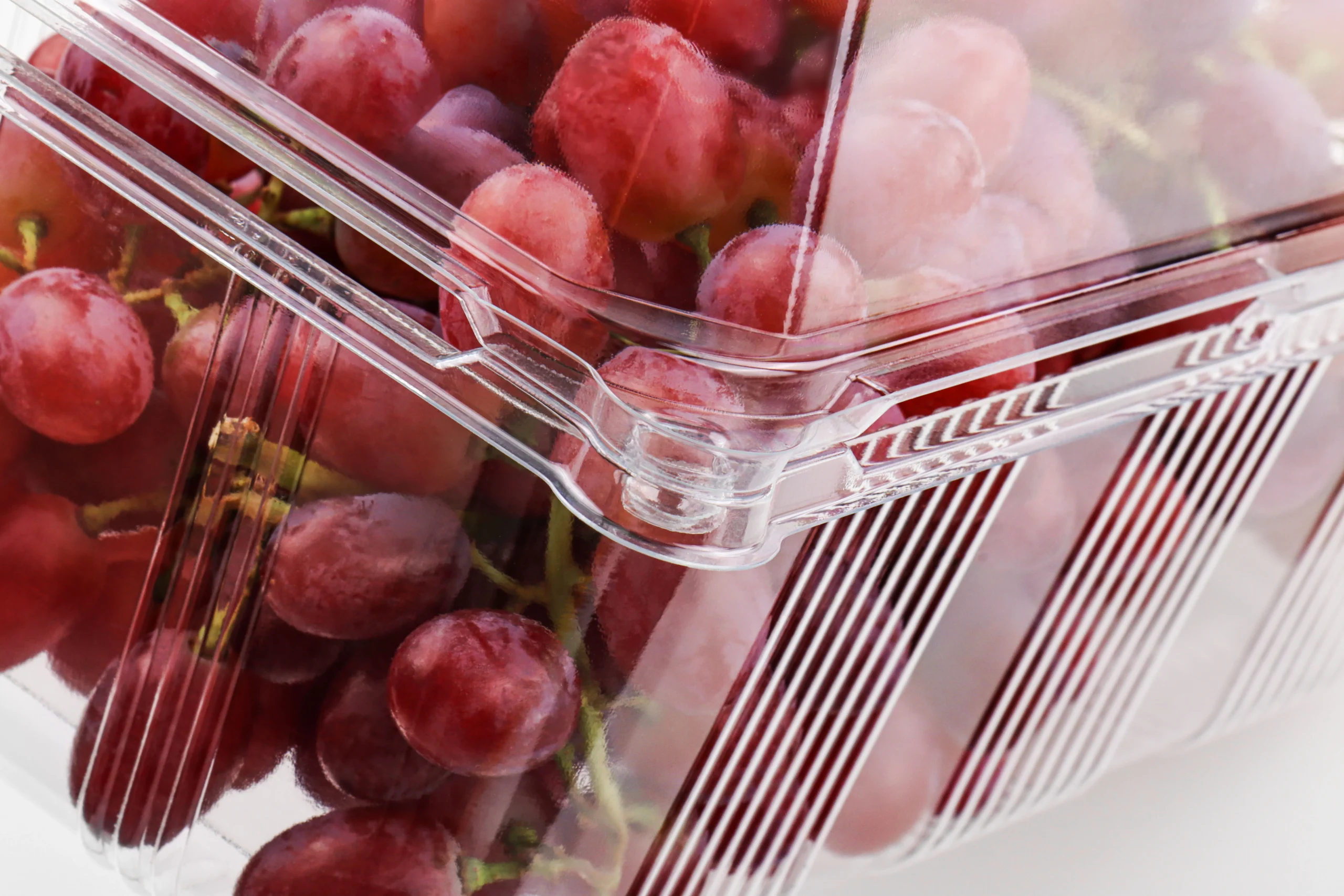
A grape container carries a very different load than a blueberry punnet, and as fill weight climbs from 1 lb to 2 or 3 lb, the container has to support that weight through packing, carton stacking, transport, and retail handling. But gram weight alone doesn’t determine strength. Two containers with similar dimensions and similar total weight can perform very differently depending on how the material is distributed across the sidewalls, corners, ribs, and base — a well-designed rib adds rigidity without simply adding bulk, and properly formed corners and rims transfer vertical load instead of letting the sidewalls buckle. This matters most under real conditions: a container that looks fine empty can still deform once it’s carrying several pounds of fruit with more packs stacked on top. For grapes, the right structure depends on fill weight and expected stacking conditions together — not on the clamshell’s external dimensions alone.
Tamper-Evident Containers: Security Without Sacrificing Stackability
A tamper-evident closure has to show whether a package has been opened, but that’s only one part of the job. Foods like salads, deli items, prepared meals, and snacks also need to stack neatly in refrigerators, display cabinets, cartons, and delivery totes — which is where lid profile becomes important. A relatively flat lid creates a more regular stacking surface, improving carton organization and shelf presentation, while the lid and base still have to hold the tamper-evident closure. In short, the structure is solving two problems at once: catching unnoticed opening while staying practical to handle and display. StlPak’s tamper-evident range is built around both of these requirements together, not just the locking feature. For more on how the closure itself works, see How Do Tamper-Evident Food Containers Work?
Eggs: Balancing Protection and Airflow
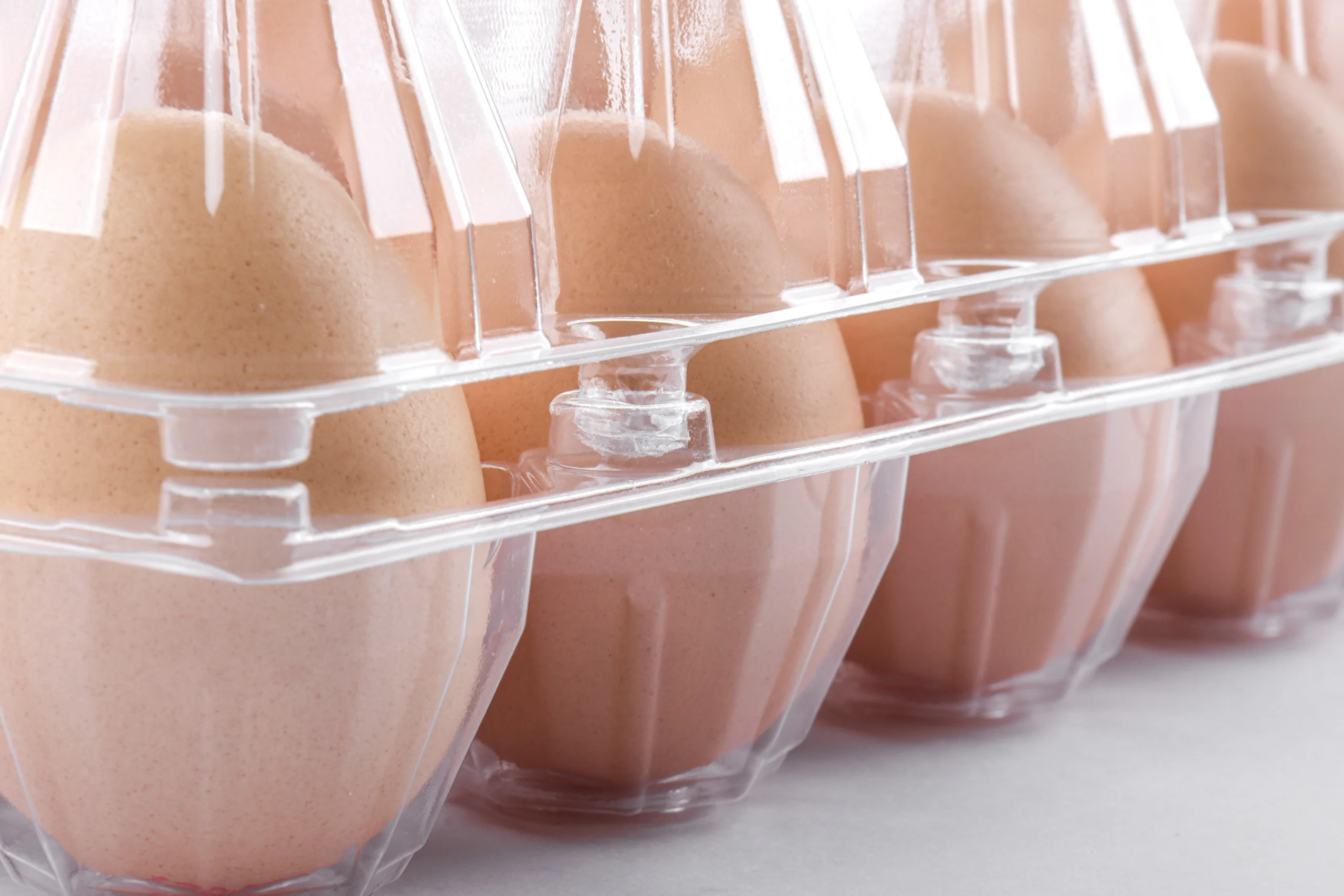
Egg packaging makes the food-first design logic obvious: an egg carton can’t just be an empty box. Each egg needs to sit in a fixed position, since free movement and egg-to-egg contact during transport raise the risk of breakage — which is why the structure typically includes individual cavities, separators or posts, supporting walls, and locking features, alongside ventilation openings the package still needs. That creates a real design tension: too much material removed for vents and the carton loses rigidity; too closed, and airflow falls short for the intended supply chain. Egg packaging has to combine separation, cushioning, support, and ventilation in a single structure — a very different design problem than a blueberry punnet or a tamper-evident deli container, even though all three are thermoformed PET.
Cakes: When Empty Space Is Protection
For most food packaging, buyers try to minimize unused internal space. Cake packaging is one of the cases where that instinct is wrong. A decorated cake or pastry may carry cream, frosting, fruit topping, chocolate decoration, or fragile icing edges, and if the lid sits too close to the food, normal handling or light stacking pressure can crush the decoration. That’s why cake packaging often needs intentional headspace, created through a deeper base, a taller lid, a dome structure, or reinforced outer edges — unused space here isn’t wasted space, it’s functional protection. The lid also does display work: a clear dome lets customers see shape, color, decoration, and toppings without opening the package, so the structure has to balance protection, visibility, closure, and presentation rather than simply minimizing material. See What Packaging Works Best for Bakery and Dessert Products? for more application-specific guidance.
Fresh-Cut Fruit: Visibility, Juice Control and Format Choice
Once fruit is peeled, sliced, or portioned, the packaging is handling a ready-to-eat product, which raises the importance of secure closure, liquid control, transparency, and portability. The right format depends on how the fruit will be packed and eaten: a deep cup suits mixed fruit portions well because it offers useful vertical capacity and is easy to carry, a shallow tray gives a wider presentation surface, and a clamshell provides an integrated lid and base in one piece. A grab-and-go fruit cup needs a different lid-base relationship than a family-size fruit tray. Visibility matters throughout, since customers want to see color, freshness, moisture condition, and portion size before buying — which is one reason clear PET is standard for cold fresh-food applications. Our guide to Clamshell vs Tray vs Cup food packaging covers format selection in more depth.
Snacks: Compartments Control What Touches What
For mixed snacks — nuts, cheese, crackers, berries, dried fruit, sauces — the structure’s job is keeping different foods apart. A single-cavity container can physically hold all of them, but it can’t stop them from shifting and mixing in transit; a compartment container can. That makes compartment design about more than appearance: the number of compartments, their size ratio, divider height, and cavity depth all need to reflect the actual portion ratio of the food being packed, and dividers need enough height to provide real separation under normal handling. Compartment packaging should be chosen around the specific food combination, not just total capacity. See Why Compartment Design Matters for Mixed Food Packaging for a deeper look.
Desserts: Structure as Presentation
Dessert packaging has to protect a delicate product while also helping sell it. For layered desserts, mousse, fruit cups, parfaits, and cream-based products, the container becomes part of the visual presentation — a clear cup shows off layers, fruit pieces, cream, sauce, and toppings, while a dome lid adds space above the product and protects decorative toppings, sometimes alongside inserts that separate components. Transparency, internal height, lid shape, and proportion matter far more here than they would for an industrial food tray, because the container is doing two jobs at once: protecting the dessert and presenting it. Our guide on why clear food packaging matters for retail display covers the presentation side in more detail.
Weight and Dimensions Don’t Tell You Everything
Buyers sometimes compare two plastic containers by asking only which one is heavier, or check whether the length, width, height, and capacity match. Weight matters, especially for heavily loaded packs, but it’s not a reliable stand-alone indicator of quality — and two containers with identical dimensions and similar weight can still behave very differently on the line and on the shelf. One may stack better, resist deformation better, offer more headspace, ventilate more effectively, or simply fit a given carton and packing process more efficiently. Container performance ultimately comes down to wall thickness distribution, rib design, corner geometry, rim structure, lid profile, base design, cavity depth, and closure geometry working together — a slightly heavier container with poor structural distribution can still deform, while a well-designed one uses less material more efficiently by reinforcing the areas that actually carry load. This is why StlPak recommends evaluating the actual finished container rather than comparing nominal thickness or unit weight on paper: filling a real sample with the actual product and checking how it performs under realistic conditions tells you far more than a spec sheet before a bulk order does.
Start With the Food, Not the Container
With hundreds of food container molds already available, most buyers don’t need to design a package from zero. A better starting point is telling the supplier what you’re actually packing, before discussing container shape:
- What food you’re packing, and how much goes into each container.
- Whether ventilation is required, and whether the product contains liquid that needs to be controlled.
- Whether the container will be stacked, in cartons, on shelves, or in refrigerated display.
- Whether presentation or compartments are required for the way the product is sold or portioned.
- What carton and transport conditions the finished pack will move through.
From there, an existing container can usually be selected and tested against the real product — custom tooling only becomes necessary once the existing structures genuinely can’t meet the application. That decision is covered in more detail in Existing Mold vs Custom Food Packaging Mold: Which Is Better?
Final Thoughts
Disposable plastic food container design shouldn’t start with “what shape looks good?” It should start with “what does this food need the package to do?” Blueberries need compact handling and ventilation; grapes need structural support for higher fill weight; tamper-evident containers need security that still stacks well; eggs need individual protection alongside airflow; cakes need headspace; fresh-cut fruit needs visibility and secure handling; snacks need separation; desserts need both protection and presentation. That’s why containers built from the same PET can end up looking nothing alike — the structure follows the application. Understanding that relationship makes it much easier to choose a container that performs well not just in a catalogue, but through packing, transport, retail display, and final use.