
A package described as “food-grade” is not automatically suitable for every bakery product. A clear PET cake box can work well for a cooled cake or refrigerated dessert — that doesn’t mean it can hold a pastry directly from the oven. And an ovenable CPET tray still needs to be used within the temperature and time limits specified for that particular product.
For bakery brands, food manufacturers, distributors, and packaging buyers, safety starts by matching the material to the food, the temperature, the storage conditions, and the destination market. This guide covers the key standards, material limits, common risks, and what to verify before placing a bulk order. Buyers can also compare StlPak’s broader Disposable Plastic Food Containers range before narrowing the options by bakery application. The clear food packaging guide covers shelf visibility, while the clamshell, tray and cup comparison helps narrow the physical format.
What Bakery Packaging Safety Actually Covers
Bakery packaging safety involves more than food-contact compliance. Under its intended conditions of use, packaging should not transfer unsafe substances into the food, change its taste or smell, deform or lose closure strength due to heat or grease, or fail to protect the product during stacking and delivery.
This means three separate things need to be right. Food-contact regulations determine whether the material can legally contact the food. Food safety management systems at the manufacturer control hygiene, traceability, and production consistency. And the bakery or food brand is responsible for ingredients, allergen information, shelf life, and product labeling. A certificate held by the packaging manufacturer cannot replace product-specific testing — the same material can behave very differently depending on food type, contact temperature, and container design.
Which Regulations Apply
The applicable standard depends on where the finished product will be sold. Packaging that meets U.S. requirements may need additional documentation or testing before being used in the EU, UK, Australia, or other markets.
United States. The FDA regulates substances that may contact food, including polymers, colorants, coatings, adhesives, and other packaging components. It’s more accurate to say a package complies with applicable FDA food-contact requirements than to describe every bakery container as “FDA approved.” Regulatory status depends on material composition and intended conditions of use. When evaluating a bakery container for the U.S. market, the supplier needs to know: what food will be packed, whether contact is direct, whether the food is dry, moist, acidic, or high in fat, the temperature at filling, the expected contact time, and whether the product will be refrigerated, frozen, or reheated.
European Union. Food-contact packaging is governed by framework Regulation (EC) No 1935/2004. Plastic materials also fall under Regulation (EU) No 10/2011 and its amendments. Materials must not transfer substances at levels that endanger health or cause unacceptable changes in the food. Depending on the application, plastic packaging may need to be evaluated for overall migration, specific migration of restricted substances, relevant food simulants, contact temperature and duration, and whether the use is single or repeated. A Declaration of Compliance may be required. Buyers should confirm that the testing conditions in the supporting report actually reflect their bakery application — a report based on short contact with dry food may not cover extended contact with a high-fat cream dessert.
Other markets. The UK, Canada, Australia, New Zealand, Japan, and other markets have their own food-contact, labeling, and packaging-waste requirements. Requirements for PFAS, recycled content, heavy metals, inks, or packaging additives should be reviewed against current local regulations and customer specifications. A U.S. food-contact report should not be assumed to apply in every other country.
PET vs CPET: The Temperature Distinction That Matters Most
This is where the most consequential misunderstandings happen in bakery packaging.
| Material | Typical Bakery Applications | Temperature Range | Key Limitation |
|---|---|---|---|
| APET/PET | Cooled cakes, cookies, pastries, dessert cups, refrigerated desserts | Ambient and chilled; follow supplier’s validated range | Not oven safe |
| CPET | Oven-ready desserts, frozen bakery, reheatable trays | Some products rated approximately −40°C to 220°C | Rating is product- and tray-specific, not universal |
| PP | Warm takeaway, selected microwave applications | Varies by grade and container design | Not every PP container is microwave or hot-fill suitable |
| Paper/paperboard | Bread, pastries, cookies, takeaway | Depends on board, coating, adhesive, and window material | Untreated board absorbs grease and loses strength when wet |
PET is widely used for bakery packaging because of its clarity, rigidity, and performance across retail and delivery applications. It is appropriate for cakes, pastries, cookies, cupcake trays, and cold dessert cups — after the product has cooled to a temperature within the manufacturer’s recommended range. There is no single safe maximum filling temperature for every PET container; material grade, sheet thickness, container shape, and contact time all affect performance. Buyers should not rely on a general statement like “PET can withstand 70°C” — the actual product temperature at the packing point should be measured and compared against the supplier’s specification.
Packing a hot pastry too early creates two problems, not one. The container may deform. And even if it doesn’t, trapped steam becomes condensation that softens the crust, damages decoration, and shortens acceptable shelf life.
CPET is crystallized PET designed for higher-temperature applications: freezer-to-oven trays, ovenable desserts, products intended to be reheated in the original container. Some commercial CPET systems are rated from approximately −40°C to 220°C, but this should be understood as a product-specific rating, not a guarantee for every CPET tray. Heating duration, food load, oven type, lid or film, and tray design must all be confirmed. Standard clear PET and CPET differ visibly — APET is transparent; CPET trays are typically opaque. If a product needs to be baked or finished in the original tray, a validated CPET solution is the appropriate choice, not a clear PET clamshell.
The Main Safety Risks in Bakery Packaging
Chemical Migration
Migration can involve polymers, additives, inks, coatings, or adhesives. The risk level depends on the food type, contact temperature, and duration. Fatty foods require particular attention because some substances migrate differently in contact with oil or fat than with dry products. Buyers should confirm that compliance information reflects the real product, not just a general food-contact statement. Printing should normally be on the non-food-contact surface unless the ink system has been specifically assessed for direct contact.
Heat and Deformation
Using packaging at the wrong temperature may cause warping, lid distortion, closure failure, or loss of stacking strength — even without visible melting. The safest approach is to measure the product temperature at the actual packing point rather than estimating based on time since the product left the oven.
Grease and Moisture
Butter, cream, icing, and fillings interact with packaging differently from dry bread or biscuits. Paperboard can stain or structurally weaken without appropriate grease barrier treatment. Moisture affects labels, adhesives, and window films. Barrier coatings and liners must themselves be food-contact compliant — selecting a package by appearance before testing with the actual product is a common source of problems.
Condensation and Microbial Risk
When a warm product is sealed inside a package, released moisture collects on the lid or walls. This can soften crisp products, damage decoration, and create conditions that support mold growth. Packaging needs to be integrated with the cooling process — the bakery must determine when the product has cooled sufficiently for packing, and whether ventilation or refrigeration is needed.
Physical Damage
Packaging must protect the product from handling, dust, and contact during distribution, and withstand stacking without crushing cakes, breaking cookies, or smearing decorations. A secure closure prevents accidental opening, but closure design alone doesn’t make a container tamper-evident. If visible first-opening evidence is required, a tear strip, security label, or film seal must be specified separately.
Choosing Packaging by Product Type
Cakes and Pastries
Cake packaging needs enough internal height to protect cream, fruit toppings, and decorations without the lid contacting the product. The base must support the cake’s weight without flexing. For cooled cakes, a transparent PET cake box provides strong visibility and physical protection. Critical checks: clearance above the decoration, stability between the cake board and container base, closure strength, cold-storage performance, and stacking under delivery conditions. For greasy pastries, evaluate direct contact with the base — if printed paperboard, labels, or adhesives are used inside, all food-contact components must be confirmed as suitable.
Cookies, Biscuits, and Macarons
The primary risks are breakage, moisture pickup, and movement inside the container. A rigid PET box or tray protects delicate products and provides clear retail presentation. Internal cavities or dividers may be needed to keep products in position. A snap-closed PET clamshell should not be assumed to be airtight — for products requiring long shelf life or strong moisture protection, an inner sealed bag, lidding film, or barrier system may be necessary in addition to the rigid outer container. Shelf-life testing must be done with the actual product, since two cookies with different fat content or filling can behave very differently in the same package.
Dessert Cups and Cream-Filled Products
Mousse, tiramisu, pudding, and cheesecake are typically distributed under refrigeration. Confirm: cup and lid compatibility, closure strength after filling, leakage when tilted during delivery, condensation under actual refrigeration conditions, and label adhesion on cold or moist surfaces. Packaging supports safe storage — it cannot compensate for inadequate refrigeration or poor hygiene during filling.
Cupcakes, Muffins, and Donuts
Cupcakes with tall frosting need more headspace than plain muffins. Donuts may require a wider tray with enough clearance to prevent toppings from sticking to the lid. Single-cavity or multi-cavity inserts reduce movement during delivery — cavity diameter, base depth, and top clearance should be tested with real products because nominal dimensions don’t account for frosting variation or handmade irregularity. Test the completed package under realistic stacking pressure, since a box that appears rigid when empty may flex once loaded and stacked in an outer carton.
Pastry and Bakery Clamshells
PET clamshells are widely used for croissants, Danish pastries, brownies, and mixed bakery assortments. A one-piece hinged design simplifies packing and removes the need to match separate bases and lids. Key features: sidewall strength, hinge durability, closure consistency, opening ease, and label space. For greasy pastries, check whether visible oil marks, trapped moisture, or product movement will affect retail presentation. Ventilation decisions should be based on the product’s cooling stage and desired texture — more holes reduce steam buildup but may accelerate moisture loss.
Labeling, Allergens, and Traceability
Packaging material safety and food label compliance are separate responsibilities. A retail bakery label typically needs to carry: product name, ingredient list, net quantity, manufacturer or distributor information, nutrition information, allergen declaration, date marking, lot or batch code, and storage instructions.
Bakery products commonly contain wheat, milk, eggs, soy, peanuts, tree nuts, and sesame. In the United States, sesame has been included among the nine major allergens since January 1, 2023. Allergen definitions and declaration formats differ between markets — labels must be reviewed against the regulations of the destination country.
The packaging supplier can provide a suitable label area and labeling support, but the bakery brand remains responsible for the accuracy of ingredients, allergens, date codes, and storage information. Batch traceability should connect the finished packaging to raw material and production records, which matters when investigating a quality issue or identifying packaging from a specific production run.
Documents to Request Before Ordering
StlPak can provide relevant FDA and EU food-contact test information for applicable products, along with food safety management documentation including FSSC 22000 and ISO certifications. However, management-system certificates don’t confirm that every container is suitable for every temperature or food type — product-specific verification is still required.
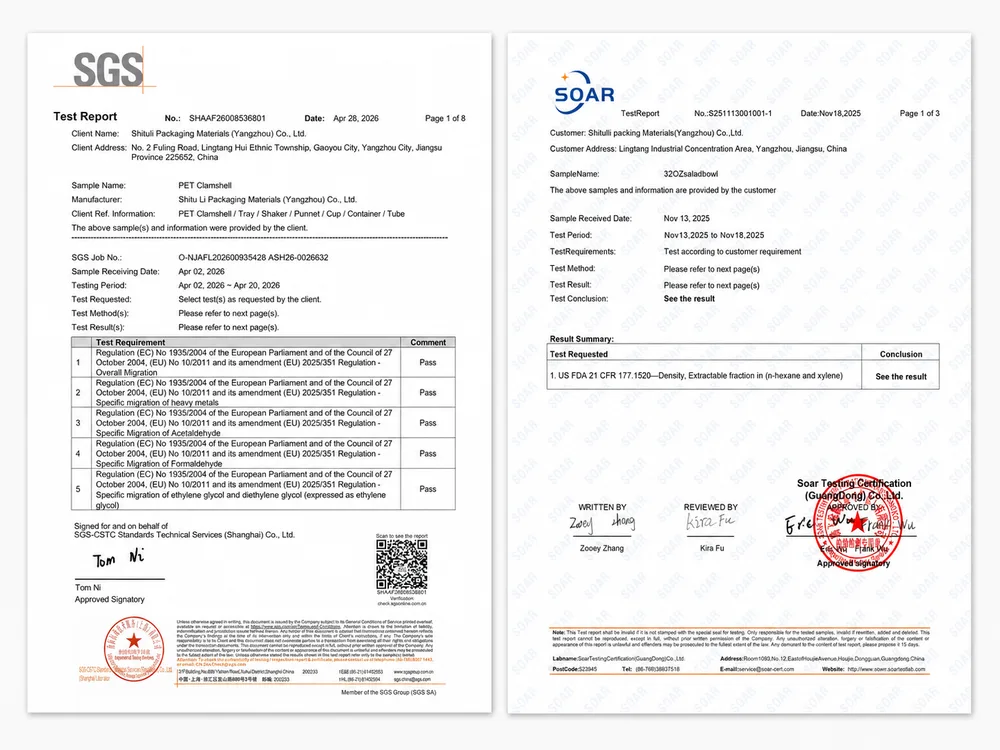
| Document | What to Check |
|---|---|
| Food-contact test report | Market covered, material tested, food simulants, temperature and contact time |
| Material specification | Resin type, structure, thickness, and intended application |
| Declaration of Compliance | Whether required and applicable in the destination market |
| Temperature guidance | Maximum and minimum use conditions for the finished container |
| Traceability records | Batch identification for raw material and finished packaging |
| Management system certificates | Scope, manufacturing site, and certificate status |
| Ink, coating, and adhesive information | Whether non-plastic components are suitable for their intended contact conditions |
Testing Before Bulk Orders
Compliance documents are one part of approval. The package must also be tested with the actual food, packing process, and distribution conditions.
Filling and closure test. Cool the bakery product to the planned filling temperature and measure it — don’t estimate. Fill the container with the normal product weight and arrangement. Check whether the lid closes correctly and whether the package deforms.
Storage test. Store the filled package under its real conditions — ambient, chilled, or frozen. Observe for condensation, grease marks, odor transfer, loss of clarity, and changes in closure strength. Cream-filled desserts should be tested through the full refrigerated shelf life. Dry cookies should be checked for moisture pickup and texture change.
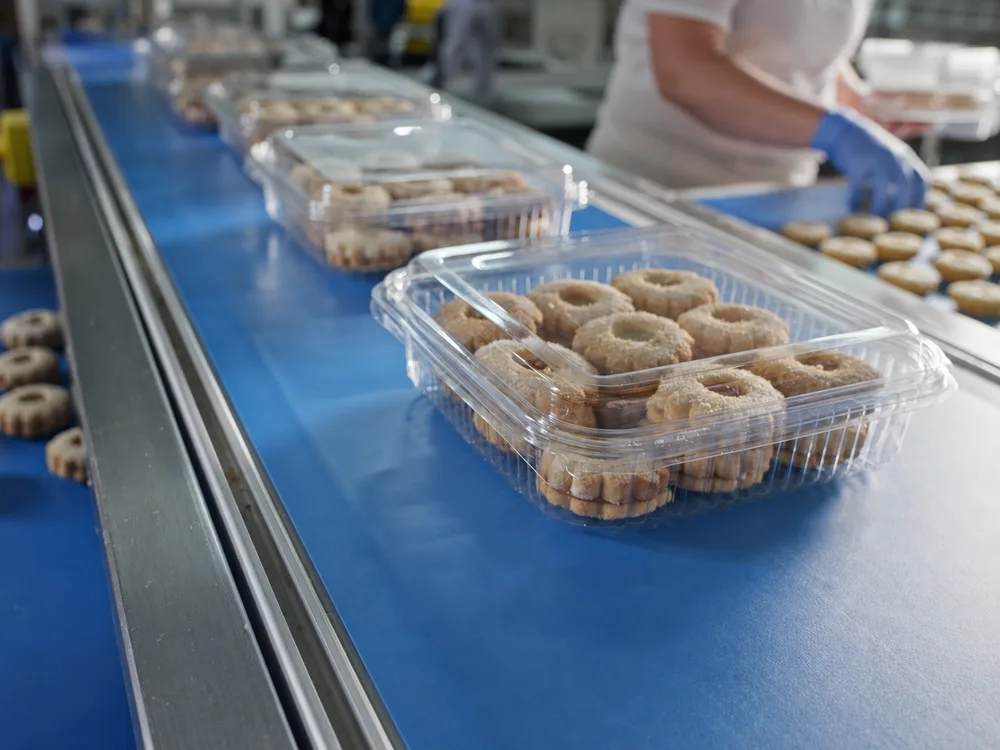
Transportation test. Reproduce the actual outer carton, stacking height, and delivery route. Check whether the product moves inside the package, whether decorations contact the lid, and whether containers at the bottom of the carton distort under load.
Label test. Apply labels under real packing conditions and check adhesion after refrigeration or surface moisture exposure. Barcodes, date codes, and lot numbers must remain readable throughout distribution.
Only after food compatibility, storage, delivery, and shelf-life performance have been confirmed should the packaging move into full-volume production.
Common Questions
Is PET safe for bakery packaging?
PET can be suitable for direct contact with cooled, ambient, and refrigerated bakery products when it complies with applicable food-contact requirements and is used within its validated temperature range. Compliance does not mean the container is suitable for every filling temperature or heating method.
Can hot pastries be packed directly in PET containers?
Not unless the measured product temperature is within the container’s validated range. Packing too early risks container deformation and traps steam that creates condensation, softening the product and shortening acceptable shelf life.
What is the difference between PET and CPET?
Conventional transparent PET is used for ambient and chilled display. CPET is crystallized for higher-temperature applications including freezer-to-oven reheating. They also differ visually: APET is clear, CPET is typically opaque.
Are PET bakery containers microwave safe?
Standard PET bakery containers should not be assumed to be microwave safe. The lid, label, film, and any other components must also be validated for the intended heating conditions.
Do bakery containers need to be airtight?
Not always. Bread and crisp pastries may need controlled ventilation. Cookies for longer storage may need stronger moisture barrier protection. A snap-closed clamshell provides physical protection and dust resistance without being fully airtight. The required barrier level should be confirmed through shelf-life testing.
What certifications should a bakery packaging supplier provide?
Relevant evidence typically includes food-contact test reports, material specifications, a Declaration of Compliance where applicable, and manufacturing certifications such as FSSC 22000 or ISO 9001. The appropriate documents depend on the destination market, food type, and conditions of use.
Should bakery packaging be tested with the actual product?
Always. Temperature, grease, moisture, product shape, fill weight, and distribution conditions all affect performance in ways that can’t be predicted from drawings or empty sample inspection. Testing through the complete process — filling, storage, transportation, and shelf-life evaluation — is the only reliable confirmation before bulk production.