
Clamshells, trays, and cups are not just three containers for three different foods. They are three different packaging systems.
A clamshell provides protection and closure in one piece. A tray creates a platform for sealing and display. A cup builds depth for portioning and upright use. The right format depends on how the food moves through packing, distribution, retail, and consumption — not just what category it belongs to.
This guide helps food processors, produce packers, retailers, and brands choose the right format across their range of disposable plastic food containers.
Explore StlPak’s broader Disposable Plastic Food Containers range when comparing formats and applications.
Related guidance: container selection guide; hinged-lid and separate-lid comparison; fresh-cut fruit packaging guide.
Quick Comparison
| Factor | Clamshell | Tray | Cup |
|---|---|---|---|
| Structure | Base and lid formed as one hinged piece | Open-top, typically broad and relatively shallow | Deep, upright with a compact opening |
| Common closure | Snap lock, tabs, or tamper-evident feature | Sealing film, overwrap, or separate rigid lid | Separate flat or dome lid, or sealing film |
| Main advantage | Integrated lid and all-around enclosure | Flexible closure and broad presentation surface | Depth, portioning, and vertical filling |
| Packing method | Manual or semi-automatic | Manual, wrapping line, or auto tray-sealer | Manual or automatic depositing and sealing |
| Consumer access | Easy opening and reclosing | Depends on film or lid selected | Convenient for carrying, spooning, and portioned eating |
| Typical applications | Berries, grapes, bakery, sandwiches, salads | Meat, seafood, produce, ready meals, assortments | Fresh-cut fruit, desserts, deli portions, snack mixes |
| Main limitation | Open hinge requires workspace; may occupy more carton volume | Requires a compatible closure system as a separate component | Narrower opening may not suit arranged or displayed foods |
Final performance depends on the specific dimensions, material, closure design, and complete packaging system — not format alone.
Choose the Material Before the Format
Material and format are two separate decisions, and material comes first.
The material determines whether the container can tolerate the filling temperature, storage conditions, and any heating method the consumer will use. The format determines how the food sits inside, how the container closes, and how it moves through packing and distribution. A PET tray for chilled fresh-cut fruit and a PP tray intended for hot food share a general shape but have entirely different specifications.
Confirm the minimum and maximum food-contact temperatures first, then determine whether refrigeration, freezing, microwaving, or oven heating is required, then select a suitable material — and only then compare clamshell, tray, and cup within those conditions.
For a full material comparison, see the Food Packaging Material Guide.
Clamshell: Protection and Closure in One Piece
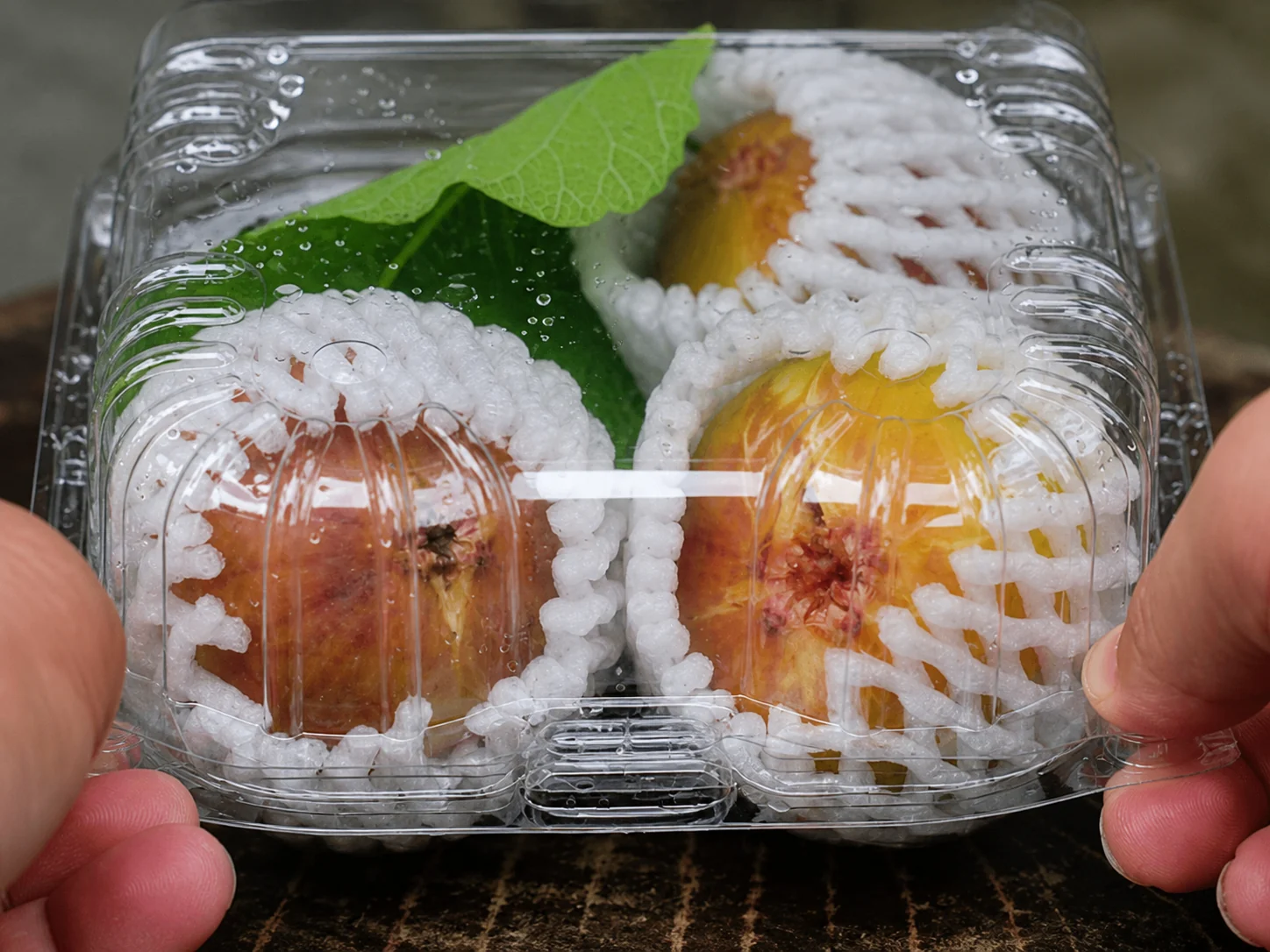
A clamshell is a one-piece disposable plastic food container with a base and lid connected by a hinge. The lid folds over the base and closes with snap locks, tabs, or a tamper-evident feature.
Because the lid is already attached, packing operators don’t need to locate or match a separate component. This simplifies manual packing, reduces the risk of mismatched lids, and keeps the two halves together through consumer use. For operations packing at a counter, packhouse, or bakery, this matters more than it might seem.
Clear clamshells are widely used for blueberries, strawberries, raspberries, grapes, cherry tomatoes, cookies, pastries, muffins, sandwiches, salads, and grab-and-go snacks — products where the food benefits from visibility and all-around enclosure. The molded lid creates defined space above the food, which is particularly valuable for products that shouldn’t be pressed flat: a strawberry calyx, a muffin top, an iced cake slice, or a grape bunch with irregular height.
A properly designed snap-lock clamshell can also be reclosed, which matters for multi-serving fruit, bakery, or snack packs. Reclosability is not the same as tamper evidence, though. A standard snap closure can be opened and closed without leaving visible evidence — if opening security is required, a tear strip or break-off tab must be specified as a separate feature.
The main limitations are practical rather than structural. The open hinge requires workspace at the packing station. Clamshells may also nest and load into cartons differently from flat-stacked trays, which can affect pieces per carton and total freight cost. Neither of these is a reason to avoid clamshells — but both should be evaluated before committing to a format.
Clamshell is a structural description, not a material description. The format is available in PET, rPET, PP, paperboard, and other materials depending on the application.
Tray: A Platform for Sealing and Display
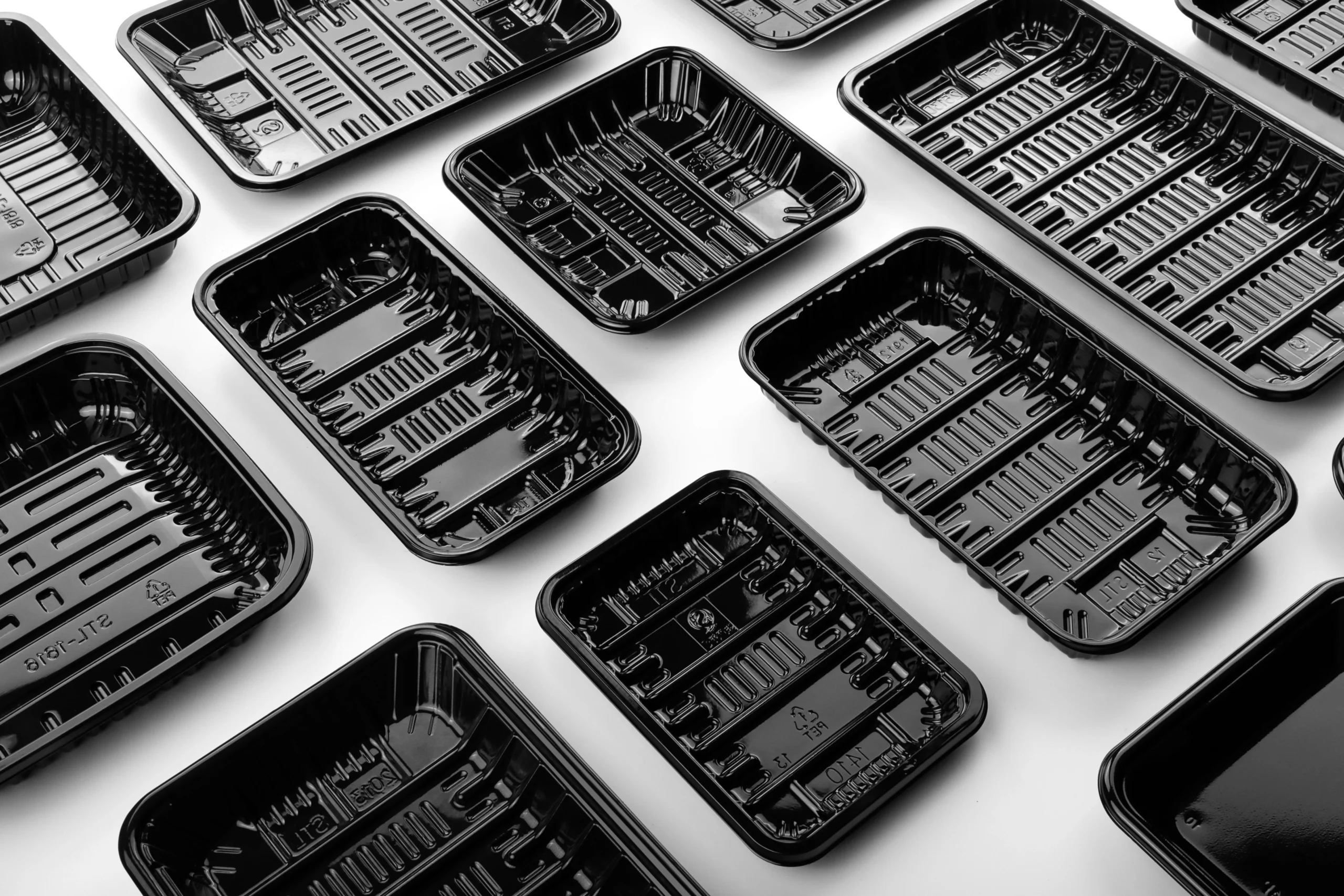
A tray is an open-top structure that supports food from below. It has no integrated lid — closure comes from a separate system: heat-sealing film, stretch overwrap, skin film, or a rigid lid.
This is both the format’s main strength and its main complexity. A tray can become part of several different packaging systems, which makes it adaptable to different packing lines and retail programs. But it means the tray is only one component of the finished package — buyers also need a compatible film, lid, or wrapping material, and the complete system must be tested together.
Trays are common for meat, seafood, vegetables, fresh-cut fruit, sushi, cheese, bakery assortments, prepared foods, and multi-component meals. The broad, flat base allows food to be laid out or arranged rather than stacked vertically, which is important for products where presentation across the surface matters — a selection of sushi pieces, a cheese and charcuterie assortment, or a compartmented meal tray.
For operations with an automatic tray-sealing line, the tray format integrates naturally with filling, weighing, sealing, and labeling in one continuous process. The large film surface also provides branding area that a clamshell lid doesn’t offer.
Seal performance is not automatic. A film-sealed tray is not necessarily airtight, leakproof, or suitable for modified-atmosphere packaging. Seal integrity depends on tray and film material compatibility, rim width and flatness, seal temperature and dwell time, contamination on the sealing surface, fill height, and distribution conditions. Modified-atmosphere packaging requires a validated system — not just a sealed lid.
Compartment trays can separate different foods within one package, but compartment integrity depends on whether the sealing film forms a continuous, reliable seal around each individual section. This must be verified on the actual tray and sealing equipment, not assumed.
Cup: Depth for Portioning and Upright Use
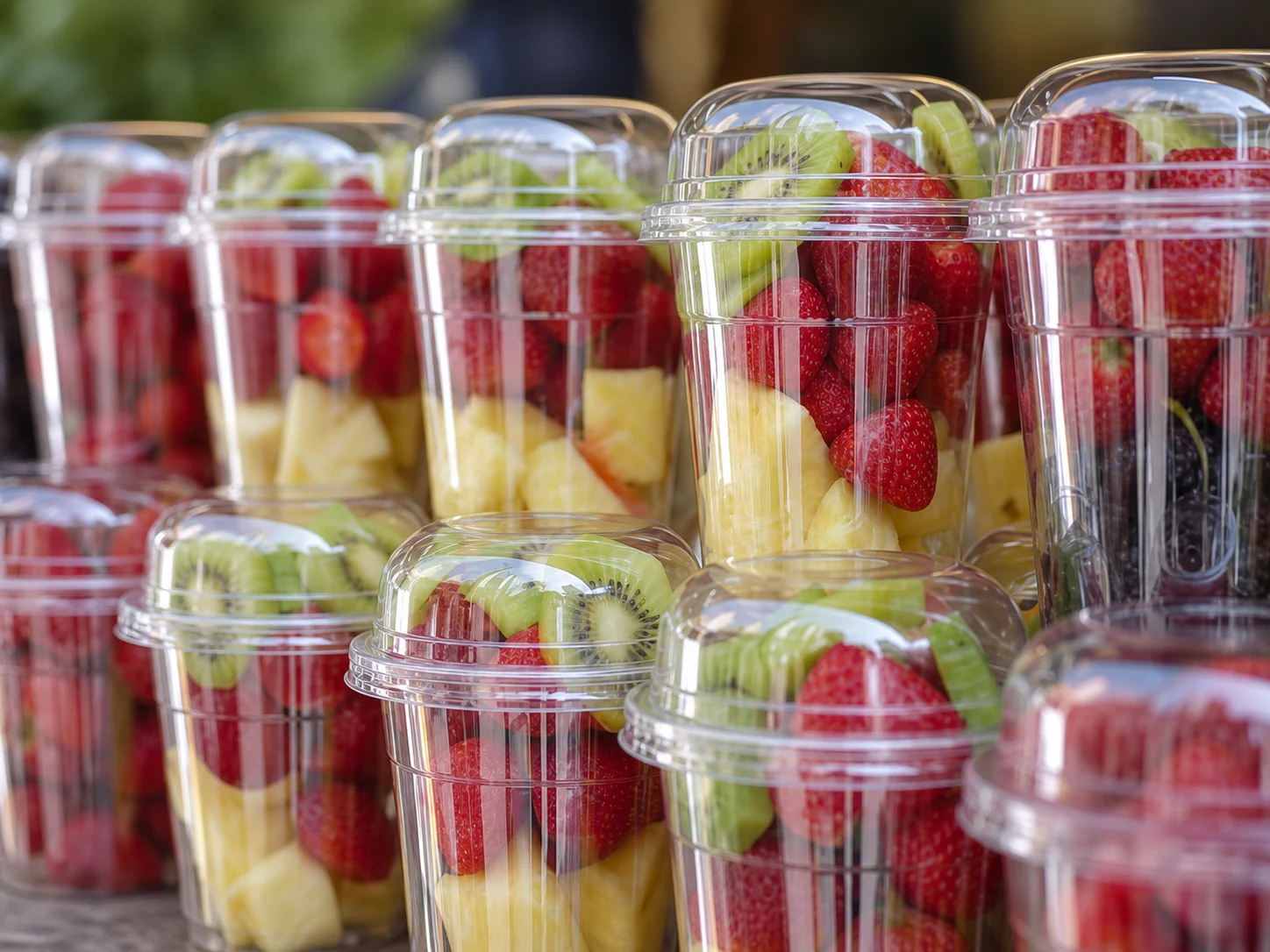
A cup is a deep, upright disposable plastic food container typically closed with a separate lid or sealing film. The defining characteristic is the relationship between depth and opening: cups are designed to be filled vertically, carried easily, and eaten from directly.
This makes them well suited to individual servings of fresh-cut fruit, layered desserts, yogurt with toppings, nuts and snack mixes, deli portions, and grab-and-go salads. The single-serve format is easy to communicate in ounces or milliliters, which suits both retail pricing and foodservice portioning.
The opening diameter is an important design variable. A narrower cup is easy to carry but inconvenient for large fruit pieces or mixed salads. A wider cup improves access but uses more shelf space and may require a different lid system. A cup with an internal insert can separate toppings, sauces, or utensils from the main food until consumption — but the insert, cup, and lid must be checked as a complete system for fit and transport stability.
Cups are not automatically leakproof. Performance depends on the rim-and-closure system, not the shape. Deep cups may also allow delicate foods at the bottom to carry the weight of upper layers, which matters for soft fruit, fragile desserts, or foods that release juice. Because the opening is smaller than a tray’s surface, cups are less suitable when food needs to be carefully arranged across a broad display area.
A cup should not be assumed suitable for hot liquids based on shape alone. Hot-food suitability depends on the material, lid specification, and finished-container testing.
The Same Food Can Use More Than One Format
Food category alone rarely determines the final choice. The same food may need different packaging depending on portion size, retail channel, and packing process.
Fresh-Cut Fruit
A cup suits a single-serve portion meant to be carried and eaten directly. The upright shape works for mixed fruit pieces and can accommodate a fork or topping insert.
A tray suits arranged fruit, compartment packs, or automated film-sealed production.
A clamshell suits a larger reclosable portion or products with irregular height that need clearance above the food.
Whichever format is chosen, closure security, drainage, processing hygiene, and uninterrupted refrigeration remain essential for cut fruit.
Bakery and Desserts
A clamshell protects muffins, pastries, and decorated products that need clearance and surrounding enclosure.
A tray suits flat assortments, cookies, and sliced products that will be overwrapped or film-sealed.
A cup suits layered desserts, mousse, parfaits, or individual portions presented with toppings or inserts.
Salads and Cold Ready-to-Eat
A clamshell works for salads needing a hinged reclosable lid and sufficient internal space for leafy ingredients.
A tray suits ingredients laid out or divided into several compartments.
A cup suits a smaller grab-and-go salad where the consumer eats directly from an upright container.
Evaluating the Complete Packing Operation
An empty container sample doesn’t reveal the full cost or performance of a format. Buyers should compare how each option moves through the real operation.
Manual packing: Clamshells are convenient because the lid is already attached — operators fill, close, and label one component. Separate trays and cups nest more compactly but require a matching lid or film, which adds a step and a separate SKU.
Automatic packing: Trays and cups commonly enter lines as nested stacks, separated by a denester before filling and sealing. Clamshells can also be automatically processed, but the hinge and open lid affect machine layout and orientation. Automatic-line compatibility must be tested with production samples — rim consistency, nesting pitch, wall rigidity, and static behavior all affect line speed and reliability.
Component inventory: A clamshell combines base and lid into one SKU. A tray or cup may require a separate lid, sealing film, label, insert, and sleeve. The complete bill of materials should be compared — fewer rigid-plastic components don’t necessarily mean a simpler or cheaper packaging system.
Carton and freight efficiency: Different formats nest and load differently. A separate tray can often nest deeply; a hinged clamshell may need more carton volume. Buyers should request pieces per carton, carton dimensions, cartons per pallet, and pallets per container. These values can affect landed cost more than a small difference in unit price.
StlPak manufactures PET and rPET clamshells, trays, and cups across more than 600 existing designs, which means most projects can start by comparing available formats before committing to custom tooling. Filled samples should be tested under actual packing, storage, and transport conditions before bulk orders are confirmed.
Common Selection Mistakes
Choosing by nominal capacity. Two containers with the same stated volume can have completely different depths, openings, and internal shapes. The actual food determines whether the container fits.
Assuming every tray can be heat-sealed. A tray requires a compatible rim, material, film, and sealing process. Some trays are designed only for overwrap or separate lids.
Assuming every cup is leakproof. Leak resistance comes from the rim-and-closure system, not the shape.
Assuming every clamshell is tamper-evident. A standard snap lock can be opened and closed without visible evidence. A dedicated tamper-evident feature is a separate design requirement.
Ignoring packing-line compatibility. A container suitable for the food may not run reliably on the available denester, filler, or sealer.
Comparing unit price instead of total cost. Total cost includes lids, films, labels, inserts, cartons, storage, packing labor, and freight. A cheaper empty container can become more expensive once all components and operational costs are included.
Frequently Asked Questions
Is a clamshell better than a tray for food packaging? Neither is universally better. A clamshell is more convenient when an attached reclosable lid and all-around protection are the priority. A tray is generally more suitable when the food needs to lie flat, be arranged across a surface, or enter a sealing or wrapping process. The right choice depends on the food, closure requirements, and packing line.
Which format is best for fresh-cut fruit? A cup suits individual grab-and-go portions. A tray suits arranged fruit, compartment packs, and film-sealed production. A clamshell suits larger reclosable portions or products needing clearance above the food. Closure security, drainage, hygiene, and refrigeration are essential for all three.
Are film-sealed trays airtight? Not automatically. Seal integrity depends on tray and film compatibility, rim quality, seal settings, fill height, and distribution conditions. Modified-atmosphere packaging requires a validated complete system, not just a sealed lid.
Can cups be sealed with film? Yes, if the cup material, rim geometry, film, and sealing equipment are compatible. Other cups are designed for snap-on flat lids, dome lids, or tamper-evident rigid lids. Compatibility must be confirmed.
Does the format determine the material? No. Clamshell, tray, and cup describe structure. Each format can be manufactured from different materials. Food temperature, heating requirements, and market regulations determine the material specification — not the container shape.
Which format uses the least plastic? There is no universal answer. Total material use depends on wall weight, lid or film, label, and other components. A film-sealed tray may use less rigid plastic than a clamshell but still require film, label, and other materials. Compare the full bill of materials, not just the empty container weight.
StlPak supplies PET and rPET clamshells, trays, and cups for fresh produce, fresh-cut fruit, bakery, salads, snacks, and cold ready-to-eat applications. To recommend a suitable starting option, we typically need a photo or sample of the food, the target portion weight, filling and storage temperatures, closure requirements, packing method, and estimated order quantity. Share your project details and we can identify existing formats for sample testing or evaluate whether a custom structure is needed.