
Choosing the right tamper-evident food container starts with the food itself — not the capacity number on the product list.
A 16 oz container can hold very different amounts of nuts, sliced strawberries, or mixed salad, because food density, piece size, and how the product settles all affect the actual fill. Two containers with the same nominal volume may also have completely different proportions: one wide and shallow, one narrow and deep. The right choice depends on what the food looks like after filling, whether the lid closes with adequate headspace, and whether the container performs through your packing process, cold storage, and delivery route.
This guide covers clear PET and rPET food containers with an integrated tear-off strip — the format StlPak produces. It explains how to match the container to the food, the packing operation, and the retail or distribution requirement. For other formats and applications, compare StlPak’s broader Disposable Plastic Food Containers range. Projects involving prepared salads can also use the salad and ready-to-eat packaging guide, while structural comparisons are covered in the food container design guide.
Start with the Food, Not the Capacity
The most reliable way to begin is to fill a sample container with the actual product at the target net weight and observe what happens. Does the food sit at a natural height with enough headspace for the lid to close? Does the lid press against the product before it fully engages? Does the food look appropriately full, or does it appear sparse inside the container?
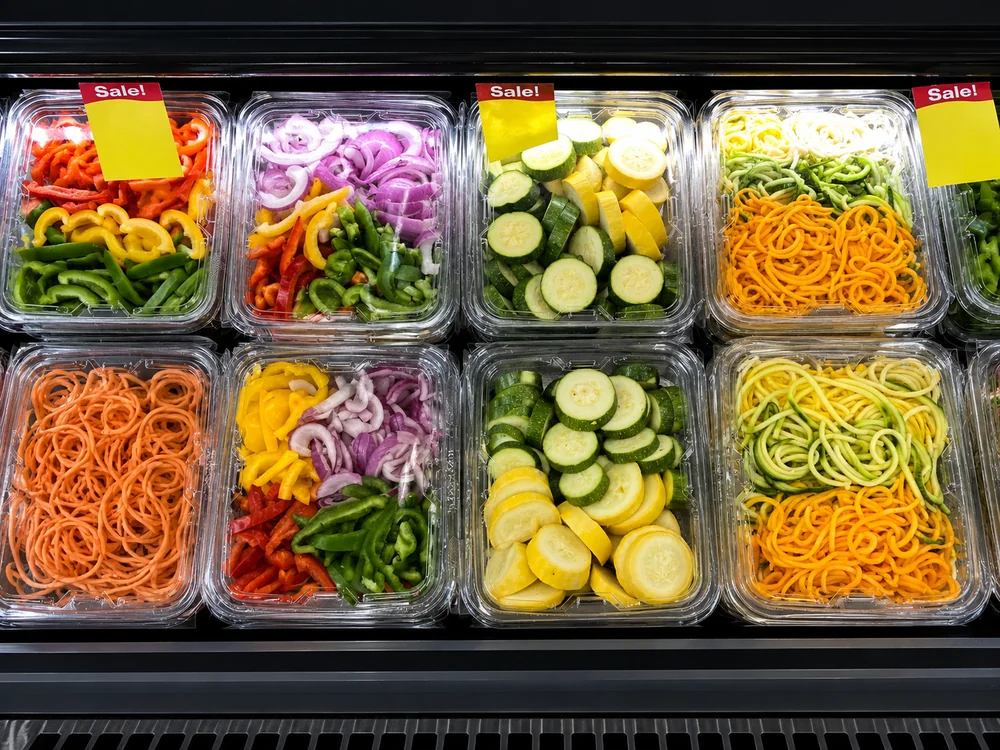
Food density creates most of the variation. Dense products like nuts, cheese cubes, and dried fruit fill a container compactly and predictably. Loose products like salad leaves, mixed fruit, and bakery items occupy much more volume for the same weight, and they settle differently between fills. This means that fill height — not net weight — is the real input for container selection.
Moisture content matters for a different reason. Dry products mainly need secure closure and suitable dimensions. Wet or oily products — fresh-cut fruit, deli salads, cheese with brine, prepared foods with dressing — can release liquid toward the closure edge during handling or transport. Tamper evidence and leak resistance are separate functions: the tear-off strip shows whether the container has been opened, but it does not make the container leakproof. For wet products, leak performance needs to be tested separately using the actual food under realistic conditions.
Temperature is the third variable. PET and rPET tamper-evident containers are suitable for cold, chilled, and ambient food applications — fresh-cut fruit, salads, sandwiches, nuts, bakery, cheese, deli items, desserts, and ready-to-eat meals. They are not standard choices for hot filling or microwave use. If the food will be packed or stored at elevated temperatures, confirm the temperature range before selecting the material.
Dimensions: Length, Width, and Depth Together
Nominal capacity is a starting point. The actual internal dimensions determine whether the food fits correctly.
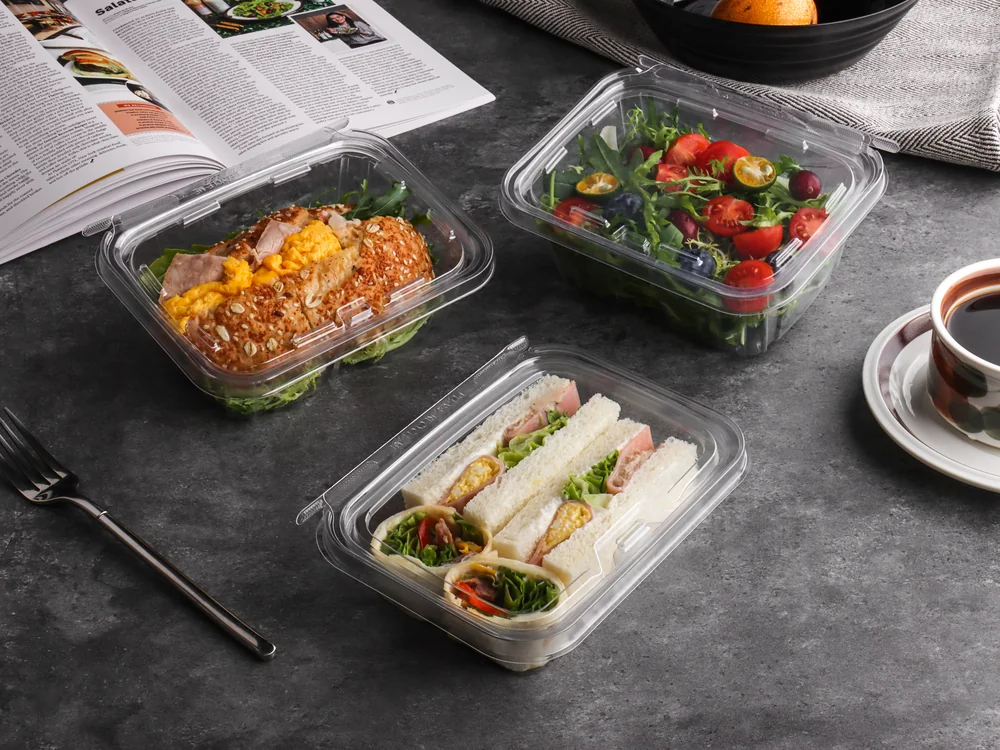
Length and width affect how the food is arranged and presented. Wider containers suit sandwiches, sliced fruit, and products that should be displayed side by side. Narrower containers may work better for dense snacks or portion packs where visual depth matters more than spread. External dimensions also affect label placement, shelf footprint, and how many units fit per carton layer.
Depth is where most selection errors happen. A container that’s too shallow compresses the food or prevents the lid from closing correctly. One that’s too deep makes a normal portion look insufficient and allows the food to shift during transport. The right depth provides enough space for the food to sit naturally, enough headspace for the lid to close without contacting the product, and enough structure to keep the food stable through handling.
Headspace deserves specific attention. Insufficient headspace causes incomplete closure, pressure against the lid, difficulty engaging the tear-off strip, and damage to delicate products. Excessive headspace makes the pack look underfilled and allows movement. The correct amount varies by product — a delicate bakery item needs more clearance than cheese cubes, and a loose salad needs room for leaves without the food compressing under the lid.
One practical point: filling is never perfectly consistent. Fruit pieces vary in size, salad leaves settle differently between packs, and manual or automatic weighing systems have normal tolerances. The container should close reliably across this variation, not only when the food is arranged precisely. A container that works only under ideal fill conditions is not a production solution.
Compartment Layout
The number of compartments should match how the food is sold and consumed, not just the total volume required.
A single-compartment container provides the largest continuous filling area and suits one product or a mix where the components can touch — salads, nuts, sandwiches, bakery, dried fruit, and most prepared foods. It’s also simpler to fill and usually provides more usable volume than a divided container of the same overall size.
StlPak’s STL-2G (two-compartment) suits combinations where separation matters: fruit and dip, sandwich and side item, cheese and crackers, or two different snack products. The STL-3G (three-compartment) adds a third section for combinations like three fruit types, cheese with nuts and dried fruit, or a sandwich with two sides. The STL-4G (four-compartment) works for mixed fruit assortments, tasting portions, or snack combinations that benefit from clearer visual separation.
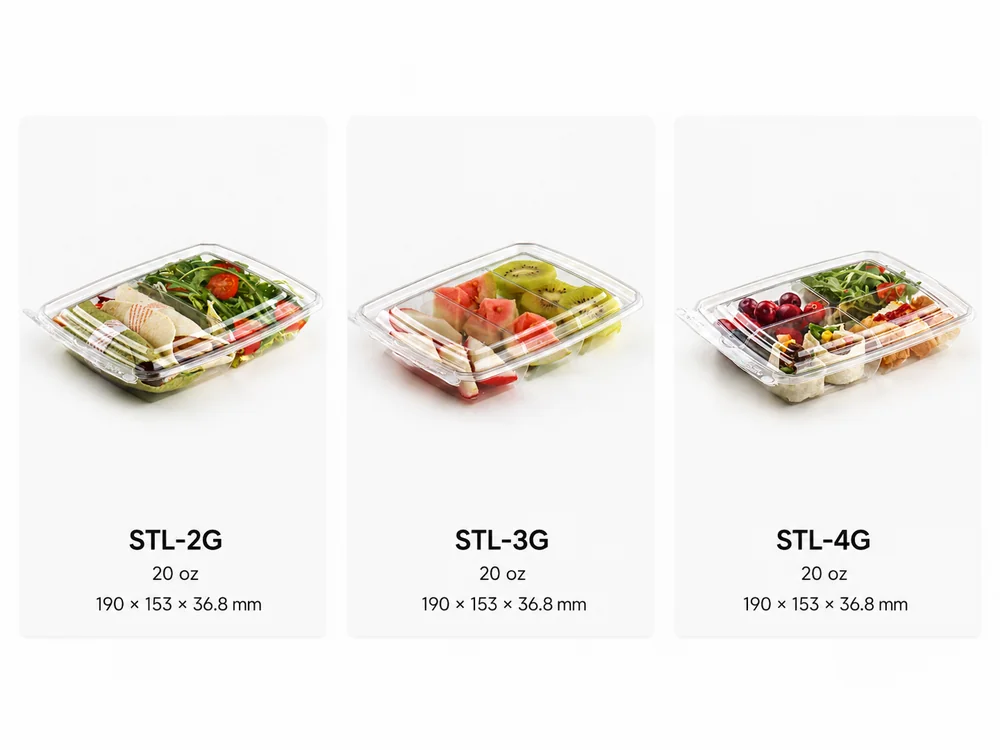
When selecting a divided container, confirm the usable volume of each individual section against the planned portion. A large total capacity doesn’t mean each compartment will hold what you need — and food pieces that don’t fit naturally into a section will either compress against dividers or prevent the lid from closing.
Tear-Off Strip and Reclosure
The tear-off strip is formed directly into the container during thermoforming — not applied as a separate label or band. When the lid is fully closed, the strip blocks normal access to the opening point. The consumer must remove it before lifting the lid, leaving a visible and irreversible change.
Two things need to be confirmed during selection. First, the strip must remain intact through your packing process, carton loading, cold storage, and delivery — it should not break prematurely from handling. Second, the container should not allow the lid to be lifted from a corner or side edge while the strip is still intact. If it does, the tamper evidence is easily bypassed. Both should be tested before ordering.
Reclosure is a separate question. In many container designs, the tear-off strip provides the first-opening indication while a remaining snap-fit structure holds the lid afterward. This allows the consumer to close the container again after accessing the food — useful for nuts, fruit, cheese, bakery, and snacks consumed across multiple occasions. In other designs, removing the strip also weakens the main closure, and reliable reclosure is no longer possible.
Reclosing after opening does not restore the original tamper-evident condition. The missing strip remains visible. It also does not restore the original sealing performance — the lid may close, but the fit after reopening may differ from the factory-closed state. For wet or oily products, this matters. Reclosure requirement and post-opening sealing performance should both be confirmed through testing.
PET or rPET
PET offers strong optical clarity and material stiffness — well suited to retail foods where product visibility drives purchase decisions. rPET contains recycled content and suits programs with specific recycled-content targets, retailer material policies, or market-level requirements.
Performance between the two is comparable for most tamper-evident food container applications. The decision usually comes down to recycled-content percentage, documentation requirements, and target-market expectations rather than container performance. When rPET is required, confirm the target percentage, transparency expectations, traceability documentation, and whether GRS certification or other supporting materials are needed before production.
Packing Process, Stacking, and Carton Fit
A container that closes correctly during occasional hand testing may not perform the same way at production speed or on a semi-automatic line. For manual packing, operators need to align the lid quickly, apply even pressure across the full closure edge, and reliably identify incomplete closure. For machine-assisted packing, confirm container dimensional consistency, equipment gripping points, closing pressure position, and whether the tear-off strip interferes with guides or tooling.
Stackability affects both retail display and transport. Test with filled containers — empty containers don’t represent the same weight or deformation conditions. Check whether stacked lids align without sliding, whether the upper container presses onto the food below, and whether the tear-off strip or pull tab catches on the container beneath.
Carton fit determines freight efficiency. A slightly larger container may reduce the number of units per carton and increase shipping cost. Confirm the number of containers per layer, number of layers, total carton quantity, and whether the container orientation needs to change to fit the planned carton dimensions.
How to Test Before Ordering
Sample testing is the most reliable confirmation before committing to a bulk order. Run these checks with the actual food, not an empty container:
- Fill test: Place the target net weight into the container. Check fill height, headspace, product arrangement, and whether the food contacts the lid.
- Closure test: Close using your planned production method. Confirm lid alignment, closing pressure, full edge engagement, and strip integrity.
- Opening test: Remove the strip and evaluate pull tab visibility, required force, tear path continuity, and how clearly the first-opening evidence shows.
- Bypass test: Try lifting the lid from corners and side edges while the strip is intact. Normal access to the food should not be possible without visibly damaging the strip.
- Reclosure test: If reclosure is required, close the lid after opening. Check how firmly it re-engages and whether the missing strip remains clearly visible.
- Leak test: For wet or oily foods, test under expected storage and transport conditions — upright, tilted, and under handling vibration.
- Stack and transport test: Pack filled containers into the planned carton and simulate stacking, chilled storage, and delivery conditions.
What to Share When Requesting a Recommendation
A request for “a 16 oz tamper-evident box” doesn’t give a supplier enough to work with. The more specific your inputs, the more accurate the recommendation:
Food type and target net weight; approximate product dimensions and natural filled volume; storage temperature and whether the food is dry, moist, oily, or juicy; required number of compartments; reclosure requirement; label dimensions and placement; carton dimensions; manual or automatic packing method; target market; and estimated order quantity.
Tamper-evident containers are designed for ready-to-eat and prepared food. For whole fresh fruit such as berries and grapes, vented fruit punnets are the more common retail format.
Common Questions
Should I choose by ounce capacity or fill weight?
Fill weight and food dimensions together. The same nominal capacity produces very different results across food types. Test with the actual product.
Can the same container work for fruit, salad, and snacks?
Possibly, but each product should be tested separately. They occupy internal space differently and have different headspace and moisture requirements.
Are PET tamper-evident containers suitable for hot food?
Standard PET containers are intended for cold, chilled, or ambient applications. Confirm the temperature range if the food will be packed or stored at elevated temperatures.
Does removing the tear-off strip mean the lid is unusable?
Not in most StlPak designs. The remaining snap-fit structure allows the lid to be closed again. The original tamper-evident condition cannot be restored, and post-opening sealing performance may differ from the factory-closed state.
Does tamper-evident mean leakproof?
No. These are separate properties:
| Property | What it means |
|---|---|
| Tamper-evident | Shows whether the container has been opened |
| Reclosable | Allows the lid to be closed again after opening |
| Leak-resistant | Reduces the risk of liquid escaping |
| Airtight | Restricts air movement through the closure |
Test each property separately against the actual food and distribution conditions.
Do I still need a security label if the container has an integrated strip?
An integrated strip may be sufficient. Additional labels or seals may still be required by the retailer, brand, or target market — or where the label is also carrying product or traceability information.
Can containers be customized?
Depending on the project, dimensions, depth, material weight, compartment layout, label area, and closure details can be customized. Check existing molds first — they reduce lead time and tooling cost.
—
StlPak supplies clear PET and rPET tamper-evident food containers with integrated tear-off strip closures, including single-compartment designs and the STL-2G, STL-3G, and STL-4G divided formats. Share your food type, fill weight, storage conditions, packing method, and carton requirements — and we’ll recommend the most suitable existing model or discuss customization where needed.