
A 500 g blueberry pack, a 500 g grape pack, and a 500 g cherry tomato pack can carry identical net weight and still behave completely differently once they’re inside a container. The fruit may be loose or bunched on stems, small or large, evenly distributed or irregularly shaped — it may stack into many layers, leave large internal gaps, or need to be held in a fixed position. That’s why clear PET fruit containers come in so many shapes: a shallow berry punnet, a deeper grape clamshell, and a molded cavity pack for apples or kiwi are all built from the same material to solve entirely different packaging problems. The simplest way to understand fruit container design is to start with the fruit itself, not the catalogue.
Explore StlPak’s broader Disposable Plastic Food Containers range when comparing formats and applications.
Related guidance: fresh-cut fruit packaging; food container design by application.
Pack Weight Doesn’t Determine Container Shape
Buyers searching for fruit packaging usually lead with capacity — a 125 g container, a 500 g box, a 1 lb clamshell. Weight matters, but it doesn’t define shape, because two fruits at the same target weight can occupy very different volumes, form different numbers of layers, and place very different loads on the structure. A more useful starting point is asking whether the fruit is loose or connected in a bunch, how large each piece is, how many layers will form inside the container, how easily the fruit moves during handling, whether each piece needs its own fixed position, and how much usable depth that requires. These questions — more than the target weight alone — are what actually explain why different fruit categories end up with such different PET container structures.
How Different Fruits Occupy the Same Space
Net weight tells you how much fruit is inside a pack; it doesn’t tell you how that fruit fills the space. The table below shows the pattern across four common categories before getting into why each one behaves the way it does.
| Fruit | Retail Weight | How It Sits in the Container | Typical Structural Direction |
|---|---|---|---|
| Blueberries | 125 g / 250 g / 500 g | Many small loose fruits, stacked in layers | Compact, relatively shallow punnet |
| Grapes | 1 lb / 2 lb / 3 lb | Irregular bunches with stems | Deeper clamshell with stronger support |
| Cherry tomatoes | 250 g / 500 g | Larger loose round fruits | Proportions that control excess movement |
| Apples / kiwi | By count or pack weight | Several large individual fruits | Molded cavity container |
Berries: Why Punnets Stay Shallow
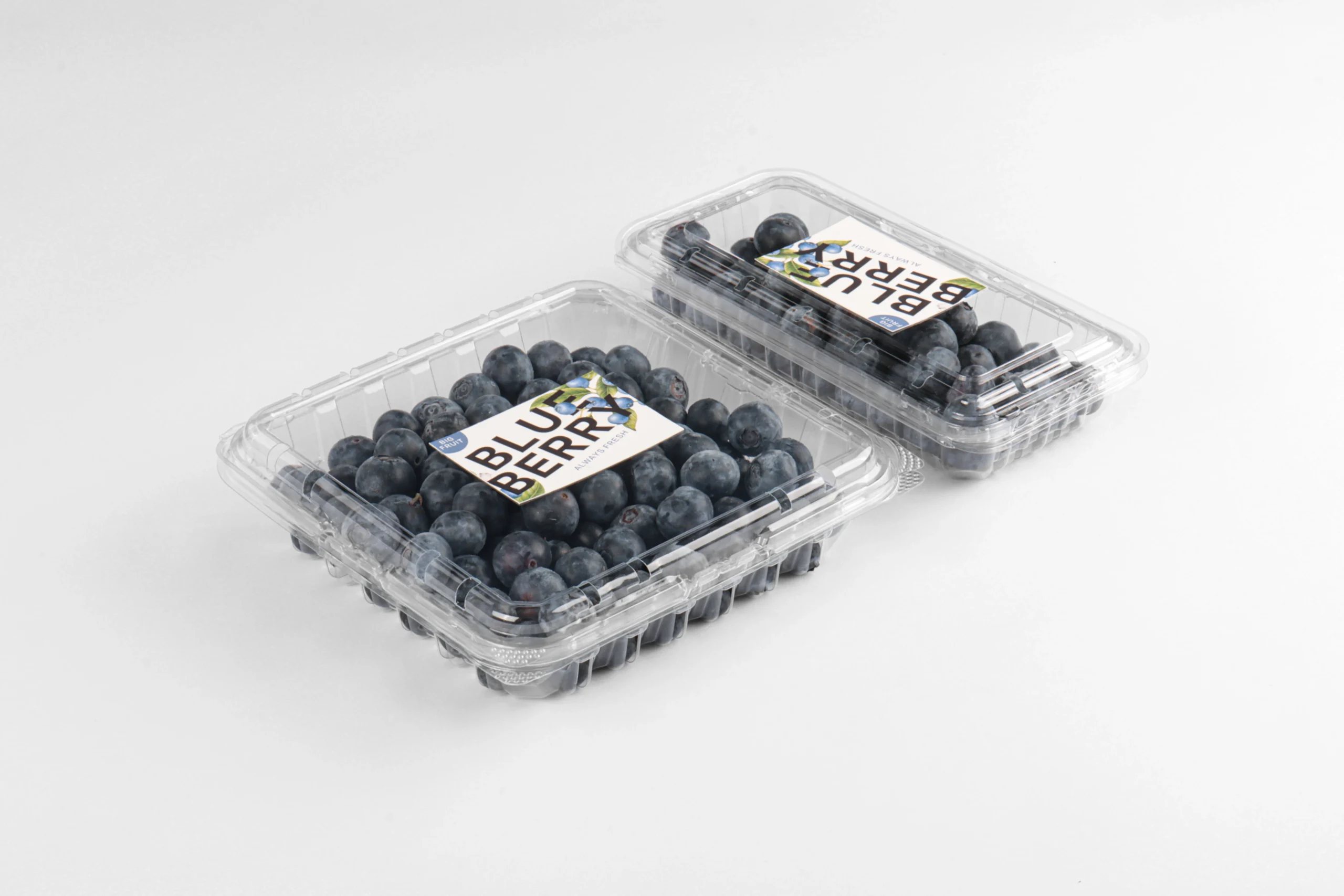
Blueberries, raspberries, and similar berries are made up of many small individual fruits that naturally stack into multiple layers once packed. That relationship between footprint and depth matters more than it might seem: a container that’s unnecessarily narrow and deep forces more layers to form, and the berries at the bottom end up carrying the weight of everything above them. A wider, shallower container spreads the same net weight over a larger area instead — which is why most berry punnets stay compact and shallow rather than tall. Two 125 g blueberry punnets can hold the same net weight with noticeably different proportions — one wider and shallower, another with a smaller footprint and more depth — and the berries will settle differently inside each one, so it’s worth looking past the stated capacity to the internal length, width, usable depth, and clearance under the lid. Our Blueberry Packaging for Retail & Export guide and Blueberry Punnet Sizing & Vent Checklist go into these specifications in more detail.
Grapes: Why Bunches Need More Depth
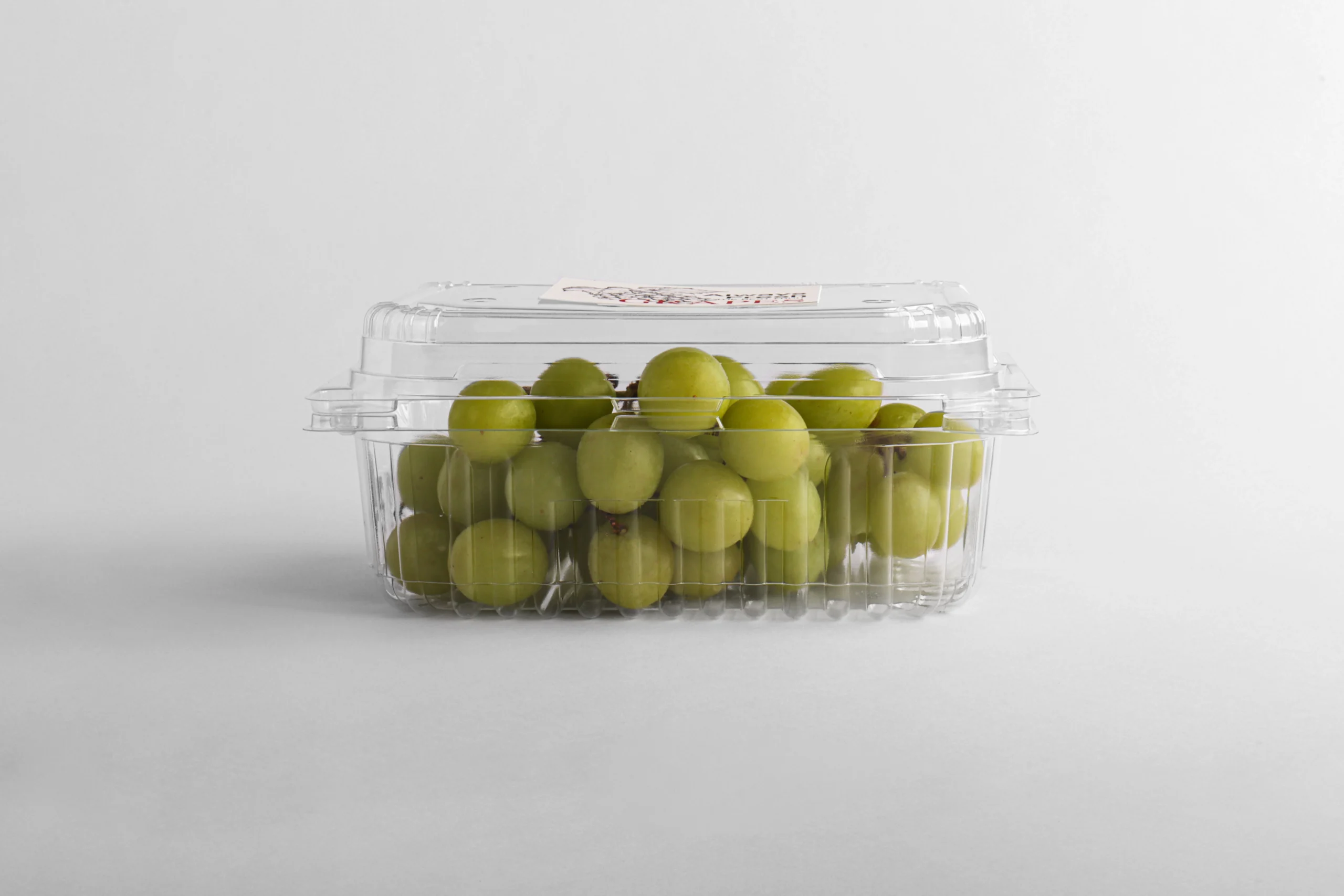
A grape clamshell isn’t just a larger blueberry punnet. Blueberries pack as individual loose fruits, but grapes pack as irregular bunches connected by stems — different bunch widths and heights, stems extending above and between the fruit, and irregular empty pockets throughout the pack. That’s why grape packaging generally needs more usable internal depth than berry packaging: the container has to accommodate the full bunch profile without forcing the lid down onto the fruit. Weight adds another layer to this, since grape packs commonly move into heavier 1 lb, 2 lb, or 3 lb formats, which means the base, sidewalls, rim, and closure all need enough support for handling and stacking as fill weight climbs. This is why “we need a 2 lb clamshell” isn’t quite enough information for a supplier — the approximate bunch size and pack style matter too, since even two grape varieties at the same retail weight can fit very differently depending on berry size and bunch profile. StlPak’s grape clamshell container range shows the range of formats this produces.
Cherry Tomatoes: Why Proportions Change With Fruit Size
Cherry and grape tomatoes are also packed loose, but they don’t behave like blueberries. Each fruit is larger and heavier, so fewer pieces are needed to reach the same target weight, and larger gaps remain between them — and because tomatoes are round, they can roll and reposition inside an oversized container far more easily than berries do. That movement, plus how much empty space is left and whether the top layer reaches the lid, all comes down to container footprint and depth. A 500 g blueberry pack holds hundreds of small berries that naturally settle into small gaps; a 500 g cherry tomato pack holds far fewer, larger fruits that don’t fill space the same way — which is exactly why “500 g fruit container” shouldn’t be treated as one standardized shape. The fruit determines whether the proportions actually make sense.
Apples and Kiwi: Why Individual Cavities Make Sense
Once fruit gets large enough, the packaging logic changes completely. Instead of letting several pieces share one open internal space, the container can hold each fruit in its own defined position — the principle behind molded cavity fruit containers, where fruit diameter, cavity depth, and clearance under the lid matter more than pack weight. Each fruit sitting in its own cavity means it can’t roll into its neighbors, and it also shifts the whole sourcing conversation: a buyer isn’t really asking for “500 g of kiwi packaging” so much as a 3-cavity kiwi container or a 4-piece apple clamshell. That’s a move from volume-based packaging to position-based packaging. StlPak’s apple containers and kiwi packaging show what this cavity-based structure looks like in practice.
Shape Is Only Part of the Picture
Container geometry answers one question — how the fruit physically fits and behaves inside the package. It doesn’t answer a separate one: how the package should interact with the fruit after it’s packed. Fresh produce keeps respiring and releasing moisture after harvest, so ventilation, condensation control, cooling, and distribution time all need their own consideration, and they influence vent location and vent area independently of container shape. We cover that side of the decision in How Does Packaging Affect Fruit Ripening and Shelf Life? — it’s worth keeping the two topics separate rather than assuming solving one solves the other.
Start With the Fruit, Not the Catalogue
The most useful thing a buyer can do is send the supplier information about the actual fruit before comparing capacities. That means sharing the fruit type and variety, target pack weight or fruit count, approximate fruit diameter or bunch dimensions, current packaging dimensions and photos if available, and any required retail or carton format. With that information, it’s usually much easier to shortlist existing molds worth sampling — for most projects, an existing container already meets the requirement without any new tooling. The final choice should still be tested with the actual fruit, since a container that looks right empty can behave very differently once it’s filled. StlPak offers a broad range of fruit punnets and PET fruit packaging containers for berries, grapes, tomatoes, apples, kiwi, and other fresh produce — and the goal in choosing between them isn’t finding a box with the right stated capacity, but finding the shape that matches how your fruit actually fits, moves, and carries weight inside the package.