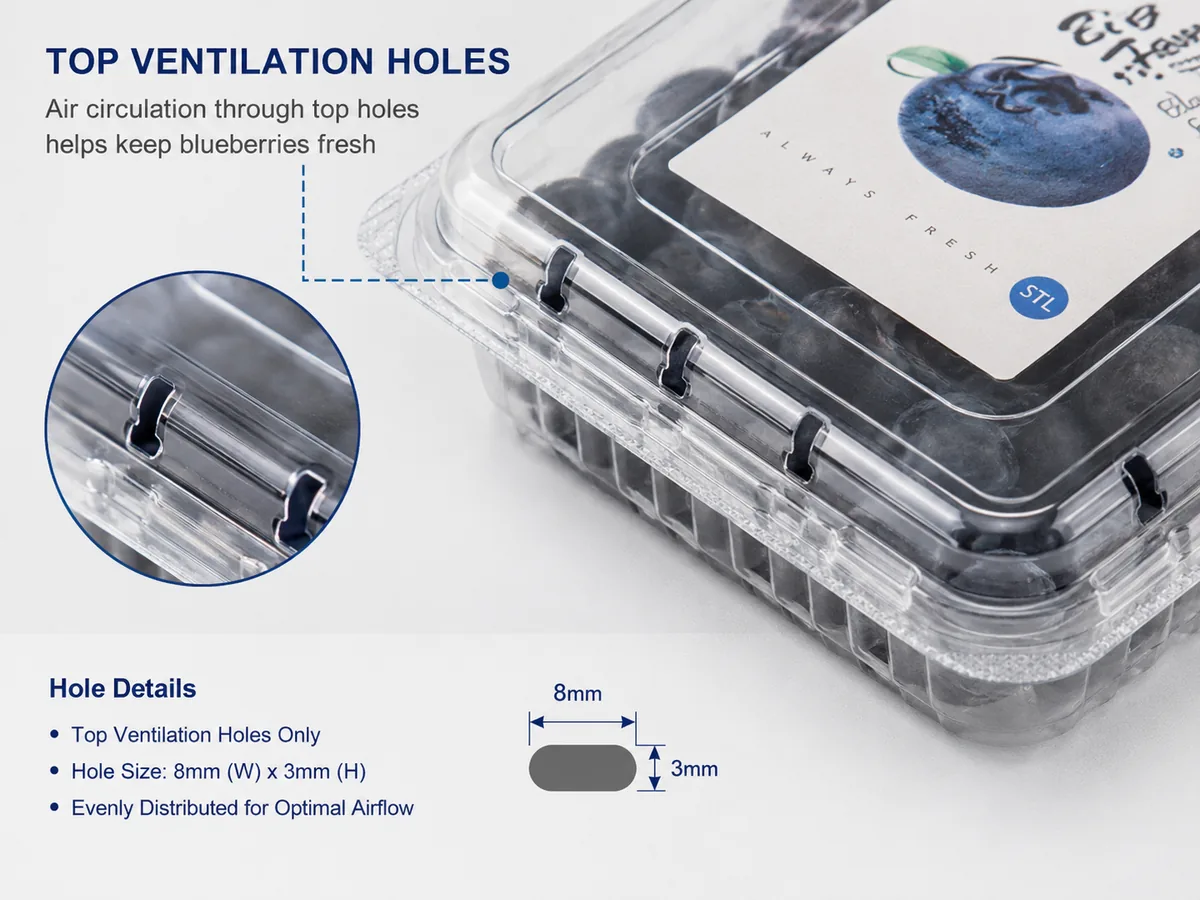
Most buyers choose a blueberry punnet by pack weight. They confirm the grams, check the dimensions fit the carton, and place the order. Then at receiving they find compressed bottom layers, broken seals, or condensation pooling inside the pack.
The weight was never the problem. The problem is that a punnet is a system, not a container.
Start with the fruit, not the spec sheet
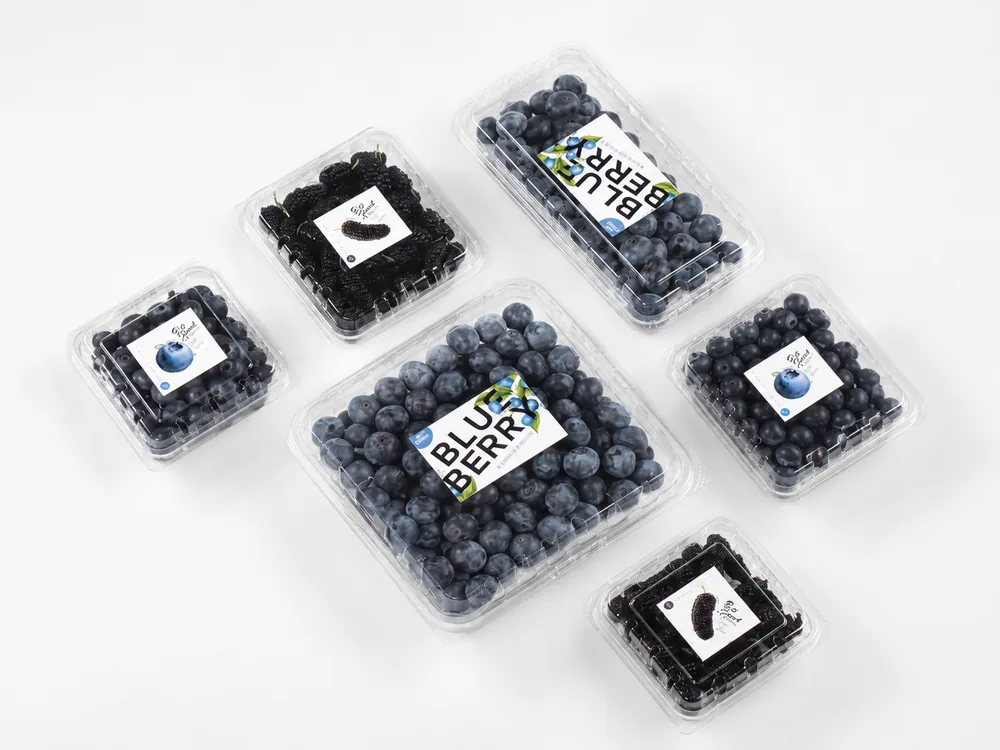
The same 250g punnet can behave completely differently depending on berry size.
Large-caliber blueberries build height fast and leave more air between them. Smaller berries pack tighter. If you select by weight alone, a punnet that fits perfectly in early harvest may crush the top layer once fruit size increases later in the season — or sit visibly underfilled when smaller berries come through.
The only reliable test is to fill the pack with real fruit at your target weight, close the lid, and look at the clearance above the top layer. Berries should not be pressed against the lid. But they should not have enough room to roll freely either. That window between the two is what you are actually selecting for.
Common retail formats as a starting point:
| Pack Weight | Typical Use | Key Consideration |
|---|---|---|
| 125g | Premium or snack packs | Display clarity, fill height |
| 250g | Standard supermarket | Depth, closure, airflow |
| 300g | Promotional formats | Stacking strength, headspace |
| 500g | Family or value packs | Structural rigidity, seal reliability |
These are starting points. They are not universal standards. StlPak offers multiple blueberry punnet formats across these weight ranges — including the 125B1 transparent PET punnet for premium retail, the 250B1 vented clamshell for standard supermarket, and the 401U large-capacity punnet for value packs. Each is designed with different depth, vent layout and stacking characteristics — not just different dimensions.
External dimensions tell you almost nothing useful
Many buyers measure the outside of a sample and calculate carton fit. That is the easiest way to miss what matters.
A recessed lid, structural ribs, a raised base, or a wide closure rim can all reduce usable internal depth — sometimes by several millimetres. Two punnets with identical external dimensions can have meaningfully different fill depths. A supplier should be able to tell you the effective fill depth directly, not just hand you a drawing with outer measurements.
On overfilling: packs that look generous at the packing table become a liability in transit. The lid may not close evenly. Bottom-layer berries carry load they were not designed for. Under carton compression, seals open and juice leaks. On underfilling: fruit moves during handling, bloom gets rubbed off, and the pack looks depleted on the shelf before anyone has touched it.
Test under real conditions. Fill the pack, close it, put it in the carton, stack it, and watch where the load goes. If it goes through the fruit, the pack does not work.
More ventilation holes is not better ventilation
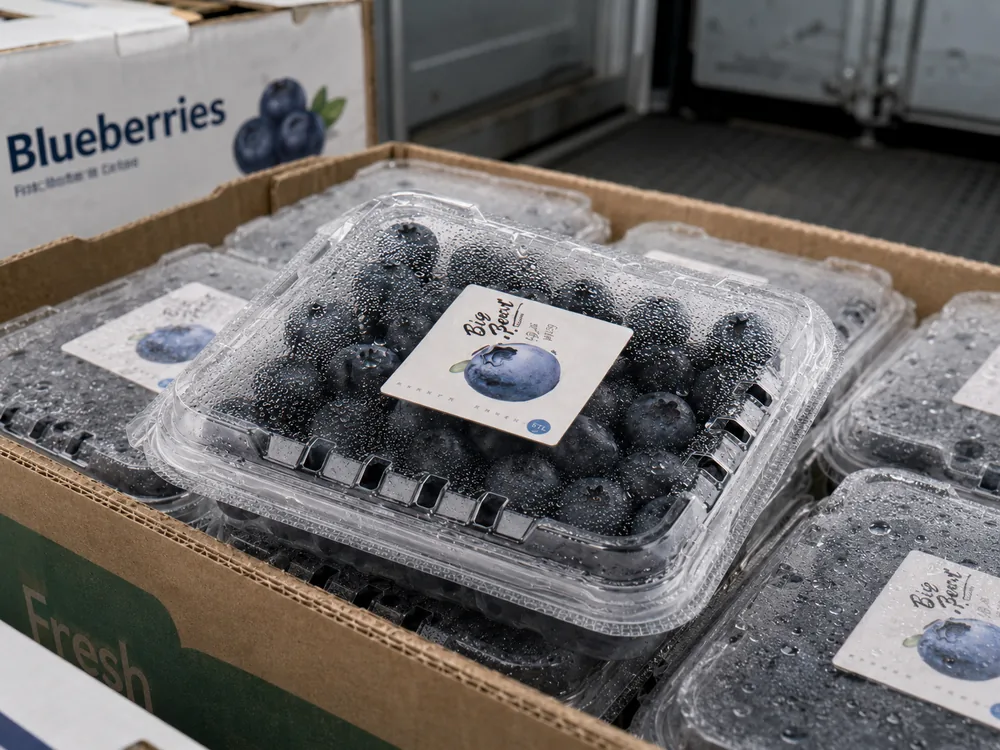
Vent holes exist to let cold air move through the pack, carry heat away from the fruit, and reduce moisture buildup. Cut too many, and the container goes soft. It deforms under stacking load, which defeats the purpose.
The more important question is whether the vents actually work in your specific carton configuration.
Lid vents help the top layer breathe — unless a neighboring carton is sitting directly on top of them. Side vents matter most for cross-flow during forced-air cooling — unless a carton wall, divider, or label is covering them. Base vents can help the bottom layer, but the base also carries the fruit’s weight, so there is a limit to how much you can open it up.
Ventilation only works as a path. Air needs a way in, a route through the packed rows, and a way out. A punnet that looks well-vented in isolation can be effectively sealed once it is loaded into a carton. Evaluate the whole configuration, not the punnet alone.
Common failure modes:
| Issue | Likely Result |
|---|---|
| Insufficient open area | Slow cooling, condensation buildup |
| Side vents blocked by carton walls or labels | No cross-flow through packed rows |
| Excessive perforations | Reduced rigidity, deformation under load |
| Vent position misaligned with carton cutouts | Cold air bypasses the fruit entirely |
There is no universal vent pattern. Pack weight, cooling method, carton design, stacking height, and transport duration all affect what you actually need. StlPak designs clamshell packaging with vent layouts optimized for forced-air cooling — not just cosmetic perforations.
Local retail and export are not the same problem
For local supermarket delivery, the priorities are shelf appearance and handling convenience. Mechanical demands are relatively forgiving.
Export is a different situation entirely. Weeks in refrigerated transit, repeated loading and unloading, stacking pressure that accumulates across a full pallet — the packaging system has to hold up through all of it. Labels covering side vents, carton cutouts misaligned with punnet vents — details you might absorb domestically will show up in your claim rate on an export program.
Before settling on a punnet design, tell your supplier how the fruit is cooled: pre-cooled before packing, cooled after packing, or forced-air cooled in filled cartons. That determines which vent surfaces matter most, and what the carton needs to do around them.
What you see at receiving is always a consequence
Condensation inside the pack points somewhere upstream — restricted airflow, insufficient pre-cooling, temperature fluctuations in transit, or some combination. Crushed bottom layers usually mean the pack is too shallow, overfilled, structurally weak under stacking, or all three. Loose fruit suggests the container is too deep for the fill volume. Open lids mean the closure was overloaded, the rim could not hold under carton compression, or both.
None of these are single-cause problems. Fruit quality, filling practice, pre-cooling, container design, carton layout, and transport conditions all feed into what you find at the other end. Switching the punnet without examining the whole system rarely fixes anything.
What to have ready before requesting samples
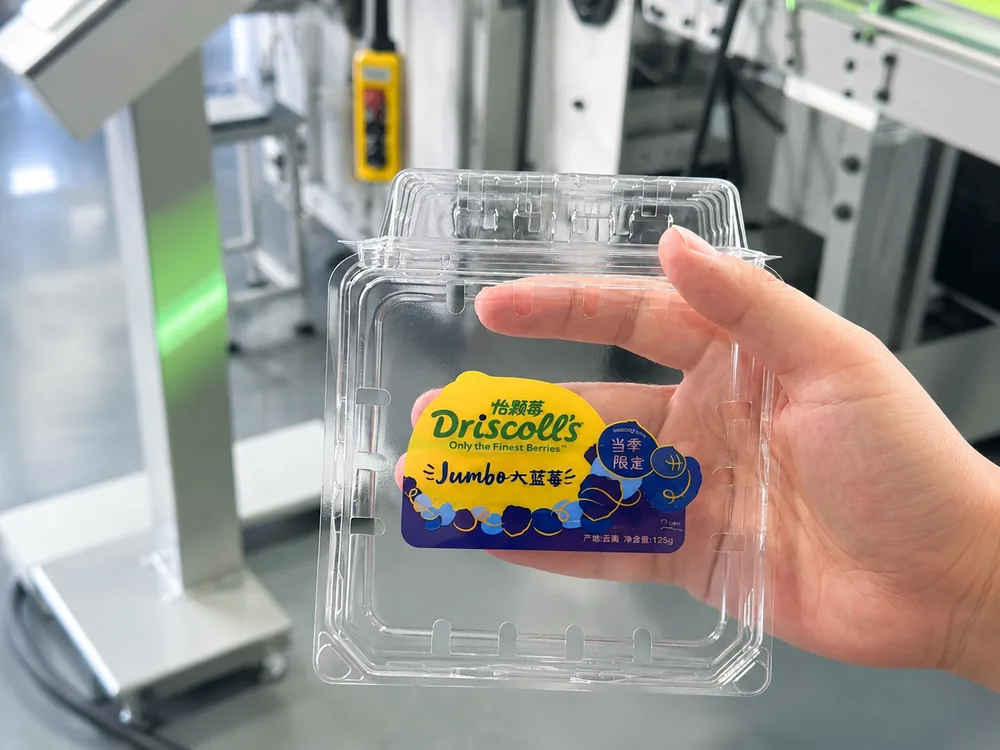
Get this information together before you contact a supplier. It is the difference between getting a recommendation built around your actual project and getting the closest item from a catalog:
- Target pack weight and expected seasonal variation in berry caliber
- Average fruit size and expected fill height
- Sales market, retailer requirements, label position
- Hinged clamshell or separate punnet-and-lid preference
- Cooling method and expected transit duration
- Carton size, packing pattern, and carton vent positions
- Material requirement — PET or rPET
- Stacking method, pallet configuration, number of handling stages
- Whether samples can be tested with real fruit and your actual carton
For ready-to-eat berry mixes and cut-fruit retail formats, tamper-evident food containers use the same food-grade PET with a tear-strip closure.
Common questions
What is the most common blueberry punnet size?
125g, 250g, 300g, and 500g all have established retail applications. Which is right depends on berry caliber, target market, and transport conditions — not on which size is most popular.
How deep should a blueberry punnet be?
Deep enough that the top layer sits below the lid with reasonable clearance when the pack is filled to target weight. The exact depth depends on your fruit size, pack weight, and stacking load.
Do I need vents on the lid, sides, and base?
Not necessarily. What matters is whether the vent pattern creates a usable airflow path in your actual carton setup. Holes blocked by labels, dividers, or carton walls contribute nothing.
Why is there moisture inside the punnet?
Temperature fluctuation, restricted airflow, insufficient pre-cooling, and high humidity inside the packaging system can all contribute — sometimes together. Look at the punnet, the carton, and the cold-chain process together. Changing the punnet alone rarely solves a condensation problem.
One final point: do not approve a pack from an empty sample. Fill it with real fruit, close it, pack it into your carton, stack it, and run it through something resembling your actual cold chain. That is the only test that tells you whether it actually works.
Ready to discuss your blueberry packaging project? contact StlPak — we will help you select or customize the right punnet with the correct depth, vent layout, and material for your specific application.