
There’s no single best container for every salad or ready-to-eat food. A clear PET bowl might work well for a chilled green salad, while a pasta salad needs a more secure, leak-resistant closure. A salad kit with dressing and toppings often performs better in a compartment container, and a meal meant for reheating needs an entirely different material. The easiest way to choose isn’t to start with the container — it’s to start with the food, and work through a short set of questions: Is it sold cold or heated? How much moisture or sauce does it hold? Should the ingredients stay together or apart? Will the consumer eat straight from the package? Is it sold on a retail shelf or sent out for delivery? Does it need visible tamper evidence? Once those are answered, the right material, structure, and format narrow down quickly. This guide focuses on salads, deli foods, and refrigerated ready-to-eat foods packed in disposable rigid containers.
Explore StlPak’s broader Disposable Plastic Food Containers range when comparing formats and applications.
Related guidance: hinged-lid and separate-lid comparison.
Match the Material to the Temperature First
Temperature is worth confirming before anything else, because it can eliminate entire material categories immediately. Refrigerated salads and cold ready-to-eat foods — leafy green salads, Caesar salads, fruit and vegetable salads, pasta salads, deli vegetables, cold noodles, sushi, chilled desserts — commonly use clear PET containers, which combine rigidity with the product visibility retail buyers want; lettuce, tomatoes, sliced egg, fruit, and chicken stay visible rather than hidden behind opaque plastic. Hot-filled or reheatable food is a different problem entirely, where temperature resistance matters more than transparency — depending on the application, that might mean PP for microwaveable use or CPET for higher-temperature, ovenable applications, with the exact resistance confirmed for the specific container and heating method. The underlying principle is simple: choose the material for the temperature the package will actually experience, not for the look you want. Our Food Packaging Material Guide compares PET, rPET, PP, CPET, paper, and bagasse in more detail.
Match Moisture and Sauce to the Structure
Two products can both be called “salad” and still need completely different packaging. A dry leafy salad — lettuce, spinach, cucumber, tomato, carrots — is mostly about protecting delicate ingredients from crushing, managing moisture inside the pack, and giving the leaves enough internal space; because leafy food takes up a lot of volume relative to its weight, internal shape matters more here than raw capacity. A dressed or moist salad — pasta salad, potato salad, coleslaw, mayonnaise-based deli salad — is the opposite problem: lid fit, closure strength, leak resistance, and sidewall rigidity matter most, because the container’s job is containing moisture rather than allowing airflow. That’s a real departure from produce packaging, where ventilation is often the priority — prepared salads and deli foods usually need secure containment instead. The wetter the product, the more it’s worth testing the actual food in the actual package before committing to a bulk order.
Decide Which Ingredients Should Stay Together
One of the most consequential decisions in salad and RTE packaging is whether every ingredient belongs in the same cavity. Take a Caesar salad with lettuce, grilled chicken, cheese, croutons, and dressing — technically all five could share one container, but if dressing sits against the lettuce too long the texture suffers, and croutons lose their crispness next to anything moist. The real question is which ingredients can stay together in storage and which should only meet shortly before eating. A single cavity is enough when the ingredients are already meant to be mixed — potato salad, pasta salad, coleslaw, pre-mixed deli vegetables — and adding compartments there just adds cost without benefit. Compartments earn their place when ingredients differ in moisture, texture, or flavor:
| Compartments | Useful When | Example Combinations |
|---|---|---|
| 1 (single cavity) | Ingredients are meant to stay mixed | Potato salad, pasta salad, coleslaw |
| 2 | Two elements need to stay apart | Salad + protein, fruit + yogurt, vegetables + dip |
| 3 | A main food plus two separate sides | Salad + protein + topping |
| 4 | Multi-component meals or kits | Meal kits, several separated toppings |
StlPak’s STL-2G, STL-3G, and STL-4G tamper-evident containers cover these configurations, but more compartments aren’t automatically better — the right choice is driven by whether the food actually needs separation, not by how many sections a container happens to have. Our guide to why compartment design matters for mixed food packaging goes further into this.
Design for How the Consumer Actually Eats It
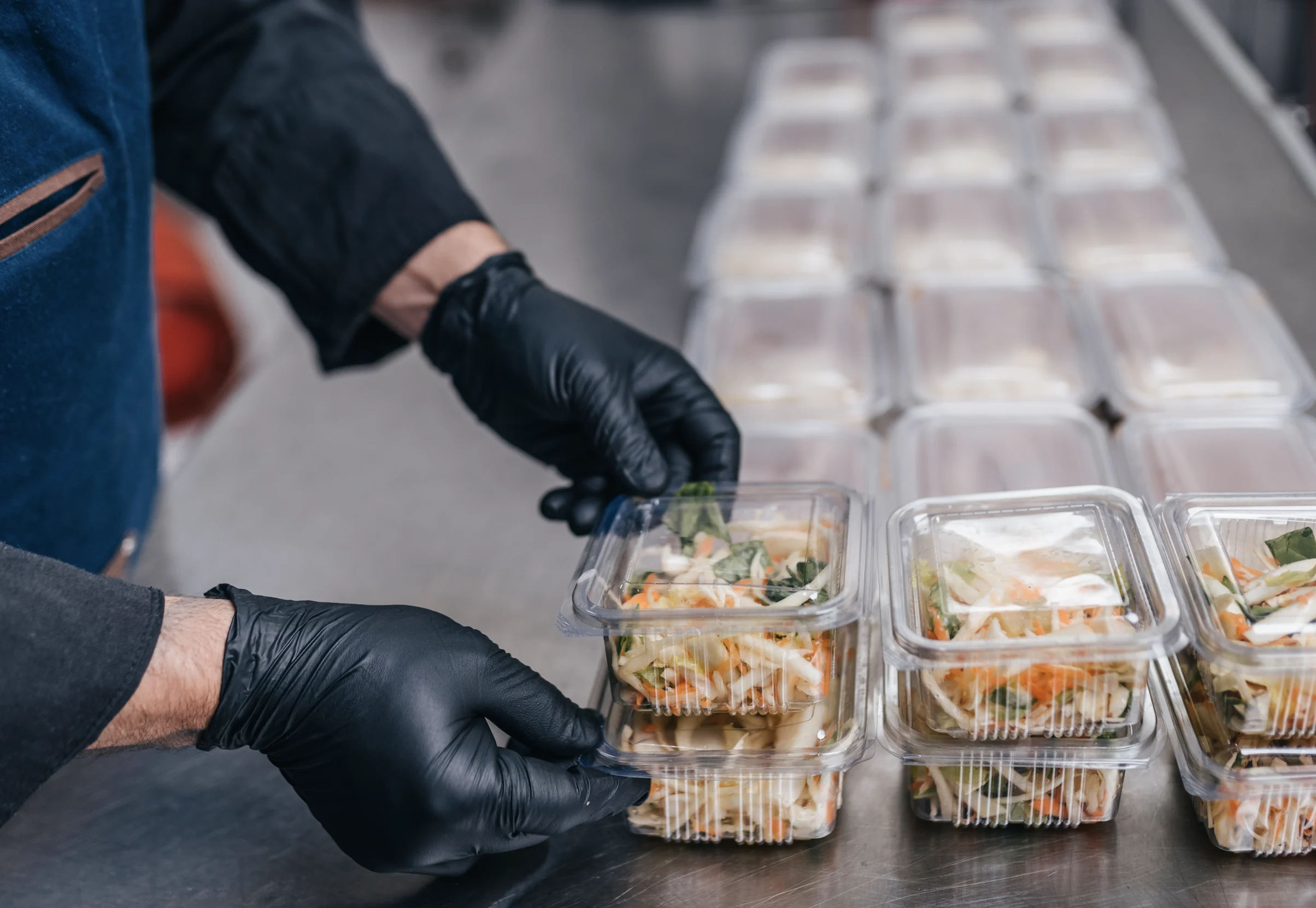
Ready-to-eat packaging often doubles as the serving container — someone buying a salad from a supermarket, convenience store, or office cafeteria may open it, add dressing, mix everything, and eat straight from the pack. That changes what “the right size” means. A narrow opening can hold the correct volume and still be awkward to eat from, since a wider mouth makes it easier to add dressing, mix, and reach ingredients in the corners with a fork. Depth matters in both directions too: containers that are too deep hurt accessibility, while ones that are too shallow spill when the consumer stirs the salad. And a common mistake is picking the smallest container that physically fits the portion — if the food reaches the lid, there’s no room left to add dressing and mix. The smallest container that fits the food isn’t always the best one; a little headspace for mixing usually improves the eating experience more than it costs in material.
Retail Display Versus Delivery
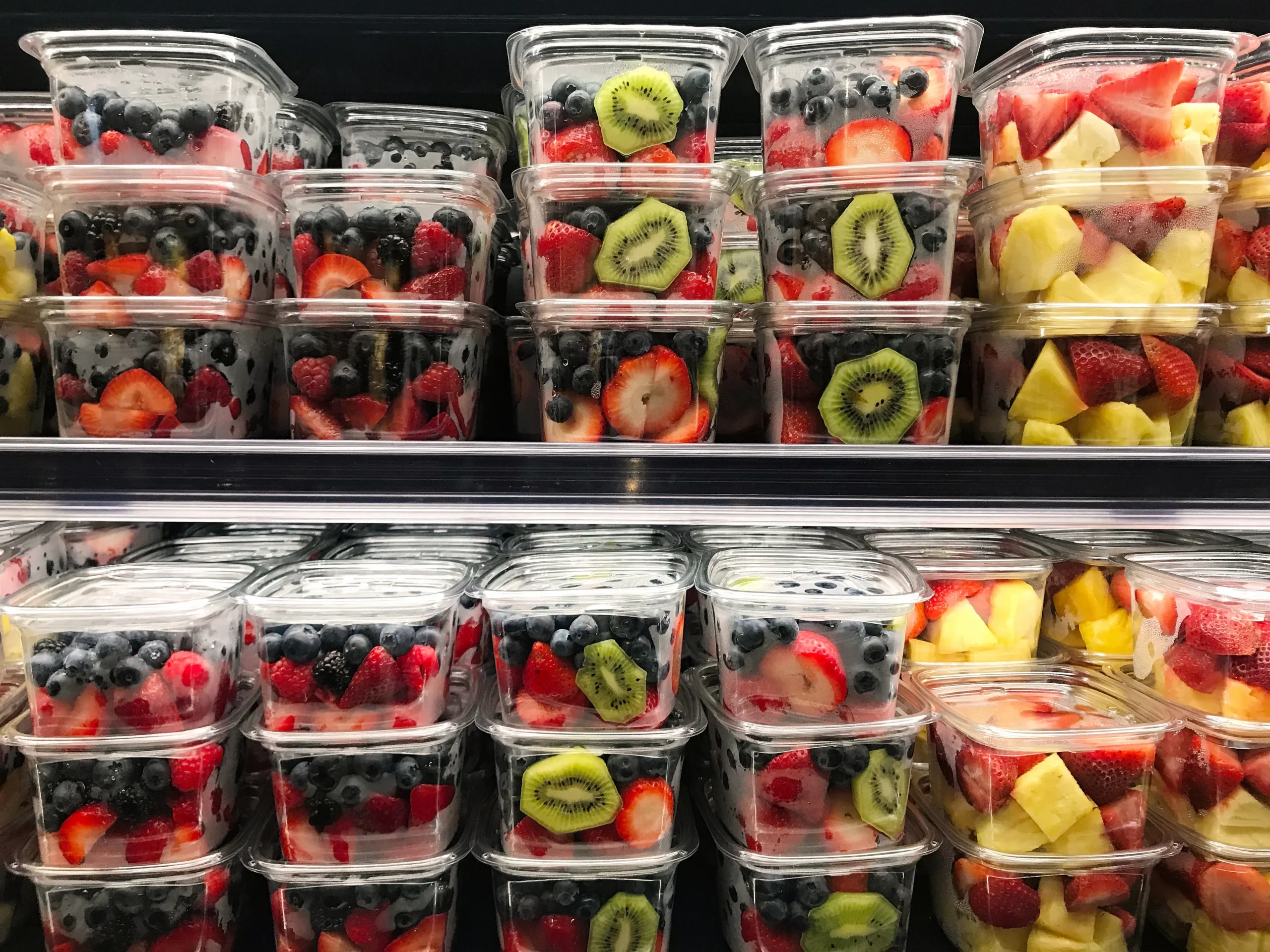
The same food can need different packaging priorities depending on how it reaches the customer. In a refrigerated retail cabinet, the balance is between product visibility, shelf presentation, stackability, labeling space, and closure security — clear PET lets shoppers check freshness, color, portion size, and ingredient distribution before buying, which is why it dominates refrigerated retail (more in why clear food packaging matters for retail display). Delivery adds movement the retail shelf never sees — containers get carried in bags, tilted, stacked with other meals, and handled multiple times before reaching the consumer — so lid retention and leak resistance become far more important than they are for something sitting flat on a shelf. A package that performs well in a static retail test can still fail in transit, which is why filled containers should be tested under conditions closer to actual delivery use, not just checked empty.
Tamper Evidence for Ready-to-Eat Food
Tamper evidence matters more for RTE food than for most packaging, since the consumer often eats immediately after opening. A product moving from a central kitchen through a distributor, a supermarket, and refrigerated display before reaching the customer passes through several handling stages along the way — a tamper-evident structure gives visible proof if any of those stages included an unauthorized opening, which is especially relevant for prepared salads, deli foods, cut vegetables, fruit-and-yogurt combinations, and multi-component RTE meals. It’s worth being precise about the distinction, though: a normal hinged container can close securely without providing any visible evidence of first opening, so if tamper evidence actually matters for your application, evaluate the locking mechanism itself rather than assuming a secure-feeling lid covers it. See how tamper-evident food containers work for the mechanics.
Match Depth and Lid Profile to the Food, Then Test the Real Portion
Capacity alone doesn’t determine the right shape — the same nominal volume can become a wide shallow container, a narrow deep one, a round bowl, or a rectangular tray, and each behaves differently once food is inside.
| Food Type | Structural Priority |
|---|---|
| Leafy salads | Wider format — presents high-volume, low-weight ingredients without compressing them |
| Dense foods (pasta, potato, deli salads) | Rigidity — bottom strength and sidewall resistance to the extra load |
| Tall ingredients (egg, large leaves, chicken, toppings) | More internal height, often a dome lid for headspace |
| Stacking-focused retail | Flat lid — better for refrigerated display, labeling, and carton packing |
Even within the right shape, catalog specifications shouldn’t replace an actual filling test. Two containers both listed as 750 ml won’t necessarily hold a salad the same way, because usable capacity depends on sidewall angle, bottom dimensions, lid height, ingredient density, and required headspace — a 750 ml round bowl and a 750 ml rectangular tray can present very differently, and a container sized for 300 g of leafy salad may not suit 300 g of dense pasta salad at all. StlPak generally recommends testing the actual food, actual portion, and actual lid together before confirming a bulk order — a small mismatch here has an outsized effect once it’s multiplied across a high-volume program.
Check Production and Shipping Efficiency Too
A good container has to work for the people filling thousands of units a day, not just the consumer. Opening dimensions and consistency affect how fast a container can be filled manually, semi-automatically, or on an automated line, and a lid that needs extra force to close might look fine in a sample evaluation but costs real time once it’s multiplied across tens of thousands of units — closure should be judged on both security and packing speed. The filled container also needs to stay stable moving through cold storage, distribution centers, refrigerated trucks, and retail shelves, and how efficiently the empty packaging itself ships — nesting, pieces per carton, carton dimensions, container loading quantity — is a real cost factor for bulk orders, covered in more detail in container dimensions and food packaging shipping efficiency.
Quick Reference: Matching Food to Packaging Format
| Food Application | Main Packaging Challenge | Packaging Priority | Typical Format |
|---|---|---|---|
| Leafy green salad | Moisture and crushing | Visibility + internal space | Clear salad container |
| Caesar salad kit | Wet and dry ingredients | Ingredient separation | Compartment container |
| Pasta salad | Sauce and moisture | Secure closure | Deli container |
| Potato salad | Dense, moist food | Rigidity + leak resistance | Rigid deli container |
| Salad + chicken | Multiple components | Separation | 2–3 compartment container |
| Fruit + yogurt | Wet and dry components | Separation | Cup or compartment container |
| Sushi | Presentation and closure | Visibility + secure lid | Clear tray with lid |
| Cold RTE meal | Multiple food components | Separation + tamper evidence | 2–4 compartment container |
| Refrigerated deli food | Moisture | Tight closure | Clear PET container |
| Microwaveable meal | Heating | Heat resistance | Suitable PP container |
| Ovenable ready meal | Higher heat | High-temperature resistance | Suitable CPET tray |
Treat this table as a starting point, not a substitute for testing with the real product.
Choose Packaging Around the Food, Not the Catalogue
A 500 ml, 750 ml, or 1,000 ml container can look perfectly suitable on a spec sheet and still perform poorly once real food is inside. The right decision comes from working through temperature, moisture, ingredient separation, eating method, sales channel, closure, structure, and an actual filling test — together, not in isolation. A simple pre-mixed deli salad may need nothing more than a single clear container; a Caesar salad kit may need compartments to protect the toppings’ texture; a refrigerated multi-component meal may call for a tamper-evident compartment container; and anything meant to be reheated starts with material temperature resistance before anything else. At StlPak, we manufacture a wide range of PET food containers for salads, deli foods, fresh prepared foods, and other refrigerated ready-to-eat applications, including single- and multi-compartment tamper-evident formats. If you’re unsure which structure fits your product, the most useful starting point is simply telling us the food type, portion weight or volume, temperature requirement, and sales channel — from there, we can shortlist existing container options and get them tested with your actual food before moving to bulk production.