No single food packaging material meets every requirement at once — high transparency, cold storage, microwave heating, oven use, grease resistance, brand printing, and low cost don’t all come from the same solution. For buyers, the right starting point isn’t “which material is best?” It’s confirming the food type, contact temperature, use duration, sales channel, and recycling requirements first — then narrowing down from PET, rPET, PP, CPET, paper, and bagasse. If you are comparing finished products rather than raw materials, start from our Disposable Plastic Food Containers range, then use this guide to confirm the material behind each option.
This guide treats PET and rPET as two options within the same polyester material family, which leaves five material categories: PET/rPET, PP, CPET, paper, and bagasse. PET and rPET suit cold and ambient applications where transparent display matters most. PP is commonly used for hot food and selected microwave applications. CPET handles freezer-to-oven requirements. Paper and bagasse work better for projects that prioritize print expression, fiber aesthetics, or foodservice takeaway. These are starting directions — the final decision should always rest on the specific finished container’s structure, test results, and compliance documentation for the target market. Buyers focusing on cold and ambient applications can continue with the PET containers for food guide, while buyers still comparing complete formats can use the container selection guide.
Need a quick recommendation? Share a photo of your food, the minimum and maximum use temperatures, and your sales channel. StlPak can help compare materials and suggest existing models.
Three-Minute Material Selection Table
The table below is a first-round filter. “Recommended material” doesn’t mean other materials can’t work — it means this option typically balances function, presentation, and procurement efficiency most readily in that scenario.
Hot takeaway food, quick service, natural fiber look
Bagasse
Molded fiber format suits foodservice takeaway and divided tray structures
Oil and water resistance, lid compatibility, closure, condensation, PFAS requirements, composting conditions
Choosing by Food Temperature
Temperature is the first filter in material selection — but buyers shouldn’t rely on a resin’s theoretical temperature range alone. Container wall thickness, ribbing, lid-and-base geometry, fat content of the food, contact time, and heating method all affect real-world performance. The right question to ask a supplier isn’t “does this material tolerate high temperatures?” It’s “has this specific finished container been tested under these conditions?”
Cold and Ambient Display: PET or rPET
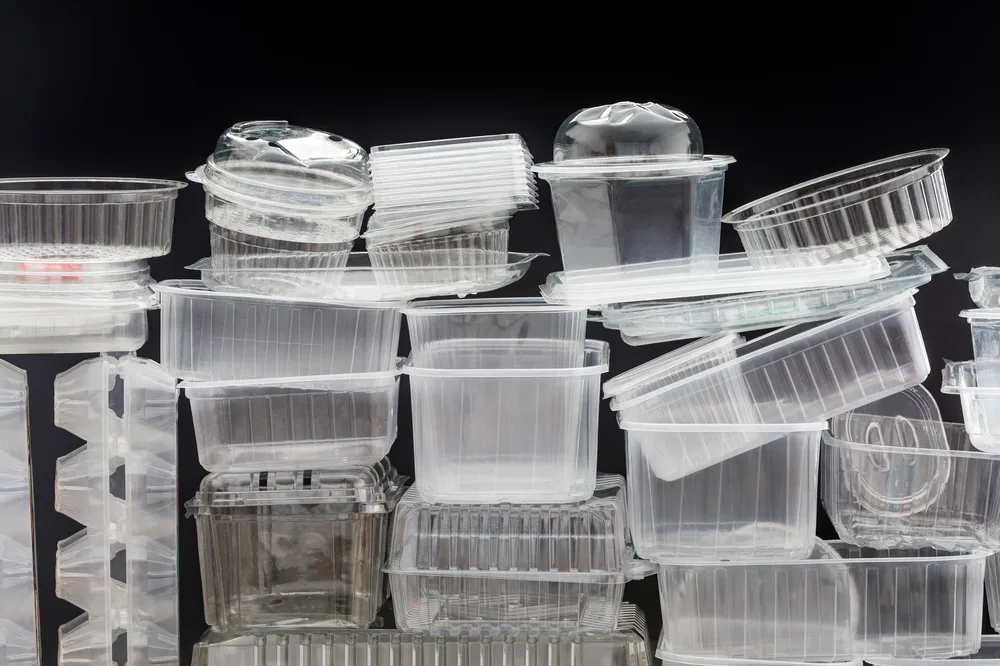
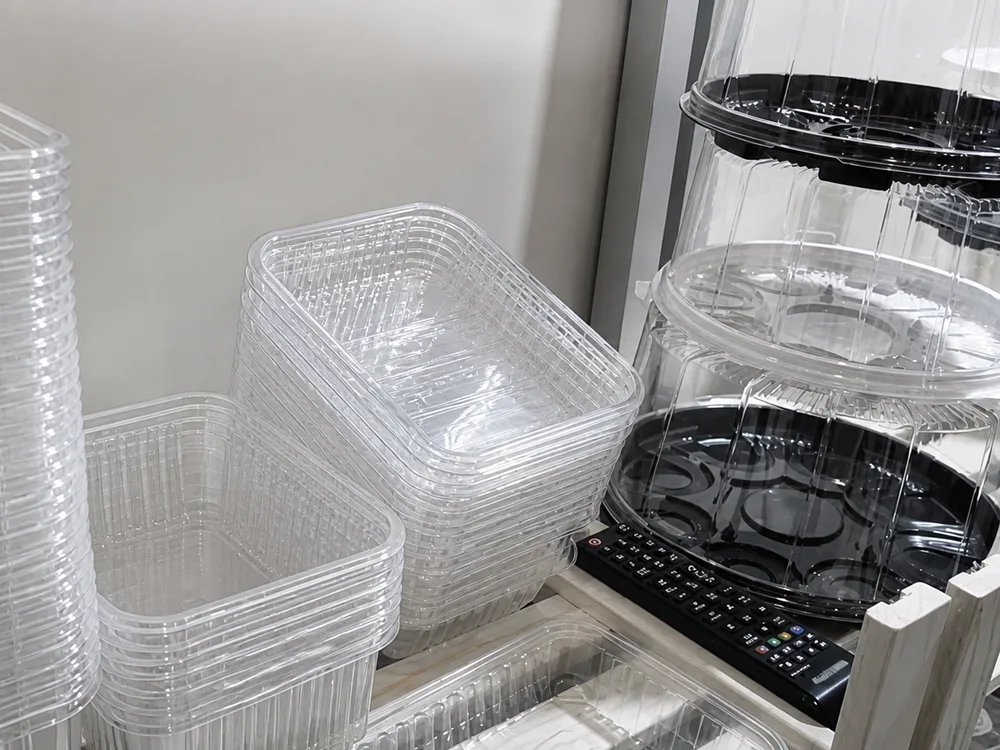
For berries, grapes, fresh-cut fruit, salads, eggs, prepared foods, and bakery products, standard thermoformed PET or food-contact-grade rPET is typically the most appropriate choice for chilled or ambient display. Both provide good transparency and rigidity, allowing consumers to assess the food directly and buyers to check fill level, label position, and shelf presentation.
If the food continuously produces moisture, ventilation holes, condensation behavior, and anti-fog requirements should all be evaluated together. Adding ventilation holes doesn’t automatically extend shelf life for every food — hole size and count should be matched to the food’s respiration rate, cold-chain humidity, and transit duration. Standard transparent PET containers shouldn’t be assumed suitable for microwave or conventional oven use unless the specific structure has been validated for those conditions.
Hot Food, Oven, or Microwave: PP or CPET
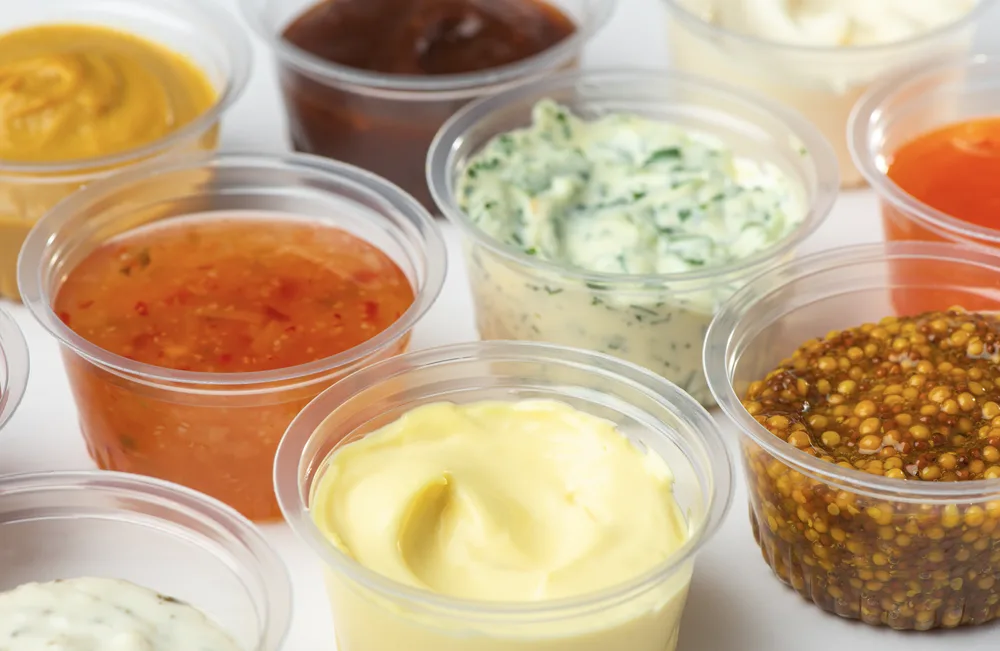
PP is commonly used for hot food containers, soup bowls, sauce cups, and selected microwave food packaging. Compared with standard transparent PET, PP generally handles higher-temperature applications more reliably — but different PP formulations, wall thicknesses, and container geometries perform differently. Before specifying PP for a hot-food application, provide the maximum food temperature, heating power, heating duration, and whether the food is high in fat, then test the finished container.
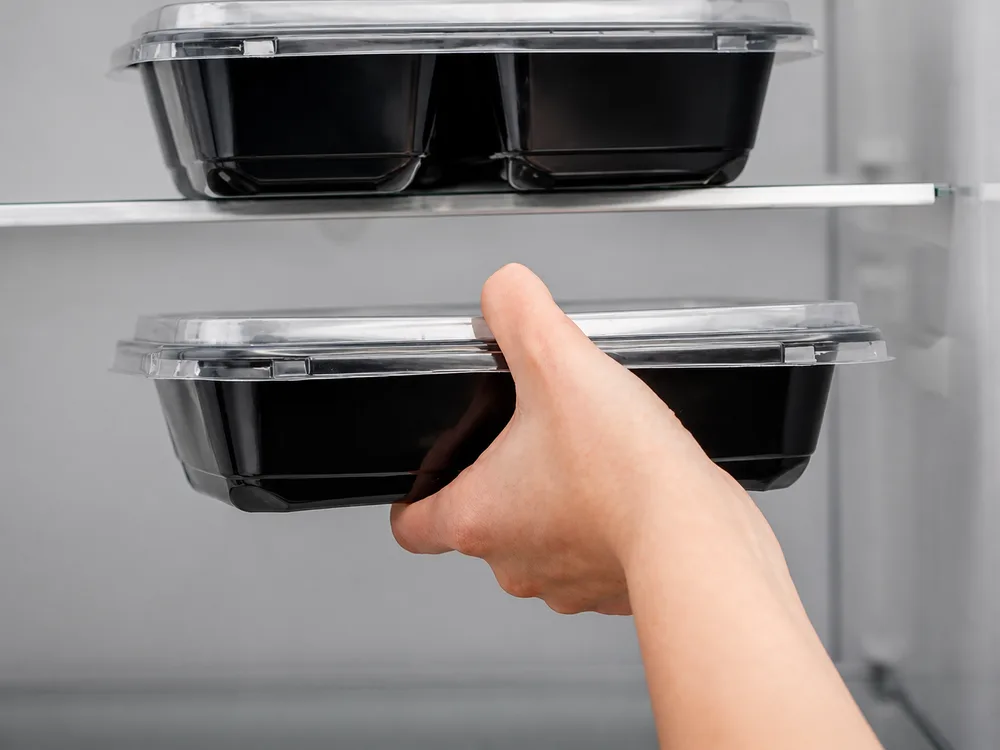
For products that move directly from a frozen state into a conventional oven, CPET is typically more appropriate than standard PET or general PP. CPET is crystallized PET, usually appearing in black, white, or other opaque forms, and is primarily used for frozen ready meals, airline meals, and oven-ready meal trays. Its advantage is heat resistance and dimensional stability under heating — not transparency. CPET should not be understood as a “clearer, more premium PET”; it’s a fundamentally different use case.
Choosing by Sales Channel
The same food entering different channels may call for different material choices. Supermarkets prioritize shelf display, label readability, and stacking. Fresh e-commerce prioritizes compression resistance and closure security in transit. Delivery formats require leak resistance, heat retention, and lid stability. Foodservice counters focus on loading speed, denesting, and microwave compatibility. The same channel-first logic applies to Disposable Plastic Food Containers as much as to any other packaging category.
Denesting efficiency, oil and water resistance, lid design, liquid leakage, local regulations
Material Comparison: Transparency, Temperature, and Cost
Material comparison shouldn’t focus on a single advantage. Transparency, temperature range, barrier performance, forming structure, shipping volume, compliance documentation, and local recycling infrastructure all affect total cost. The table below is for initial screening — actual pricing and performance require confirmation by container dimensions, wall weight, structure, and order volume.
Some products suitable for microwave or short-duration heating
Influenced by wall weight, structure, surface treatment, and carton efficiency
Verify oil and water resistance, PFAS declaration, lid material compatibility, and actual composting conditions
Cost figures in the table are directional only. Two visually similar containers may have meaningfully different unit prices because of wall weight, cavity depth, number of locking points, mold layout, and units per carton. When comparing quotations, obtain unit price, units per carton, carton dimensions, pallet or container loading, and estimated damage rate together. When comparing Disposable Plastic Food Containers across suppliers, ask for wall weight and gram weight per cavity, not just the unit price.
PET and rPET
PET is StlPak’s core in-house manufacturing material, used primarily for thermoformed transparent food containers. Its strengths are clarity, light weight, clean profile, and scalable production — which is why it appears across fruit containers, berry clamshells, grape boxes, salad containers, egg trays, bakery boxes, and chilled food trays. Beyond dimensions and capacity, buyers should check sheet thickness distribution, edge rigidity, locking point strength, denesting behavior, and deformation risk after carton loading.
rPET is not a fundamentally different resin — it’s a PET material solution that incorporates recycled PET content. For projects aiming to reduce virgin plastic use or meet brand recycled-content targets, StlPak can evaluate appropriate recycled-content percentages based on the product, target market, and documentation requirements. rPET clarity and color may be affected by source material, recycled content ratio, and batch control, so sample confirmation should include agreed production standards for color, black specks, haze, and visual acceptance — not just a single sample approval.
Transparency, Recycled Content, and Traceability Documentation
When specifying rPET, buyers should at minimum confirm: whether the recycled content is post-consumer or another source; how the percentage is calculated; whether it is suitable for direct food contact; which recycling process was used and what conditions it covers; and what batch or supply-chain traceability documentation can be provided.
Traceability systems such as GRS can help verify recycled content and supply-chain information, but GRS is not a food-contact safety certificate. Food-contact compliance must be confirmed separately based on the target market, food type, temperature, and contact duration.
If a brand intends to use environmental claims such as “contains recycled material” or “recyclable” on the packaging, the evidential and wording requirements in the sales region should be verified first. A material being theoretically recyclable doesn’t mean every city’s collection system accepts that container — labels, adhesives, inks, colors, and multi-material combinations can all affect actual recyclability.
PP and CPET
PP and CPET may both appear in food packaging that involves heating, but they are not interchangeable. PP is more common for hot-fill food, takeaway containers, sauce cups, and microwave meal boxes — it typically offers better toughness and lid-fit performance. CPET is used for higher-temperature, more demanding freezer-to-oven applications where the tray must maintain dimensional stability throughout the heating process.
Temperature Requirements and Test Conditions
Procurement documentation shouldn’t simply say “high-temperature resistant” or “microwave safe.” Instead, specify: minimum storage temperature, maximum fill temperature, microwave power and duration, conventional oven temperature and duration, and whether the food is high in fat, sugar, or salt. The same material in contact with different foods may produce different heating behavior and migration test conditions.
If the container also needs to work with a sealing film, test the heat-seal window, peel strength, seal contamination tolerance, and microwave venting simultaneously. The lid, film, and tray may be made from different materials — the fact that a tray can be heated doesn’t mean a transparent lid can be heated with it. Final use instructions should be based on the validated performance of the complete packaging system.
Paper and Bagasse
Paper packaging suits projects that need brand printing, shelf information, and different surface finishes — bakery boxes, paper bowls, dry food packaging, outer cartons, and combination structures. Paper’s inherent barrier against liquids and grease is limited; actual performance typically comes from coatings, extrusion lamination, or other functional layers. When selecting paper packaging, the paper substrate, food-contact layer, inks, adhesives, windows, and closure method must be evaluated as a complete structure.
Bagasse is a molded fiber packaging material commonly used for quick-service containers, meal trays, divided compartment boxes, and takeaway packaging. It provides a natural fiber aesthetic, but its oil resistance, leak resistance, microwave compatibility, and compostability cannot be assessed from “plant fiber” alone. Different products vary in fiber formulation, surface treatment, wall thickness, and lid compatibility, all of which directly affect performance.
Print Quality, Oil Resistance, Moisture, and Aesthetics
If the food is oily, moist, or requires extended storage, specify the required grease resistance level, liquid penetration time, condensation conditions, and structural strength. Adding barrier layers to paper or bagasse packaging may improve function but can also change material separation, recycling, or composting conditions. For markets with PFAS restrictions or heightened concern, raise PFAS declarations and testing requirements at the inquiry stage — not when the order is about to ship.
Paper and bagasse generally don’t provide the full transparency of PET. If the food’s visual appearance is a core selling point, consider windowed cartons, transparent lids with fiber bases, or other combination structures — but evaluate upfront whether different materials can be easily separated and how this affects recyclability claims and total cost.
What to Confirm Before Selecting a Material
Food Type, Temperature, Shelf Life, and Distribution
An effective material inquiry doesn’t require complete engineering drawings at the outset, but the supplier needs to understand the following. The more complete the information, the more accurately the supplier can screen existing models and reduce repeated sampling and mis-quoted specifications.
Inquiry item
Recommended information
Why it matters
Food type
Fruit, salad, bakery, meat, ready meal, soup, or high-fat food
Determines barrier, ventilation, grease resistance, and food-contact test direction
Net weight and food dimensions
Weight, individual dimensions, fill height, whether sauces or accessories are included
Same capacity doesn’t mean the cavity shape fits
Temperature conditions
Fill, refrigeration, freezing, transit, microwave, or oven temperature and duration
Determines material and finished-container validation conditions
Shelf life
Expected shelf life and whether MAP, sealing film, or ventilation is used
Affects gas permeability, sealing, and barrier requirements
Sales channel
Supermarket, fresh e-commerce, delivery, wholesale, or foodservice
Affects display, labeling, transit, and opening experience
Packing equipment
Hand-fill, auto-labeling, sealing film, or auto-cartoning
Determines dimensional tolerance, denesting, and equipment compatibility
Distribution method
Domestic, sea freight, cold chain, pallet, or bulk container loading
Affects outer carton, stacking, and total landed cost
Target market
Country/region and any customer-specific standards
Determines food-contact documentation, labeling, and environmental claim requirements
Procurement plan
Trial quantity, annual volume, first-order timing, and whether multi-SKU mixing is needed
Determines existing mold, custom tooling, and supply approach
Why Unit Price Alone Isn’t the Right Comparison
Unit price is only part of procurement cost. A container that looks cheaper may result in lower carton density, more shipping space, unstable denesting on automated lines, closure failures in transit, or higher retail damage rates — raising the actual cost per saleable food unit.
A more useful comparison calculates total use cost: unit packaging price plus label and sealing film cost, filling labor, outer cartons and pallets, international freight, warehousing, packaging loss, food loss, and customer complaint risk. For transparent fresh food packaging, the right container depth and profile can also improve how the product looks on shelf — without changing the net weight — so selection shouldn’t be made on minimum wall weight or minimum unit price alone.
StlPak Product Recommendations by Application
For fruit, berries, grapes, fresh-cut fruit, vegetables, eggs, salads, and chilled bakery products that need transparent display, start with StlPak’s PET and rPET food packaging range. Different products can be compared by capacity, depth, ventilation layout, closure method, label area, auto-labeling compatibility, and carton loading count. Where transparent Disposable Plastic Food Containers are the goal, these PET and rPET starting points usually match existing StlPak molds before custom tooling is needed.
For foodservice projects requiring microwave heating or hot-fill, evaluate PP containers, PP sauce cups, and compatible lids based on temperature and structural requirements. For frozen products going directly into a conventional oven, evaluate CPET trays and sealing film compatibility. For projects requiring brand printing or fiber aesthetics, compare paper food packaging and bagasse containers.
Condensation, label area, sealing film or hinged lid
Bakery, desserts, and cakes
PET clear boxes, paper cartons, or combination structures
Top clearance, grease migration, display, transit protection
Hot food, takeaway, and sauces
PP containers and sauce cups
Fill temperature, microwave compatibility, leak resistance, lid fit
Frozen oven-ready meals
CPET trays
Frozen drop resistance, sealing film, oven conditions
Quick service and disposable foodservice
PP, paper, or bagasse
Oil and moisture resistance, denesting, lid design, local regulations
Existing Molds and Custom Development
StlPak’s core in-house production focuses on PET and rPET thermoformed food packaging, with a substantial range of existing molds that allow buyers to screen testable specifications quickly and reduce sampling and order confirmation time. When existing models can’t meet the food dimensions, packing line, label area, or channel requirements, structural adjustment or custom tooling becomes worth evaluating.
PP, CPET, paper, and bagasse products are integrated through StlPak’s partner supply network. Inquiries and recommendations will indicate the relevant production and supply arrangement, with applicable specifications, testing, and documentation confirmed accordingly. For food brands, retailers, and distributors sourcing multiple material types, this approach allows material comparison and combined purchasing within one project — but MOQs, lead times, tooling conditions, and compliance documentation for different materials should be confirmed separately.
Common Material Selection Errors and How to Test
The same material name doesn’t mean every container performs the same way. Before placing a bulk order, test with real food, real equipment, and real distribution conditions — not empty container inspection alone.
Common material selection mistakes include: using standard PET as a microwave or oven tray; focusing only on the rPET percentage without verifying food-contact suitability; treating GRS as a food safety certificate; asking only whether paper or bagasse is “eco-friendly” without evaluating barrier layers and local disposal infrastructure; and testing only the base, not the lid, sealing film, labels, and outer carton together.
The following tests should be completed before bulk production:
Food fit test. Fill with the actual food at the planned net weight. Check whether dimensions, fill height, liquid, sauce, absorbent pad, and serving access are all workable. Two containers with the same stated capacity may have completely different usable internal space.
Temperature cycling test. Run through the actual process: fill, refrigerate, freeze, thaw, or store as hot food, then observe warping, cracking, condensation, leakage, and closure changes. The test duration should cover the planned shelf life, not just a few hours.
Microwave or oven test. Record equipment type, power or temperature, heating time, food weight, and fat content. Test whether the tray, lid, film, and labels need to be removed. Don’t substitute a single empty-container heating result for a filled-food test.
Closure and leak test. Check that all four sides are fully engaged or heat-sealed, then tilt, invert, and vibrate in the actual transit orientation. Note that a standard hinged lid, a tamper-evident closure, and a truly liquid-tight container solve different problems.
Stacking and transit test. Run outer carton stacking, drop, and vibration tests at the actual units-per-carton count. Observe whether container edges, ribs, lids, and bases deform. Sea freight, cold chain, and e-commerce courier conditions should be considered separately.
Packing line and label test. Check denesting, filling, sealing, labeling, and barcode scanning on the hand or automated line. For transparent containers, assess whether lighting reflections affect machine vision or consumer label readability.
Documentation review. Confirm food-contact declarations, test reports, recycled-content traceability, PFAS requirements, material identification, and environmental claims against the target market. The material, color, use temperature, and food type in the documentation must match the actual product being purchased.
After sample testing, classify results into “must be corrected,” “acceptable deviation,” and “production control points” — then confirm jointly with procurement, packaging engineering, quality, and the supplier. This produces more reliable outcomes than a simple “sample approved” response.
Get Material Recommendations, Samples, and Quotes
If you’re comparing PET, rPET, PP, CPET, paper, or bagasse, you don’t need to determine the single correct material before reaching out. Share a photo of your food, your current packaging dimensions, minimum and maximum temperatures, sales channel, and estimated volume. StlPak can assess whether an existing model, a combined solution, or custom development is the right starting point. Whether the project lands on Disposable Plastic Food Containers or on a paper or bagasse format, the test steps above remain the same.
StlPak will first screen testable specifications from existing products and explain the supply arrangement — in-house for PET/rPET or partner-sourced for other materials. Once the initial direction is confirmed, we can arrange samples, review compliance documentation, compare carton loading data, and provide a quote. That way buyers receive not just a material name, but a packaging recommendation matched to the food, equipment, distribution route, and market requirements.
×
Scroll to Top
We use cookies to enhance your browsing experience, analyze site traffic, and personalize content. By clicking Accept, you consent to our use of cookies. Learn more