
Don’t start with a product catalogue. Start with the food — and everything that will happen to it after filling.
A clear PET clamshell that works well for chilled berries may deform during hot filling. A tray with the correct volume may still be too shallow for a leafy salad. Two containers with the same stated capacity can perform very differently because of their shape, lid design, internal dimensions, and stacking structure. Material alone doesn’t determine whether a container is right for an application.
The correct selection follows a consistent logic: food application → temperature → moisture and oil → material → size and headspace → lid structure → ventilation → stacking and transport → compliance.
Related guidance: food packaging material guide; clamshell, tray and cup formats; bulk purchasing checklist.
Quick Selection Table
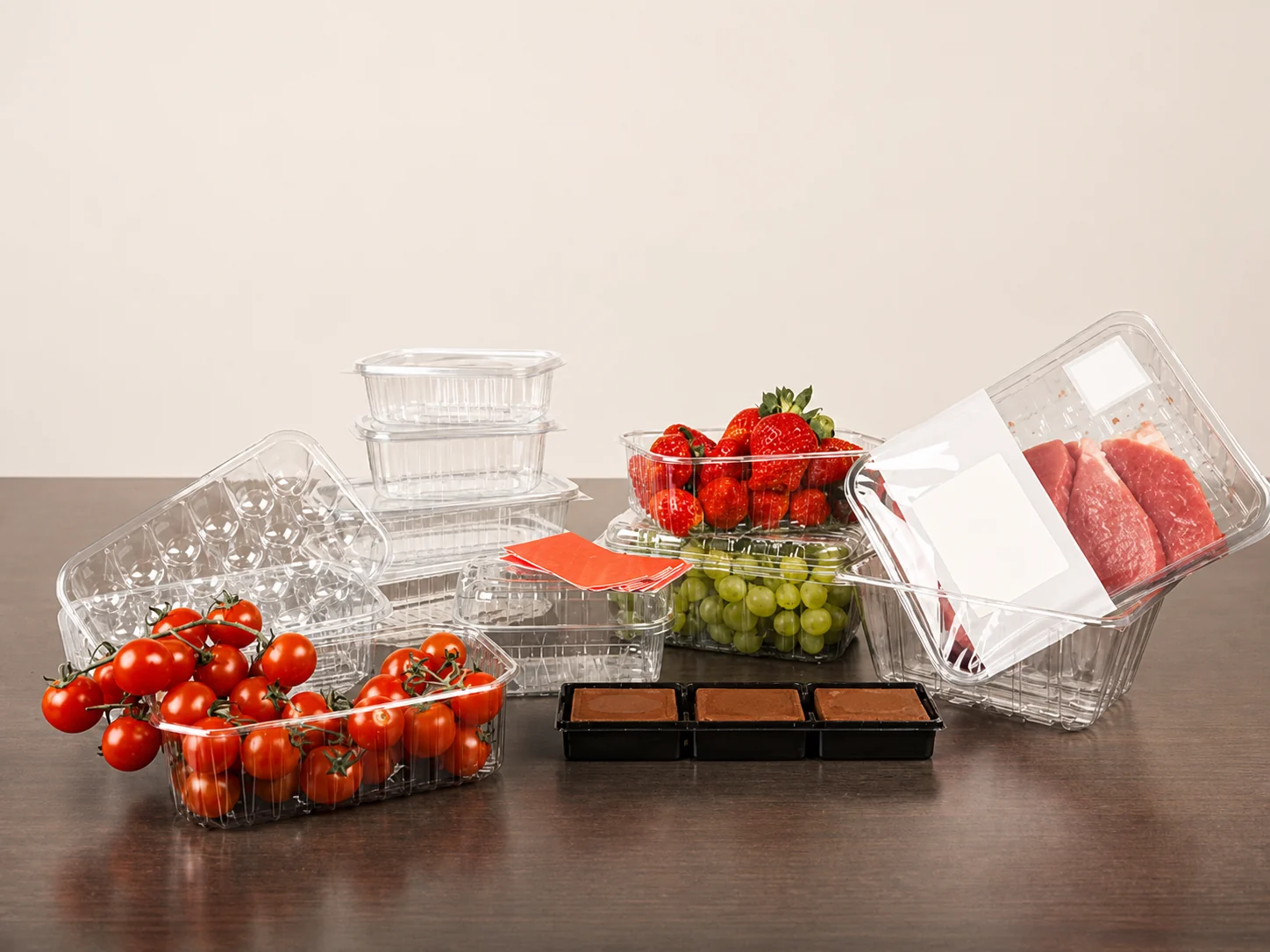
| Food application | Main packaging requirement | Common material | Typical format |
|---|---|---|---|
| Fresh fruit and berries | Visibility, ventilation, protection | PET / rPET | Punnet, clamshell |
| Fresh-cut fruit | Clarity, secure closure, moisture control | PET / rPET | Cup, tray, container |
| Salads and cold ready-to-eat | Visibility, lid security, portion control | PET / rPET | Bowl, hinged container |
| Bakery and desserts | Product height, headspace, display | PET / rPET | Clamshell, dome-lid container |
| Meat and fresh food | Tray rigidity, moisture, sealing | PET / rPET | Tray with film or lid |
| Hot meals and takeaway | Heat resistance, secure closure | PP where specified | Takeaway container |
| Frozen or oven-ready meals | Temperature resistance, dimensional stability | CPET where specified | Rigid meal tray |
These are general directions, not universal rules. A resin name alone doesn’t confirm that a container is suitable for a specific temperature, food, or heating process.
Start with the Food’s Complete Journey
The fastest way to eliminate unsuitable containers is to map what happens before, during, and after packing.
Consider the food’s physical characteristics: Is it dry, moist, oily, acidic, or high in liquid? Does it release juice during storage? Is it easily bruised or crushed? Does it need ventilation? Whole berries, fresh-cut melon, leafy salad, cookies, and curry may all fit inside a clear plastic container, but their requirements are entirely different.
Filling temperature is often more important than later storage temperature. A meal may eventually be refrigerated but packed while hot. A container suitable for cold storage may deform during hot filling before it ever reaches the refrigerator. Document the actual filling temperature, whether the food is packed manually or automatically, and whether the lid is applied immediately. “Cold food” and “hot food” are not precise enough specifications.
Finally, confirm what happens at the end of the journey: ambient display, refrigeration, freezing, microwave reheating, or oven heating? Each condition changes what the container must withstand.
Choosing the Right Material
Different plastics have different strengths, and no material is the best choice for every food.
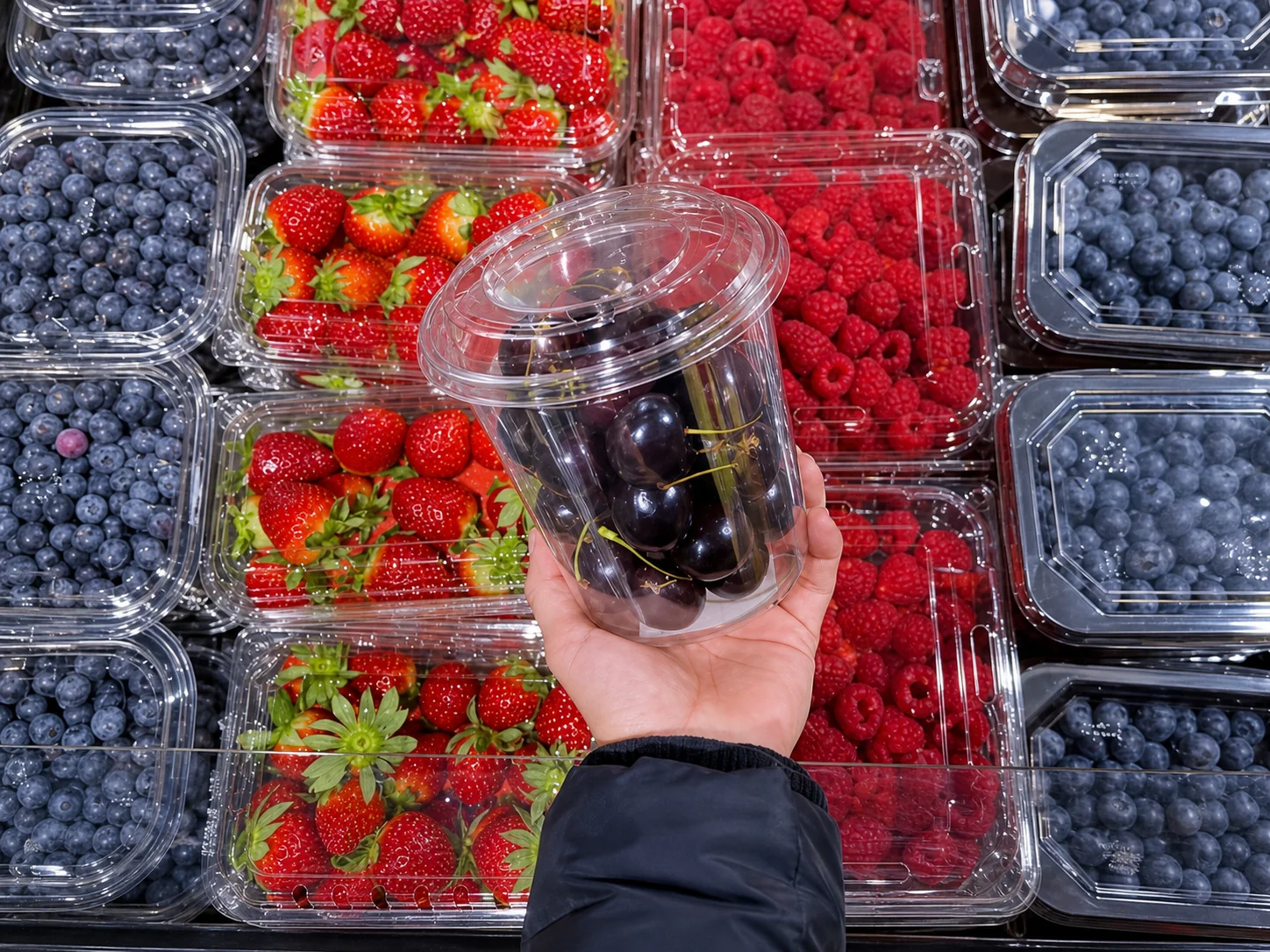
PET and rPET are widely used for clear thermoformed disposable food packaging. PET provides excellent visibility, allowing consumers to inspect the food without opening the package — which makes it especially valuable for supermarket and grab-and-go presentation. It is the standard material for fresh fruit and berries, chilled salads, fresh-cut fruit, bakery products, desserts, and cold ready-to-eat foods. Standard thermoformed PET should not be assumed suitable for hot filling, microwaving, or oven use without confirming the permitted temperature range with the supplier.
rPET delivers comparable packaging performance while incorporating recycled content. When evaluating rPET, confirm the recycled-content percentage, food-contact suitability, material traceability, visual clarity expectations, and whether documentation such as GRS certification is required. Recycled content should not be evaluated separately from packaging performance — the container must still close correctly, protect the food, and remain stable throughout distribution.
PP is commonly used where greater heat resistance is needed: hot takeaway meals, reheating applications, soups, and cooked dishes. However, PP is not automatically microwave-safe. Wall thickness, additives, lid material, heating time, and food composition all affect performance. Request the specific temperature rating and heating instructions for both the container and its lid.
CPET is designed for applications requiring higher temperature resistance than standard PET — typically frozen ready meals, heat-and-eat foods, and selected oven or microwave applications. The complete package, including tray, film, and sealing system, must be evaluated. Confirmed the permitted heating temperature and time rather than assuming uniformity across all CPET products.
The comparison below captures the practical differences:
| Factor | PET / rPET | PP | CPET |
|---|---|---|---|
| Product visibility | Excellent | Moderate to good | Usually limited |
| Fresh produce and chilled foods | Excellent | Possible | Uncommon |
| Hot food or reheating | Not the primary use | Common where specified | Suitable |
| Microwave | Generally not applicable | Common where specified | Application-dependent |
| Oven | Not normally suitable | Generally not applicable | Common where specified |
| Typical format | Clamshells, punnets, cups, trays | Takeaway containers, bowls | Ready-meal trays |
Container Structure and Lid Design
Once material is confirmed, the packaging format determines how well the container actually performs.
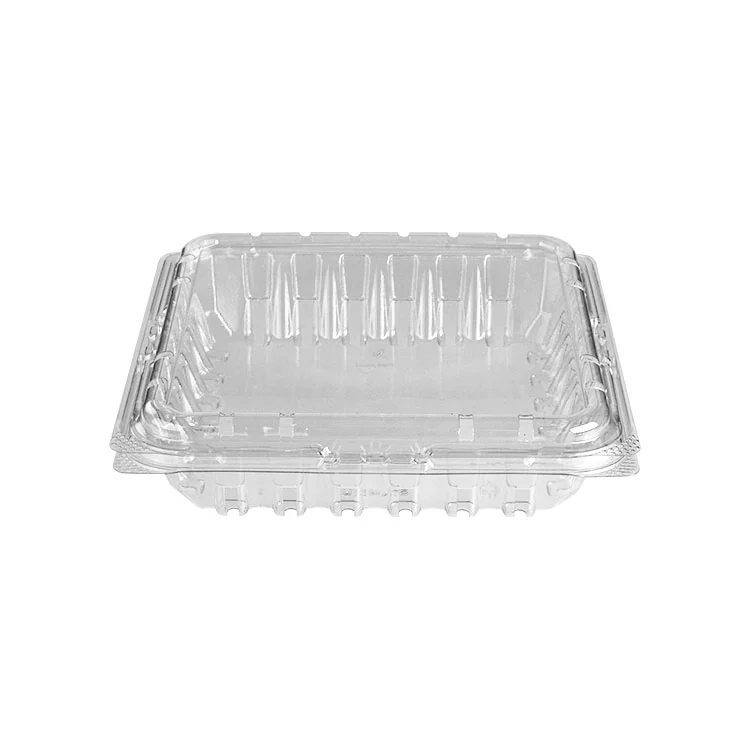
Hinged clamshells combine the base and lid in one piece — fewer components, consistent lid alignment, practical for produce, bakery, salads, and grab-and-go food. Check whether the hinge closes naturally after filling and whether locking points stay engaged during stacking and transport.
Separate base-and-lid containers offer more flexibility in shape and depth but require precise matching. Always confirm the correct lid code; two containers with similar external dimensions may have completely different rim profiles.
Tamper-evident containers provide visible evidence of first opening. This is useful for fresh-cut fruit, salads, deli food, and retail-ready products. Tamper evidence is not the same as leakage resistance or airtightness:
| Property | What it means |
|---|---|
| Tamper-evident | Shows whether the package has been opened |
| Reclosable | Allows the lid to be closed again after opening |
| Leak-resistant | Reduces the risk of liquid escaping |
| Airtight | Restricts air movement through the closure |
Each function should be evaluated separately. A tamper-evident strip does not automatically make a container leakproof.
Vented containers suit fresh produce that benefits from airflow during cold storage. The number, size, and position of ventilation holes should be matched to the produce, cold chain, and packing process — more ventilation is not automatically better, and excessive openings can increase moisture loss or reduce structural strength.
Compartment containers keep different foods separated but require careful evaluation. Confirm the usable volume of each compartment, not just total capacity. A 20 oz three-compartment container does not mean every section holds the same amount.
Dome lids provide additional vertical space for muffins, decorated cakes, or taller fruit portions. Balance the extra height against carton and stacking efficiency.
Size, Capacity, and Headspace
One of the most common purchasing mistakes is selecting a container by nominal capacity alone.
A 16 oz container does not hold 16 oz by weight of every food. Fluid volume and food weight are different measurements. Dense foods like nuts and cheese cubes occupy space differently from leafy salads and bakery products. Two containers with the same stated capacity can also have different proportions — one wide and shallow, another narrow and deep — producing very different retail presentations for the same portion.
The most reliable method is to fill a sample with the actual product at the target net weight. Check whether the food sits naturally inside, whether there is enough headspace for the lid to close without compressing the food, whether the portion looks appropriately full, and whether the food shifts excessively during handling.
Headspace is the unused space between the food surface and the lid. Too little causes bakery items to touch the lid, fruit to compress, or sauces to contact the top of the container. Too much makes the package look underfilled and reduces carton efficiency. The correct amount depends on the food — this is why external dimensions alone are insufficient and why internal usable space is what matters.
Stacking, Transport, and Retail Performance
A container that performs well on the packing table may fail after it enters the supply chain.
Close several filled samples using the normal packing method and confirm all locking points engage consistently. Test multiple filled containers in the intended stacking configuration, checking for lid deflection, base deformation, pressure on the food, and accidental opening. Then place them in the shipping carton and simulate the actual delivery conditions — refrigeration, movement, and handling — before checking for leakage, deformation, and food presentation on arrival.
Testing an empty container cannot reproduce the pressure and movement created by the actual food. For clear packaging, also evaluate the product under display conditions: visibility, condensation, label placement, barcode scanning, and whether the portion looks attractive from the customer’s viewing angle.
StlPak provides samples of PET and rPET containers for exactly this kind of evaluation — food fit, closure testing, stacking, and carton loading assessment before bulk production is confirmed.
Food-Contact Compliance
“Food-grade” is not a complete specification. Food-contact compliance depends on the material, food type, contact time, temperature, and intended market. A document for one use condition does not automatically cover another application.
For the United States, the FDA regulates food-contact substances according to authorized uses and applicable conditions. For the European Union, requirements including Regulation (EU) No 10/2011 and applicable migration limits apply. Documentation requirements differ by country.
Ask the supplier for the material declaration, food-contact test report, declaration of compliance where applicable, migration information, product specification, recycled-content documentation, and traceability records. Avoid relying on a general statement like “FDA approved” without understanding which material, food type, temperature, and conditions the documentation actually covers.
What to Send a Supplier
A request for “a 16 oz plastic food container” doesn’t provide enough information for an accurate recommendation. Include:
- Food type and whether it is dry, moist, oily, or liquid-containing
- Target net weight and approximate food dimensions
- Filling temperature and storage conditions
- Whether the consumer will microwave or oven-reheat the food
- Required shelf life
- Lid and closure requirements, including tamper evidence or compartments
- Label dimensions and position
- Manual or automatic packing method
- Target market and estimated order quantity
- Carton or pallet restrictions
Photos of the food and existing packaging help identify suitable models more quickly.
Common Selection Mistakes
- Choosing by material name alone. PET, PP, and CPET describe material families, not the complete performance of a finished container.
- Choosing by nominal capacity alone. The same capacity produces very different fill heights and presentations depending on food density and container shape.
- Assuming every clear container is microwave-safe. Standard PET containers are for chilled or ambient applications. Confirm the rating before specifying.
- Assuming tamper-evident means leakproof. They are different properties. Test leakage resistance separately.
- Forgetting product height. Especially common with bakery, desserts, and produce. Measure the finished food, not just the base footprint.
- Testing only empty containers. Empty inspection cannot reveal problems involving fill height, moisture, movement, or product weight.
- Comparing only unit price. Include cartons, freight, packing labor, product damage, closure failure rate, and rejection rate in the full cost comparison.
Buyer Checklist
Before approving a disposable plastic food container for bulk production, confirm:
- The material matches the filling and storage temperature
- The container is suitable for the actual food, including any liquid or oil
- The food fits at its target net weight with adequate headspace
- The lid closes consistently under the planned packing process
- Leakage performance has been tested where applicable
- The container survives stacking and distribution simulation
- Labels fit the intended surface area with barcode accessible
- Carton quantities and dimensions are acceptable
- Food-contact documents match the intended use and market
- Samples have been approved using the actual food before bulk ordering
Frequently Asked Questions
What is the best plastic for disposable food containers? There is no single best plastic for every application. PET and rPET are widely used for clear chilled packaging — fresh fruit, salads, bakery, and ready-to-eat foods. PP is commonly selected for hot food and microwave applications where the specific container is rated for that use. CPET handles selected freezer-to-oven ready-meal applications. The right material depends on the food, filling temperature, and intended conditions of use.
How do I choose between PET and PP disposable food containers? Start with temperature and presentation priority. PET provides excellent transparency and suits cold, chilled, and ambient food applications. PP is the more common starting point when heat resistance or microwave use is required. Always confirm the temperature rating of the specific container — material category alone is not a sufficient specification.
Is PET suitable for hot food? Standard thermoformed PET containers are designed for cold, chilled, and ambient applications. They should not be used for hot filling or reheating without confirming the validated temperature range with the supplier.
Which disposable containers are suitable for microwave use? Suitable PP containers are commonly used for microwave applications, but not every PP product is microwave-safe by default. Confirm the heating specification and temperature rating for both the container and its lid before use.
What type of container is best for fresh fruit? Clear PET or rPET punnets and clamshells are widely used for fresh fruit because they combine excellent product visibility with ventilation options, protective closure structures, and good stacking performance. The exact design — depth, vent layout, closure type — should match the specific fruit, pack weight, and distribution conditions. StlPak’s PET and rPET range covers multiple depths, ventilation layouts, and closure structures for fresh produce applications.
What should buyers check before ordering in bulk? Confirm the food application, material and temperature range, container dimensions and usable capacity, lid structure, ventilation requirements, stacking and carton loading conditions, labeling needs, and food-contact compliance documentation. Test physical samples with the actual food before placing a bulk order.
StlPak specialises in thermoformed PET and rPET disposable food packaging for fresh produce, bakery, salads, fresh-cut fruit, and retail ready-to-eat food applications. Our existing mold range supports fast sampling across a wide variety of sizes, depths, and closure structures, and we offer OEM and ODM development, logo printing, and packaging structure evaluation for applications where existing models need adjustment.
Explore our disposable plastic food containers to compare formats for your application, or share your food type, fill weight, storage conditions, target market, and order quantity to receive a packaging recommendation.