
Most bulk-buying problems don’t start on the production line. They start earlier, when a buyer approves a container based on a catalogue size, an empty sample, or a low unit price, without checking how it actually performs with the food it’s meant to hold.
Before you buy plastic food containers in bulk, there are a handful of things worth confirming — food application, material, real dimensions, closure performance, carton packing, MOQ, compliance documents, and lead time. None of these take long to check, and skipping them is usually what leads to a warehouse full of disposable plastic food containers that technically match the quotation but don’t work in practice.
Explore StlPak’s broader Disposable Plastic Food Containers range when comparing formats and applications.
Related guidance: supplier comparison guide; shipping-efficiency guide; existing versus custom mold guide.
Quick Checklist
| Check | What to Confirm |
|---|---|
| Food application | Food type, temperature, moisture and storage |
| Material | PET, rPET, PP or another suitable resin |
| Dimensions | Outer size, inner size, usable depth and capacity |
| Closure | Lid fit, hinge, snap lock or tamper evidence |
| Sample | Test with the actual food, not empty |
| Packing | Pieces/carton, carton dimensions and CBM |
| Loading | Pieces/pallet or 40HQ |
| MOQ | MOQ per SKU and mixed-order conditions |
| Customization | Label, printing, vents, cartons or molds |
| Documentation | Food-contact documents for your market |
| Lead time | Sample, production and repeat-order timing |
| Consistency | Bulk production matches the approved sample |
Start With the Food, Not the Container Size
“I need a 500 ml plastic food container” isn’t enough information for a supplier to recommend the right packaging. A 500 ml container for chilled fruit and a 500 ml container for a hot prepared meal can need completely different materials and closures.
Before requesting a quotation, be ready to answer: What food is going inside? Is it cold, chilled, frozen or hot? Dry, moist, oily or liquid-heavy? Does it need clear retail visibility? Will it be refrigerated, transported or reheated?
PET is generally the choice where clarity and cold-food presentation matter; PP is used where higher temperature resistance is needed. The goal isn’t to find the “better” material in the abstract — it’s to match the material to the food.
Don’t Buy by Capacity Alone
Two containers can both be labeled 500 ml, 16 oz, or 1 lb and still have different shapes and usable dimensions. One might be wide and shallow, another narrow and deep — and that difference affects how the food sits inside, label placement, carton packing, and shelf space.
A common example: a buyer replacing an existing 1 lb fruit clamshell finds another 1 lb model that holds roughly the same weight, but with a different lid height and base footprint. The fruit still fits, but the old label no longer sits correctly, and fewer packs fit into the existing master carton. Always confirm actual dimensions, not just the stated capacity.
Test the Sample With Real Food, Not an Empty Box
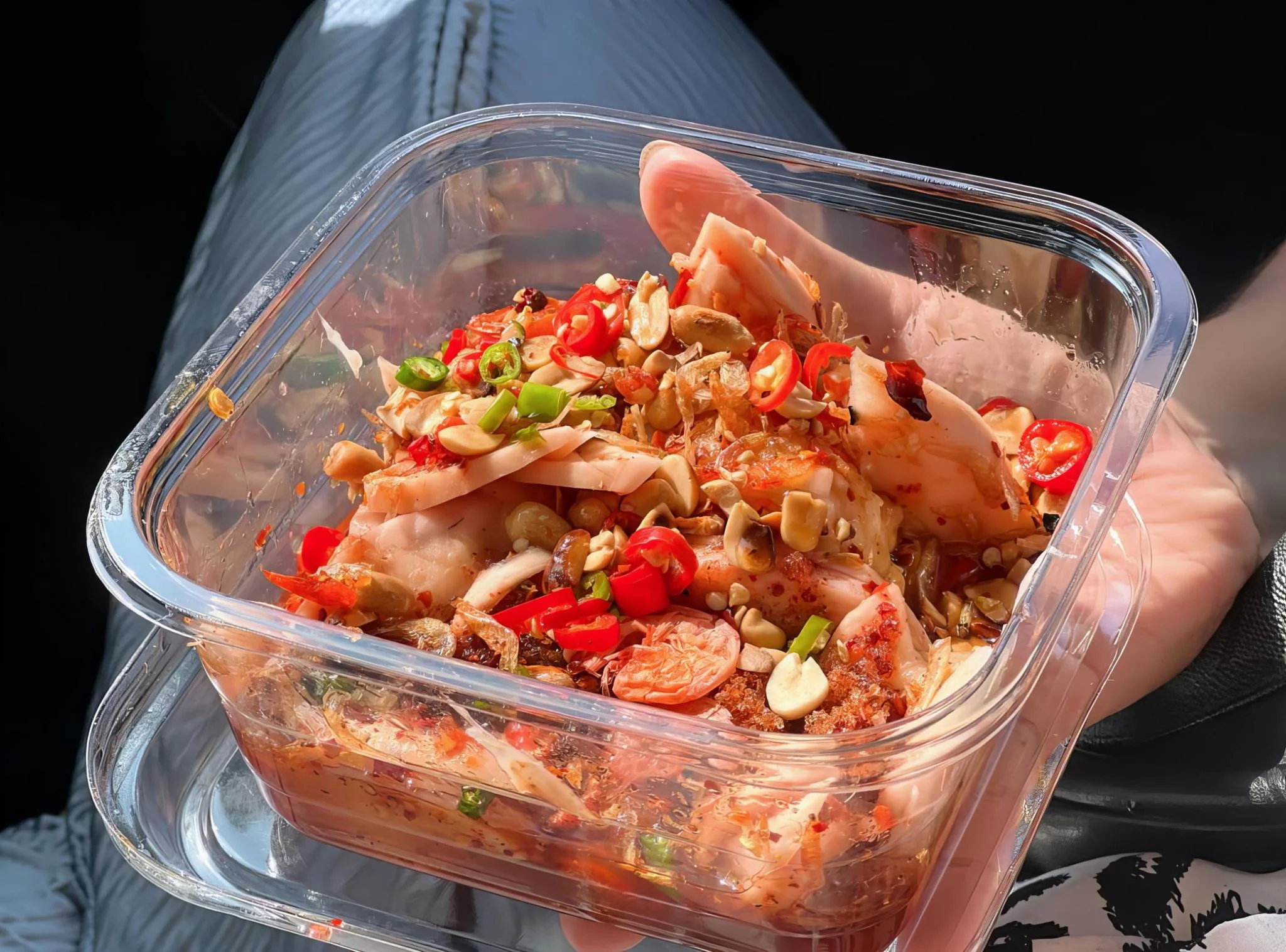
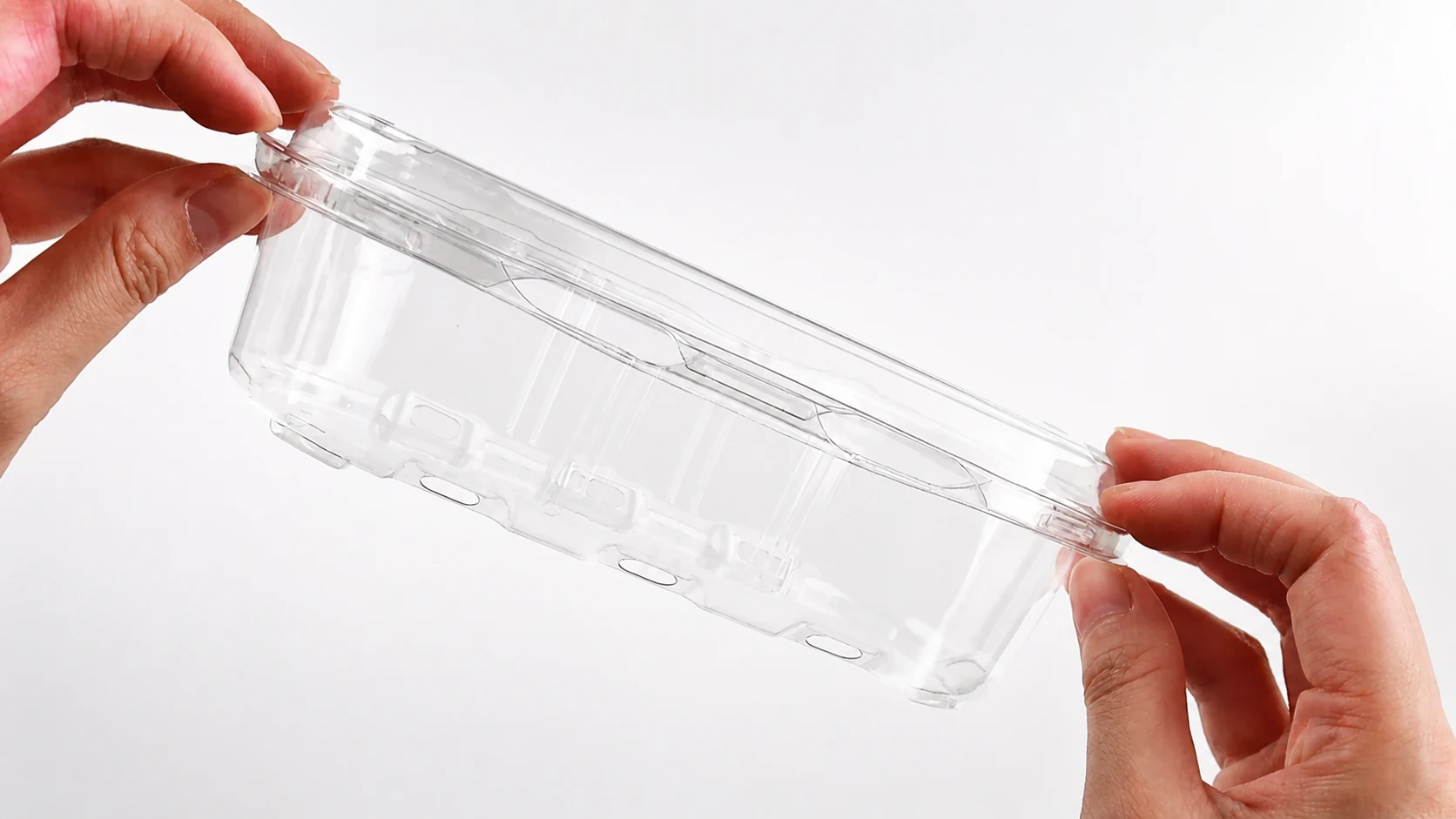
An empty sample on a desk tells you very little. Closure problems in particular tend to look fine until a buyer has already ordered thousands of units — lids that pop off, don’t match cleanly, or don’t hold as securely once the product is actually loaded inside. The same goes for fit: blueberries may sit comfortably in a nominal 1 lb container while strawberries of the same weight need more headspace because of their shape, and bakery items can touch the lid even when the measured height looks acceptable.
The fix is a proper sample test, done with the real product:
- Fill test — does the normal portion fit without forcing it?
- Closure test — does the lid close cleanly under normal fill weight, and stay closed?
- Stacking test — do filled containers hold their shape when stacked?
- Label test — does your actual label fit the intended area?
- Transport test — does the package survive realistic handling and still look presentable?
For hinged clamshells, check the hinge and snap points specifically. For separate lids, confirm the exact lid/base pairing. For tamper-evident designs, the seal should be easy enough for packing staff to close but still show clearly if it’s been opened. The cost of testing a few samples this way is small compared to discovering the problem after a full container load arrives.
Compare Landed Cost, Not Just Piece Price
Thermoformed containers are light, but they take up real cubic space, and that can flip a price comparison on its head. Supplier A quoting $0.046/pc looks cheaper than Supplier B at $0.048/pc — until Supplier B’s design nests more efficiently and fits meaningfully more pieces per carton and per 40HQ container, bringing the freight cost per piece down below Supplier A’s.
Before comparing quotations, ask each supplier for pieces per carton, carton dimensions and CBM, net and gross weight, cartons per pallet, and estimated pieces per 20GP or 40HQ. For lightweight packaging, packing efficiency can change the landed cost more than the quoted unit price does — so the real comparison isn’t unit price alone, it’s product price plus packing efficiency plus freight per piece.
Clarify MOQ and Customization Upfront
“MOQ: 50 cartons” can mean several different things — 50 cartons total, 50 per SKU, 50 per size, or a separate MOQ once custom cartons or printed labels are involved. If you’re ordering multiple sizes, ask directly whether different SKUs can be mixed in one shipment.
It’s worth raising customization needs at the quotation stage rather than after: custom labels, logo printing, printed cartons, special vent holes, modified dimensions, or new tooling all affect pricing and MOQ. A frequent quoting headache is a buyer requesting a standard container price first, then adding printing or a new mold later — at which point the original quote has to be redone from scratch.
Ask for Compliance Documents, Not Just “Food Grade”
“Is this food grade?” is a fair first question, but it shouldn’t be the last one. For commercial imports, ask what documentation is actually available for the material and your destination market — food-contact declarations, material specifications, relevant test reports, migration testing where applicable, and documentation for recycled content if the container uses it. “Food grade” is a description; your purchasing file may need actual paperwork behind it. Confirm this before shipment, not after a customs broker or retailer asks for it.
Make Sure the Supplier Can Repeat the Sample at Scale
The real risk in bulk buying isn’t whether a supplier can produce one good sample — it’s whether they can produce 100,000, 300,000, or a million pieces that still match it. Before placing the order, confirm the specifications that matter for your application: dimensions, weight, thickness, transparency, closure fit, hinge performance, vent-hole position, and carton quantity. Also ask about first-order and repeat-order lead times, and production capacity during peak season.
This matters most for fresh produce buyers, where the first shipment being on time isn’t the whole story — packaging also needs to stay available once harvest volume picks up and repeat orders become urgent.
Buying Plastic Food Containers in Bulk From StlPak
StlPak manufactures PET and rPET thermoformed disposable plastic food containers for fresh produce, fruit, bakery, salads, fresh-cut foods and other cold-food applications. With more than 600 existing molds, most buyers can start by comparing container sizes StlPak already produces and testing samples before considering new tooling.
To get a recommendation or quotation from StlPak, share the food type, target pack weight or capacity, required dimensions, storage temperature, closure requirement, label or printing needs, destination market, and estimated order quantity. From there, StlPak can check existing models, carton packing, and sample availability before you commit to a bulk order.