
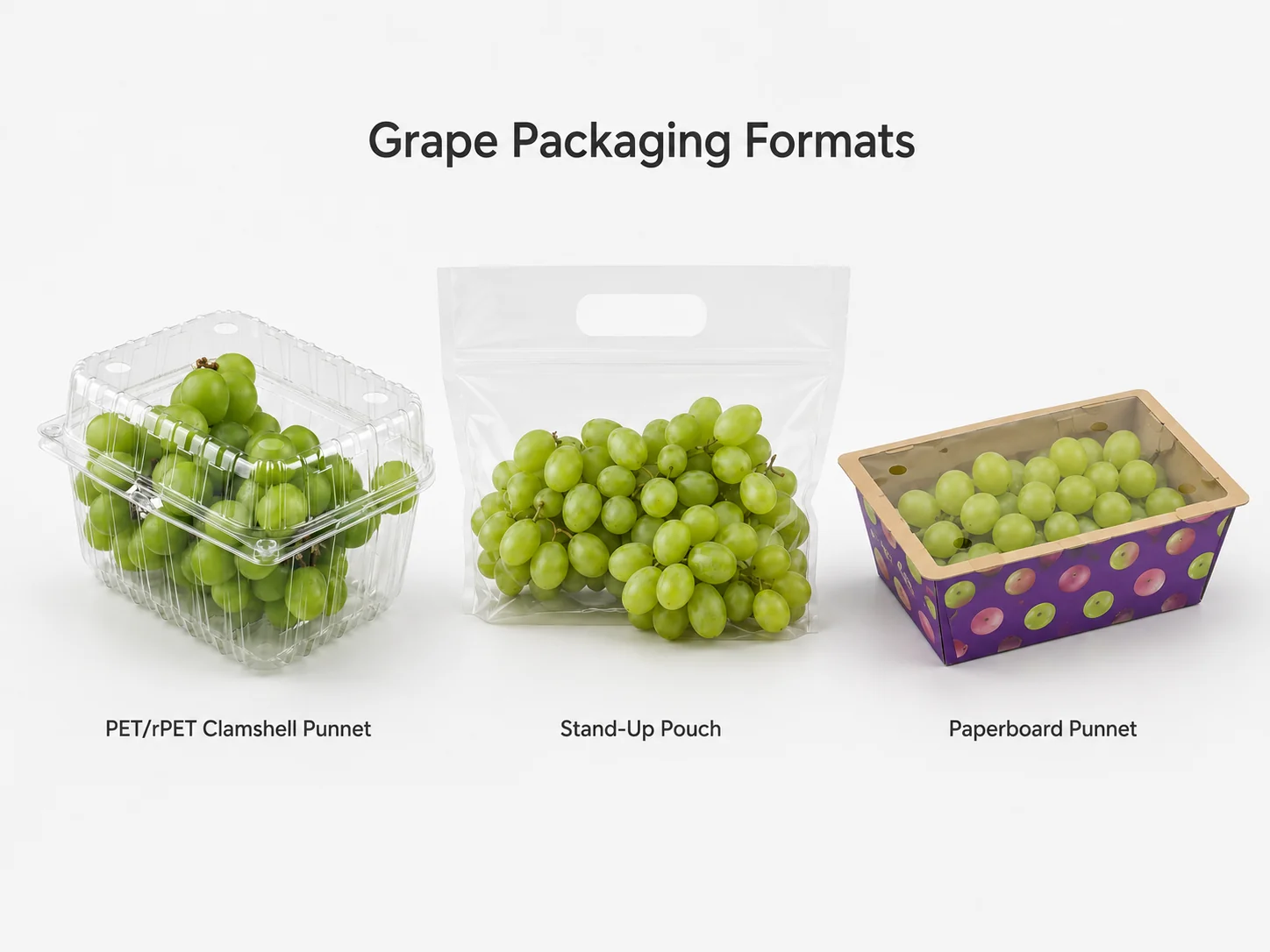
There is no universally best retail grape packaging format. The right choice depends on the retail program, the packing line, and the supply chain route — not on which format looks best as an empty sample.
The three formats divide along clear lines: clamshells lead on protection and export stability; bags lead on flexibility and cost; top-seal punnets lead on automation and clean presentation. Everything else is about which trade-offs your program can accept. At StlPak, we help buyers match the packaging format to the actual retail program and supply chain — not just to the spec sheet.
Start with the Retail Program
Before comparing formats, define what the packaging needs to do.
| Retail Program | Primary Demand |
|---|---|
| Premium supermarket | Visibility, bunch protection, structured shelf appearance |
| Value or high-volume retail | Cost efficiency, filling speed, flexible sizing |
| Snack or portion pack | Easy opening, compact footprint, impulse appeal |
| Automated packhouse | Sealing line compatibility, consistent fill height |
| Export retail | Rigid protection, carton fit, cold-chain stability |
| Extended shelf-life program | Film, ventilation, and cold chain as a tested system |
Format selection follows from here.
The Three Formats: Strengths, Limits, and Best Fit
Clamshell
A rigid PET or rPET clamshell offers the strongest combination of visibility, bunch protection, and carton stability. The defined internal space keeps bunches in place through filling, cartoning, palletisation, and transport. Labels sit flat and stay readable. For export programs with multiple handling stages, this predictability is the main reason clamshells remain the default choice.
The limits are real. Depth has to match the actual grape variety — not just the target weight. Too shallow and the lid presses on the top layer; too deep and bunches shift and lose bloom. Neither problem appears in an empty sample. For detailed sizing guidance across different pack weights, see grape punnet sizes for 500g, 750g and 1kg grapes. Material weight also matters: a clamshell that’s too light will flex under carton stacking load and lose the rigidity that justified choosing it over a bag.
Best fit: premium supermarket, export retail, programs where visibility and protection are the priority. For packhouses supplying clamshell grapes to export retail programs, the container must also match the carton footprint and pallet configuration.
Bag
Bags suit high-volume value retail with fast turnover — situations where the fruit moves quickly, filling flexibility matters, and a lower per-unit packaging cost is a real commercial requirement. Printed bags also offer stronger branding presence than transparent clamshells, which matters for some retail programs.
The trade-off is protection. Bags depend on the outer carton for most of their structural support. On short local routes with controlled handling, this works fine. On longer export routes with repeated transfer points and stacking pressure, grapes in bags move more — and movement means bloom loss, bruising, and berry shatter. Film specification matters more than buyers typically expect: perforation, anti-fog performance, and seal quality all affect how grapes behave in cold storage and on the refrigerated shelf.
Best fit: value retail, fast-turnover programs, short to medium distribution routes.
Top-Seal Punnet
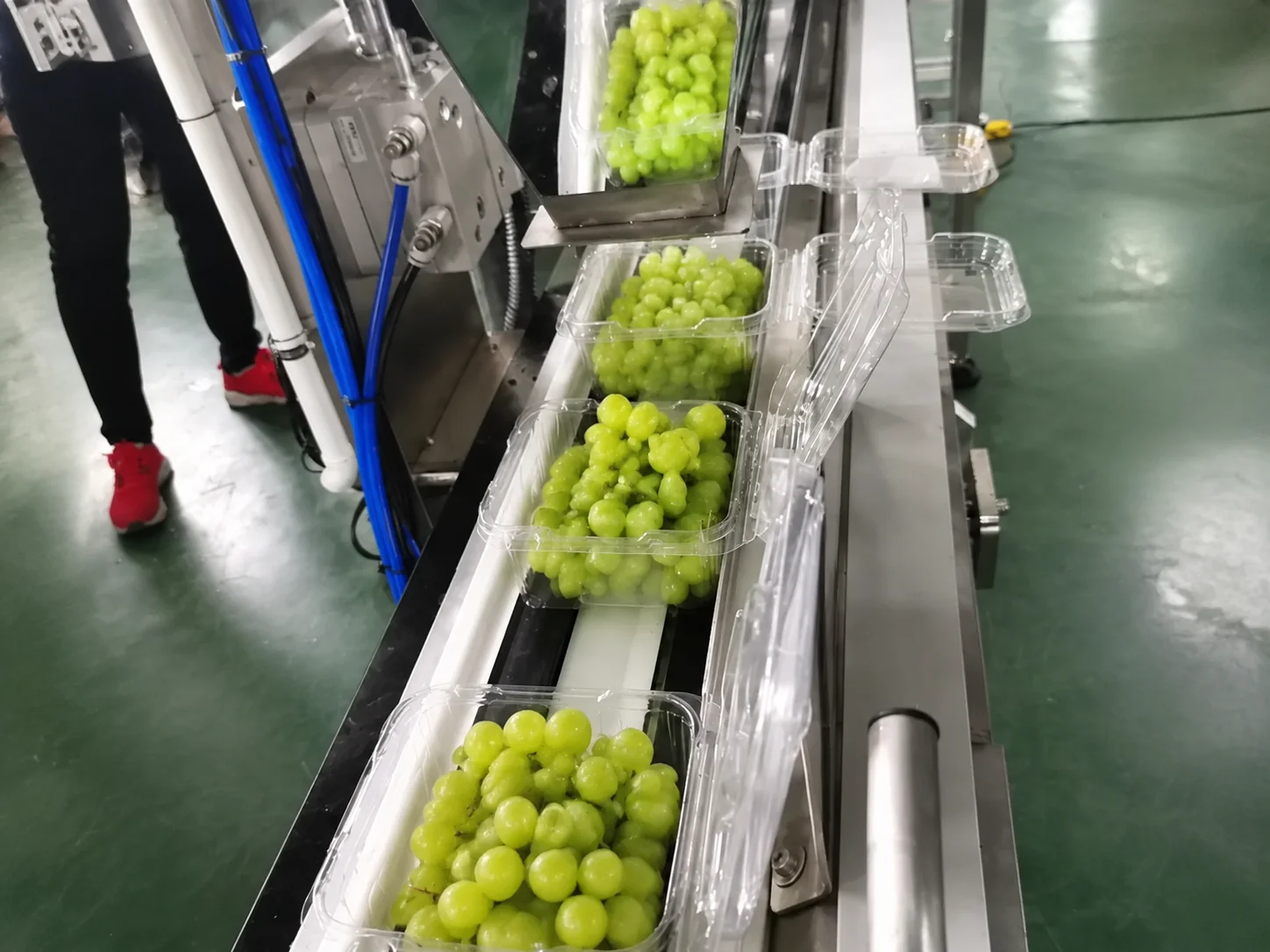
A top-seal punnet — a rigid tray sealed with film rather than a hinged lid — is primarily a packing-line format. Its main advantage is integration with automated weighing, filling, and sealing equipment at high throughput. If the packhouse is built around a sealing line, this format often wins by default regardless of other comparisons. The large flat film surface also supports printed branding more cleanly than a label on a curved clamshell.
For snack-size grape packs — 150g to 300g — top-seal punnets often outperform small clamshells on shelf presence and portion clarity. For extended shelf-life programs, the format can be part of the solution, but only when tray, film, sealing quality, ventilation, and cold chain are tested together as a system. The film alone doesn’t extend shelf life.
Fill height consistency is the critical process requirement. If bunch heights vary across a filling run, sealing becomes inconsistent. Top-seal punnets are also generally not reclosable, which matters for larger consumer packs but less so for single-use snack portions.
Best fit: automated packing lines, snack and portion packs, extended shelf-life programs with full system testing. For buyers comparing plastic punnets across fruit packaging applications, top-seal and clamshell formats serve different packing-line and retail requirements.
Format vs. Route: A Practical Summary
| Program | Clamshell | Bag | Top-Seal Punnet |
|---|---|---|---|
| Premium supermarket | Strong fit | Possible | Strong fit |
| Value / high-volume retail | Possible | Strong fit | Possible |
| Snack / portion pack | Possible | Possible | Strong fit |
| Automated packing line | Depends on line | Bagging lines | Sealing lines |
| Export / long route | Strong fit | Depends on carton | If system-tested |
| Extended shelf life | With ventilation | Film-dependent | If system-tested |
The Factor All Three Formats Share: Carton Performance
No retail grape pack operates independently. It goes into a carton, gets palletised, cooled, and transported — and that system determines real-world performance more than the retail pack alone.
A clamshell with the wrong footprint wastes carton space or allows movement between units. Bags in a poorly matched carton compress against each other, increasing damage on longer routes. Top-seal punnets need seal integrity to survive carton pressure without film failure.
For export programs especially, the retail pack, outer carton, pallet configuration, and cold chain need to be evaluated together. Testing an empty retail pack tells you almost nothing about how it performs after two weeks in a reefer container. For the full supply chain picture from packhouse to shelf, see how grapes are packaged for retail and export.
What StlPak Covers
StlPak focuses on rigid PET and rPET grape clamshells and punnets. The starting point for any project is the retail program — pack weight, grape variety, bunch profile, packing line, transport route, and carton requirements.
For most programs, existing clamshell options are worth checking before considering custom tooling. If an existing container fits the fruit, closes correctly, and matches the carton, it avoids development time and tooling cost. If the program clearly points toward bags or top-seal formats, that’s worth establishing early rather than after sampling the wrong format.
For high-value or ready-to-eat fruit formats sold in-store, tamper-evident food containers add tear-strip security using the same food-grade PET.
Common Questions
Are clamshells or bags better for grapes?
Neither is universally better. Clamshells provide stronger protection and export stability. Bags suit value retail and fast-turnover programs where the route is short. The retail program determines the format.
Can bags work for export grapes?
They can, but the outer carton carries most of the protection burden. Film strength, perforation, anti-fog performance, and carton design all need to be tested together. Bags that work well locally may not perform the same way in a reefer over two to three weeks.
Does top-seal film extend grape shelf life?
Only as part of a complete system. Tray design, film specification, sealing quality, ventilation, fruit quality, and cold-chain management all contribute. The film alone doesn’t extend shelf life.
When should I use rPET over standard PET?
When the program has a recycled-content requirement or retailer material policy. Performance is comparable for most grape packaging applications. Actual recyclability depends on local collection and sorting infrastructure at the destination market.