
Buyers comparing grape clamshell sizes often begin with a target pack weight, but the pound rating alone does not determine the right container. A 1 lb pack of compact red grapes and a 1 lb pack of large green grapes with long stems may require different footprints and usable depths.
The right clamshell should match the grape variety, bunch profile, fill height, closure zone, carton layout and transport conditions — not simply a nominal 1 lb, 2 lb or 3 lb pack size.
At StlPak, we help buyers match container dimensions to their actual grape variety and supply chain — not just to a nominal pound rating. Understanding how grapes are packaged for retail and export provides the wider supply chain context.
What Determines the Right Grape Clamshell Size
Four dimensions matter in a rigid grape container. All four need to be right.
Footprint (length x width)
The footprint determines how naturally bunches sit inside the box. Too narrow and bunches get squeezed together, making filling difficult and putting pressure on berries and stems. Too wide and grapes spread unevenly, the pack looks underfilled, and carton efficiency drops.
Usable depth
This is the most critical and most misread dimension. The total external height of a container is not the same as the usable space inside — lid structure, hinge geometry, stacking ribs, and internal curves all reduce the actual space available for fruit. Always evaluate usable depth, not just overall height.
Too shallow: the lid presses on berries and traps stems near the closure, causing bruising, broken stems, and unstable sealing. Too deep: bunches shift during transport, bloom rubs off, and the pack looks underfilled on the shelf despite correct net weight.
Lid clearance and closure zone
The lid needs to close fully without touching the top layer of fruit. Stems are the most common problem — if any stem sits near the closure edge, the pack won’t seal flat. This becomes increasingly important for 2 lb and 3 lb packs, where the filled weight places greater stress on the closure.
Structural strength
Heavier packs need stronger bases, sidewalls, and stacking zones. A container that holds its shape when empty may flex, deform, or lose closure stability once filled and stacked inside a carton.
1 lb, 2 lb and 3 lb: What Changes Across Grape Pack Sizes
These pound ratings describe common retail pack classes, not fixed container dimensions. Two clamshells labeled for the same pack weight may still differ in footprint, usable depth, ventilation, closure strength and carton efficiency. Buyers should confirm the final size with real grapes at the intended fill weight.
1 lb Grape Clamshells
The 1 lb class is commonly used for compact retail packs and smaller household portions. The clamshell should provide enough usable depth for the bunch without making the pack look loose or underfilled.
The main risk is selecting a container that is too shallow. Large berries, long stems or loose bunches may touch the lid or interfere with the closure even when the final net weight is only 1 lb. Physical filling and closure tests are therefore necessary before confirming the model.
2 lb Grape Clamshells
The 2 lb class requires more attention to usable depth, closure strength and carton fit. A filled 2 lb clamshell places noticeably more pressure on the base, sidewalls and locking areas than a smaller retail pack.
Wider and deeper formats may both hold 2 lb, but they do not perform in the same way. The right option depends on bunch height, berry diameter, shelf presentation, carton arrangement and packing-line requirements.
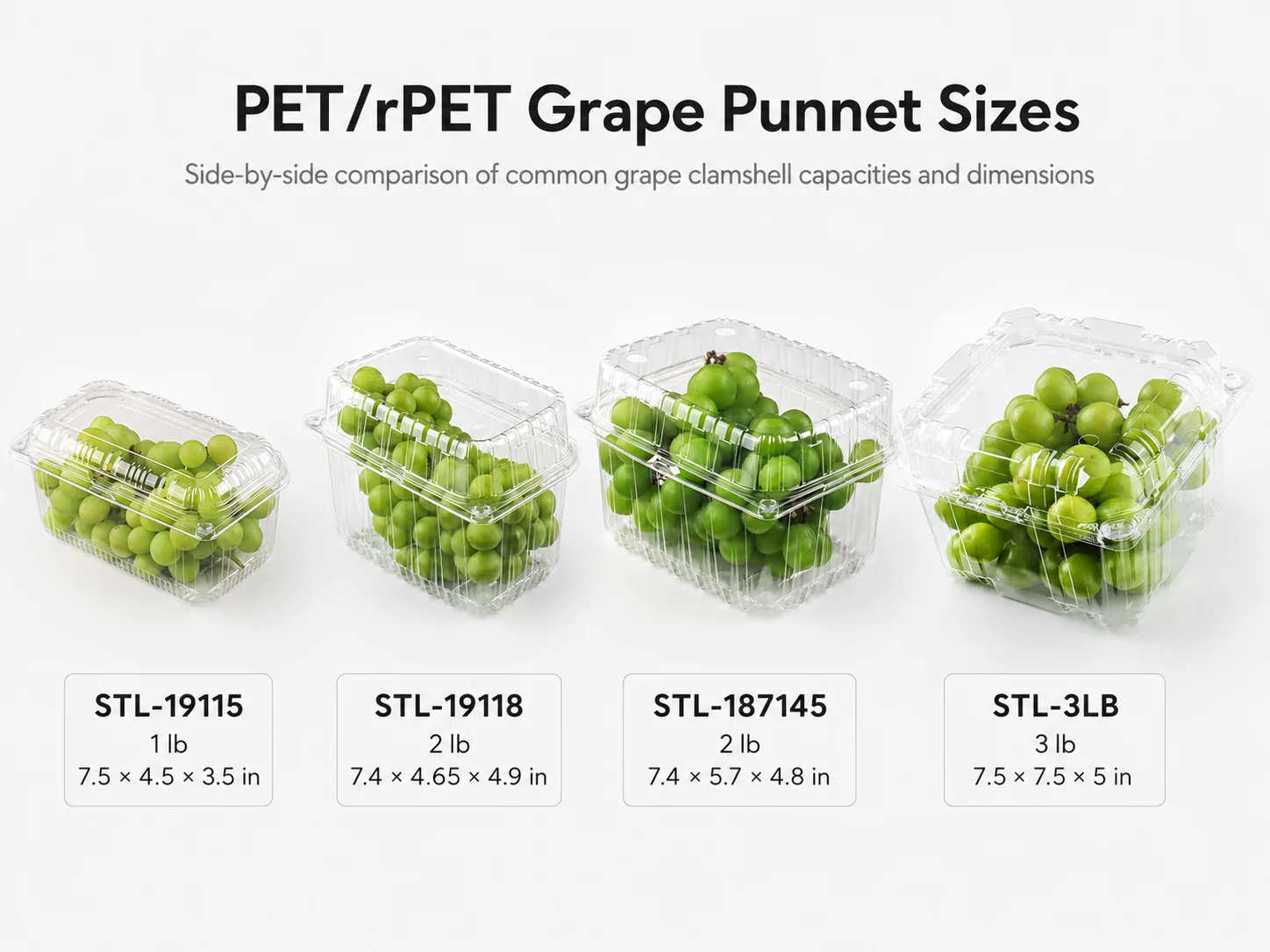
This is exactly where StlPak’s two existing 2 lb formats differ: STL-187145 offers a wider footprint (187 x 145 x 122 mm), while STL-19118 is narrower and deeper (190 x 118 x 125 mm). Both hold 2 lb, but they suit different bunch profiles, shelf presentations and carton layouts.
3 lb Grape Clamshells
The 3 lb class is designed for larger family-size retail packs and requires the strongest structural performance. The base, sidewalls, hinge, closure and stacking zones must support the filled weight during packing, refrigeration, transportation and retail display.
Ventilation and carton fit become especially important at this size. Too many openings may reduce rigidity, while insufficient airflow may slow cooling. The final clamshell should therefore be tested inside the intended carton with real grapes at the full 3 lb fill weight.
Ventilation: Structure and Airflow Together
Ventilation in a grape clamshell is not a hole-count decision. It is a structural trade-off.
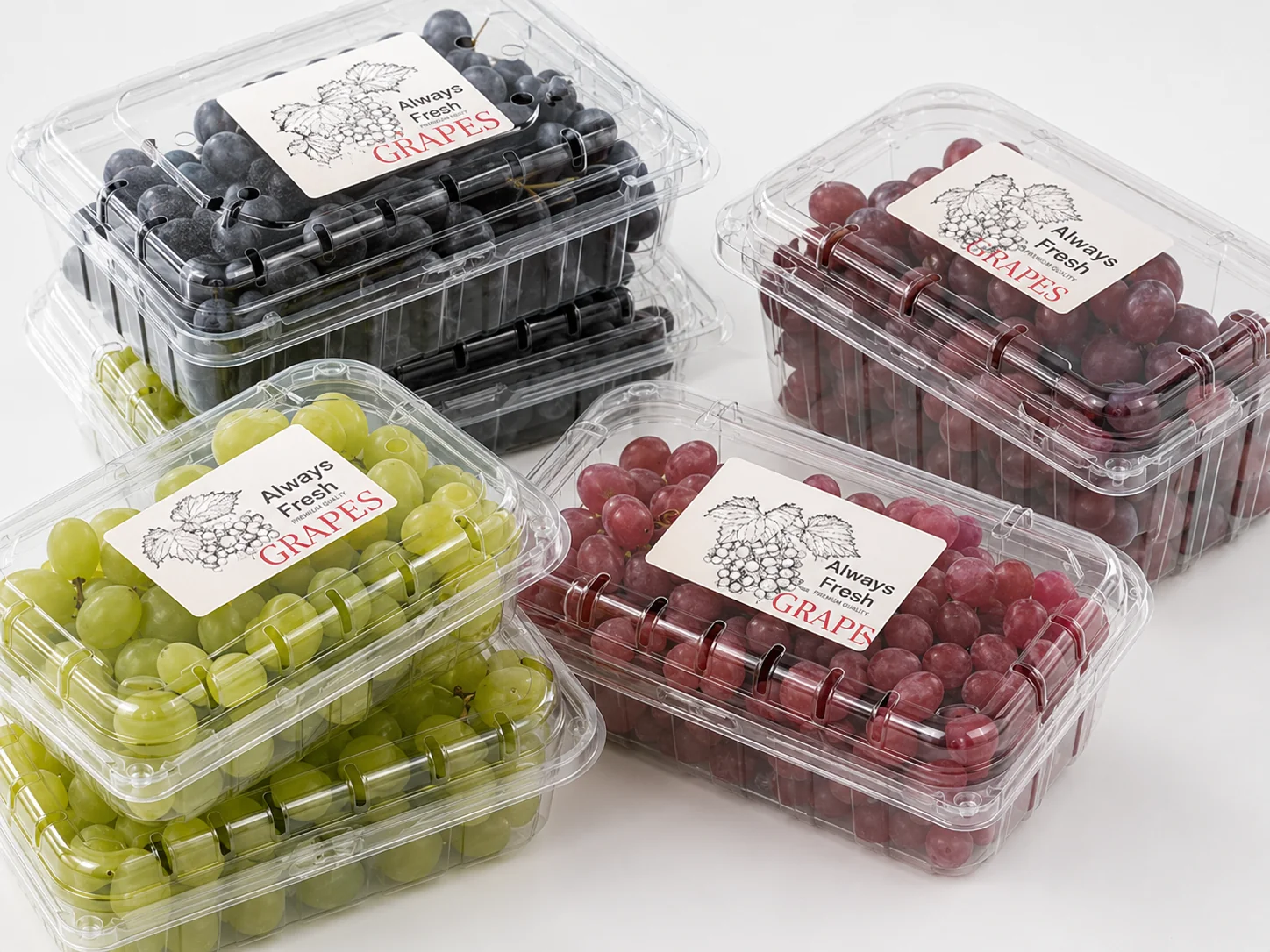
Openings in the lid, sidewalls, or base support airflow during pre-cooling and cold storage — but each opening also removes material from a load-bearing surface. Too little ventilation restricts airflow and risks moisture buildup. Too much weakens the container at exactly the points where stacking load and closure stress are highest.
Ventilation also cannot be evaluated on the retail pack alone. The pack’s vent pattern needs to align with the carton’s opening layout. A well-ventilated clamshell inside a poorly ventilated carton still cools poorly. A carton with large openings cannot compensate for a retail pack that blocks airflow through its arrangement.
For 2 lb and 3 lb packs in particular, the ventilation-to-structure balance should be confirmed with filled containers inside the intended carton.
Carton Fit: The Dimension Most Buyers Check Last
A grape punnet must fit the bunch. It must also fit the carton.
The container footprint directly determines how many packs fit per carton layer, how stable the carton is when filled, and whether the vent openings on the carton align with the airflow path through the pallet. A footprint that’s slightly off can drop carton efficiency, create internal movement, or block cooling — none of which is visible when evaluating an empty sample.
For export programs this matters more. Filled retail packs will go through pre-cooling, palletisation, refrigerated transport, and multiple handling stages. A punnet that looks good on the table and fails inside the carton after two weeks in a reefer is the most expensive kind of mismatch to discover.
Check the punnet size against the intended carton dimensions before sampling, not after. For buyers supplying clamshell grapes to export programs, this carton-level check is part of the standard evaluation.
Grape Variety Affects Size Selection More Than Most Buyers Expect
| Grape Characteristic | Effect on Punnet Selection |
|---|---|
| Large berry diameter | More lid clearance needed; wider support area |
| Long stems | Stem space near closure becomes critical |
| Loose bunch structure | More footprint needed to avoid compression |
| Compact bunch structure | Smaller footprint possible but airflow still matters |
| High bunch profile | Deeper usable space required |
| Heavy fill weight | Stronger base and closure zone essential |
These are tendencies, not fixed rules. The only reliable confirmation is a physical fill test with real grapes at target weight inside the actual container. A drawing or nominal volume narrows the options — it doesn’t finish the selection.
Existing Mold or Custom Tooling?
Most grape packaging projects don’t need a new mold.
If the target weight, bunch profile, usable depth, closure geometry, and carton layout all match an available container, an existing mold is faster, cheaper, and lower-risk than custom tooling. StlPak’s existing grape clamshell range covers multiple depths, footprints and ventilation layouts across the 1 lb, 2 lb and 3 lb pack classes.
Custom tooling makes sense when an existing container creates a real performance problem — wrong depth for the bunch, incompatible with the carton, unsuitable for the packing line, or missing a required structural or labelling feature. For a broader comparison of clamshells against bags and top-seal punnets, see grape clamshell vs bag vs top-seal punnet. It should follow a confirmed need, not a preference for something bespoke.
StlPak Grape Clamshell Specifications
| Model | Nominal Pack Size | Container Weight | Dimensions LxWxH (mm) | Carton Size (mm) | Qty/CTN | Retail Positioning | Base Sidewall Ventilation | Lid Sidewall Ventilation | Base Round Ventilation Holes | Lid Round Ventilation Holes | Closure Type | Closure Ventilation Slots |
|---|---|---|---|---|---|---|---|---|---|---|---|---|
| STL-19115 | 1 lb / approximately 454 g | 20 g | 190 x 115 x 90 (7.5 x 4.5 x 3.5 in) | 600 x 390 x 480 | 800 | Compact 1 lb grape retail pack | – | 10 | 4 | – | Exposed Snap Closure | 4 |
| STL-187145 | 2 lb / approximately 907 g | 36 g | 187 x 145 x 122 (7.4 x 5.7 x 4.8 in) | 570 x 390 x 580 | 600 | Wide 2 lb grape retail pack | 16 | 16 | 8 | 4 | Exposed Snap Closure | 6 |
| STL-19118 | 2 lb / approximately 907 g | 31 g | 190 x 118 x 125 (7.5 x 4.6 x 4.9 in) | 570 x 390 x 500 | 600 | Narrow deep 2 lb grape retail pack | 14 | 14 | 4 | 4 | Exposed Snap Closure | 6 |
| STL-3LB | 3 lb / approximately 1.36 kg | 45 g | 190 x 190 x 127 (7.5 x 7.5 x 5.0 in) | 450 x 385 x 195 | 100 | Large 3 lb family grape pack | 16 | 17 | 8 | 4 | Exposed Snap Closure | 6 |
Nominal pack weights are for reference. Actual filling performance depends on grape variety, berry diameter, bunch profile and required headspace.
What to Share Before Requesting a Recommendation
| Detail | Why It Matters |
|---|---|
| Target pack weight | Identifies the pack class and narrows the mold range |
| Grape variety | Bunch profile varies significantly by variety |
| Average berry diameter | Determines lid clearance and headspace |
| Bunch length and height | Sets usable depth and footprint requirements |
| Retail market | Affects label area, shelf presentation, and pack weight norms |
| Carton dimensions or target pack count | Determines footprint compatibility and carton efficiency |
| Transport route | Local retail and export programs have different structural demands |
| Label size and position | Prevents labels from covering vents, closure, or visibility zones |
Physical samples tested with real grapes at final fill weight remain the most reliable confirmation before committing to production. For buyers evaluating plastic punnets across multiple fruit packaging formats, the same dimensional principles apply: footprint, usable depth, closure geometry, and carton fit.

For high-value or ready-to-eat fruit formats sold in-store, tamper-evident food containers add tear-strip security using the same food-grade PET.
Common Questions
Why Can’t I Choose a Grape Clamshell by Pound Rating Alone?
Because the same 1 lb or 2 lb fill weight can produce different bunch profiles depending on berry diameter, stem length and bunch density. The pound rating identifies the general pack class, but it does not determine the required footprint, usable depth or lid clearance.
Is a deeper punnet always safer?
No. Excess depth allows bunches to shift during transport, removes bloom through friction, and makes the pack look underfilled on the shelf. The right depth holds the bunch securely without pressing on it.
How do I know if a punnet is too shallow?
Fill it with real grapes at target weight, then close it. If the lid touches the berries before fully closing, or if stems are caught in the closure zone, the container is too shallow for that variety.
Does ventilation affect structure?
Yes, directly. Every opening removes material from a load-bearing surface. More ventilation is not automatically better — the right balance depends on pack size, fill weight, stacking conditions, and carton layout.
Does a 2 lb Grape Pack Need a Different Clamshell Than a 1 lb Pack?
Usually, yes. A 2 lb pack requires more usable space and places greater load on the base, sidewalls and closure. However, the final mold selection should still be based on the actual grape variety, bunch profile and carton layout.
Can StlPak help with existing mold options first?
Yes — that’s the recommended starting point. Share the grape variety, target weight, bunch profile, carton dimensions, and transport route, and StlPak will assess which existing containers are worth sampling before any discussion of custom tooling.