
PET food container durability can be quickly evaluated from several practical angles, including bending toughness, resistance to deformation, de-nesting performance, lid fit, low-temperature performance, and forming quality. For buyers, a few simple sample checks are often enough to reveal clear differences between PET food containers.
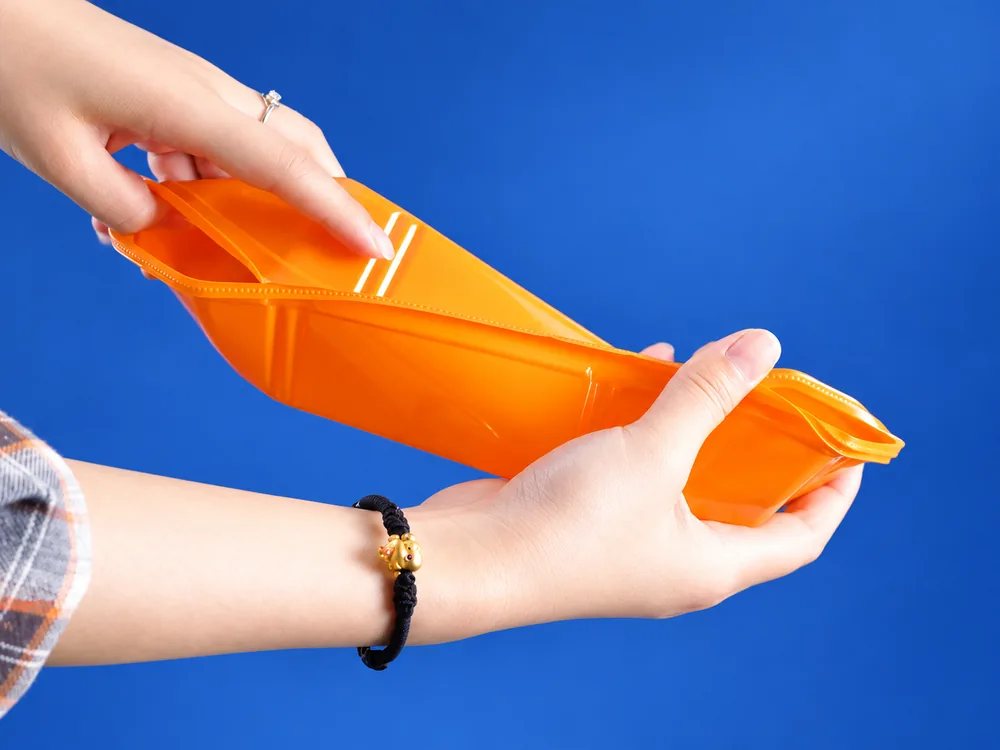
1. Bend Test: Does the PET Flex or Break Easily?
Bend the edge, sidewall, or corner of the sample directly. PET with good toughness should deform to a certain degree before failure. It may leave a crease or show slight stress whitening, but it should not crack or snap from a light bend. If the sample develops cracks, breaks suddenly, or fractures with very little deformation, the material may be too brittle or certain areas may have been stretched too thin during thermoforming. Stress marks or whitening alone do not necessarily indicate poor quality; the key question is whether the container fails under very light force.
2. Compression Test: Does the Container Deform Too Easily?
Press the sidewalls, bottom, and rim by hand. A properly formed PET container can flex under normal pressure while still maintaining its basic shape. If slight pressure causes obvious collapse, permanent rim distortion, or deep local dents, the container may be more vulnerable during packing, warehousing, and transportation. Durability is not only about whether the container cracks; it is also about whether it can maintain its structure after normal handling.
3. De-Nesting Test: Does the Container Deform When Removed from a Stack?
Simulate how the customer actually takes containers from a stack. PET food containers are normally nested together for bagging, carton packing, storage, and transportation. During use, each container has to be pulled out from the stack, which creates force around the rim and sidewalls. If the container is locally too thin, lacks sufficient toughness, or has poor nesting design, it may deform around the rim, crack along the sidewall, or even break during normal separation. A qualified PET container should withstand normal de-nesting without obvious deformation or damage. If a container becomes unusable before food is even packed into it, that is already a quality problem.
4. Lid-Fit Test: Can It Still Close Properly After Pressure and Handling?
Apply normal pressure or de-nest the container first, then test the lid closure. Before actual use, PET containers may already have experienced nesting, carton compression, stacking, and pulling during separation. If the rim becomes distorted, the lid may no longer align correctly with the base, which can lead to incomplete closure, loose locking points, one side lifting, or the lid failing to close completely. A stable PET container should maintain sufficient rim geometry after normal handling so that the lid can still align and lock correctly. This is especially important for tamper-evident food containers.
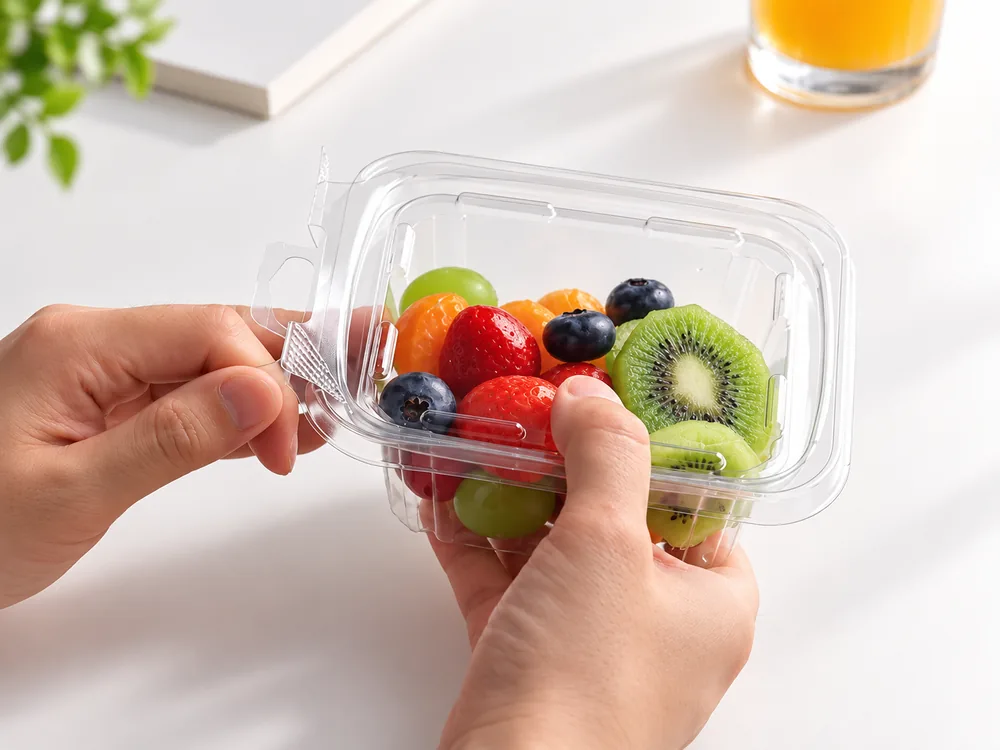
5. Low-Temperature Test: Chill the Container and Test It Again
Place the sample in its actual low-temperature environment, then repeat the bending, pressing, and lid-fit tests. PET containers are commonly used for fruit, salads, chilled foods, refrigerated displays, and cold-chain transportation, so room-temperature performance alone is not enough. Some PET containers may appear acceptable at room temperature but become noticeably more brittle after cooling, causing cracks or breakage under forces they could previously withstand. Depending on the specific design and application, relevant StlPak PET food containers can maintain good structural integrity and toughness at approximately -20°C to 60°C. This does not mean PET is suitable for microwaves, ovens, or other high-temperature heating applications; compare materials in our food packaging material guide.
6. Do Not Judge Durability by Thickness or Weight Alone
A heavier or thicker container is not automatically more durable. PET food containers are thermoformed from heated sheet, and the material stretches differently across the bottom, sidewalls, corners, and rim. Final performance therefore depends on sheet quality, thickness distribution, rib design, rim structure, corner geometry, and forming consistency. Two containers with similar weight can perform very differently if one has excessively thin areas around the rim, corners, or sidewalls. Learn more about how food container design affects performance.
7. Compare Supplier Samples Under the Same Conditions
Put two supplier samples side by side and test them by bending, pressing, de-nesting, closing, chilling, and testing again. If one container cracks under a light bend, deforms while being removed from the stack, loses lid alignment after compression, or becomes noticeably brittle at low temperature, while the other still maintains its structure and closes normally, the durability difference becomes much easier to see. These checks are useful when you buy plastic food containers in bulk.
For buyers, the real question is not simply whether a PET food container feels rigid when it is new. The more useful question is whether it can still maintain its structure and function after bending, compression, de-nesting, cold storage, and transportation.
For more precise evaluation, laboratory testing such as impact strength, tensile testing, and elongation at break can be used to quantify material performance.